Area 51
StrikeArea 51 is both a strategic target in the war against the Retros and the temporary home of the people displaced from the future. The survivors’ year at the desert military base gives them shelter, but not a return to ordinary life: their identities are concealed, their past cannot safely be disclosed, and their presence is gradually erased from official knowledge. When they leave, the nearby Project Alcatraz Dome is being dismantled, making Area 51 the setting for a final separation from the time-travel project and its secrets.
Strategic Setting
Area 51 stands in the Mojave Desert, about sixty miles from the site where the dome was built. Its significance changes over the course of the story. It is associated first with the destruction of the Retro aircraft fleet and later with the government’s attempt to contain the consequences of time travel. The base is therefore not simply a military location: it sits within the landscape of the conflict and close to the structure that made travel between eras possible.
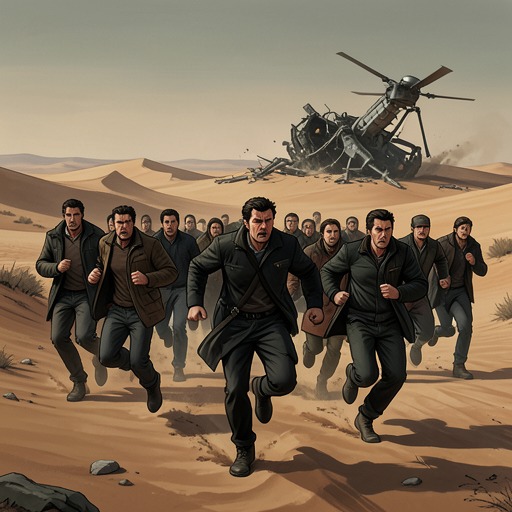
That proximity becomes ominous when Captain Granger takes the group through the area. After the SYLO helicopter is attacked and brought down, Tucker recognizes that they are near the Mojave Desert location. He remembers seeing a Retro fighter emerge from inside the dome before the attack. The sight undermines the apparent finality of the earlier victory at Area 51: although the fleet there had been destroyed, the Retros still had aircraft, and more could be produced. From Tucker’s perspective, the dome remains protected, the enemy remains capable of fighting, and his own part in the war has ended with his capture.
The Fleet’s Destruction and Its Aftermath
Area 51 is the site of the saboteurs’ attack on the Retro fleet. Later, Tucker realizes that the Retro soldiers who have come for the prisoners are hunting the three people responsible for destroying the aircraft at the base. The discovery ties the military pursuit directly to the earlier operation: the survivors are not merely caught in a wider campaign, but are being targeted because of what they did at Area 51.
The attack’s aftermath also supplies an unresolved image from the destruction of the craft that had wiped out Las Vegas. Tucker had seen a dark shape escape from the doomed aircraft, but could not identify it at the time. When an officer steps out of a jeep, he recognizes the shape as an escape pod and understands that Mr. Feit survived the explosion. The later revelation gives the Area 51 operation a consequence beyond the loss of the fleet: it also becomes part of the chain of events that brings Mr. Feit back into the survivors’ lives.
Area 51 remains part of the group’s relationships after the operation. Olivia tells Tucker that she did not prevent the sabotage of the drone fleet and nearly died saving him. He later thanks her for saving his life at Area 51, alongside his gratitude for the ordinary comfort she has restored and for an apple she gives him. His forgiveness does not erase the distrust between them, but the reference to Area 51 anchors their reconciliation in a concrete act of risk and assistance. The site’s history is thus both military and personal: the operation changed the balance of the conflict while also shaping the group’s bonds.
A Hidden Refuge
After the survivors return to 1952, they spend the next year at the military base sixty miles from the dome’s construction site, identified as Area 51. Their existence is known only to a small circle of senior military personnel, scientists, and government officials. Most people who know who they are avoid contact, either to avoid learning about future events or, as Tucker considers, because they are afraid. For the survivors, secrecy is not a brief precaution but the condition under which their first year in the past takes place.
The base’s association with concealed visitors gives rumors about it a new, personal meaning. Tucker believes that information about something unusual at Area 51 leaked and generated headlines about aliens being kept there. He does not claim that the survivors were the beings those stories imagined; rather, he recognizes that they were strangers to their own era and were in fact hidden at the base. His account treats the alien story as an imperfect public explanation for a real secret, while carefully distinguishing the rumor from what actually happened.
The Army does not subject the group to the strange experiments associated with popular stories about Area 51. Instead, officials treat them as ordinary children who happen to come from the future. Physicists from around the country speak with them about the phenomenon that opened a hole through time, and the survivors’ existence lends support to theories that time travel is possible. Yet the researchers avoid asking for specific details about the future. Their caution reflects an ethical problem: giving a few people knowledge of events that others do not know could alter the course of history. The group shares warnings about fossil-fuel exhaustion, pollution, and overpopulation, but those warnings meet the same difficulty faced by people in their own era: listeners take note without appearing greatly concerned.
New Identities and Departure
The Army must decide what to do with people who have no valid place in 1952. The survivors have no families they can safely contact, no birth certificates, and no history in the records; even approaching their grandparents would raise questions they cannot answer. Instead of keeping them indefinitely in the desert, the authorities create new identities and fabricate personal histories describing them as children abandoned at birth and raised in foster homes.
The Army finds adoptive families in Los Angeles. Although the survivors are sent to separate households, placing them in the same region allows them to remain near one another—the family they still have. Before they leave, a unit commander advises them to put both the past and the future behind them and live as normally as possible. Their records, the commander says, will be sealed, and the Army will check on them from time to time. No one ever follows up. Their departure from Area 51 is also their last contact with anyone who knows they came from the future.
Tucker suspects that the authorities ultimately destroy rather than merely seal their records. He connects the decision to fears that the truth might prompt other countries with atomic weapons to attempt to reproduce the Bridge, or leave the survivors exposed to constant questions about what lies ahead. The official arrangement gives the group a chance at ordinary lives, but only by making their actual origins inaccessible. Their security and their erasure are bound together.
The Dome’s Dismantling and the Site’s Significance
As the survivors are driven away in a vintage jeep, Tucker looks back at the base and sees the Project Alcatraz Dome being dismantled. There will be no above-ground atomic test; Project Alcatraz is scrapped and will not be revived. The physical removal of the dome gives visible form to the government’s retreat from the experiment and to the end of its connection with the people who crossed through time.
The ending makes Area 51 a place of both refuge and severance. It has sheltered the survivors while officials questioned them, arranged new lives for them, and kept their identities from public view. It is also where the apparatus associated with the Bridge is taken apart, leaving no public continuation of the project. Tucker imagines that the secret will die with the people they met there, and eventually with the survivors themselves. Area 51 thus closes the immediate chapter of time travel not with a public explanation, but with departure, fabricated records, and a structure disappearing into the desert.