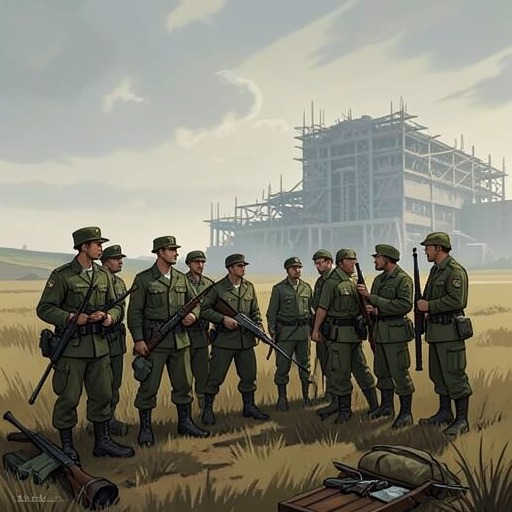
Retro Colonization Camp
StrikeRetro Colonization Camp is a detention site in the Mojave Desert where Retro forces hold prisoners amid their invasion of the past. Its significance lies not only in its cruelty but in the way the surrounding war reaches into the camp: prisoners are confined behind locked barracks, escape is an active and repeated possibility, and the guards’ priorities during an attack help decide the fate of the nearby dome.
Setting and Function
The camp belongs to a military occupation organized around the Retro invasion. Colonel Pike warns that the future Air Force can keep sending machines into the past, replacing losses faster than SYLO can resist; without intervention, the remaining population will be eradicated. She describes an approaching offensive that will destroy entire cities, followed by another wave intended to finish off survivors. Against this strategic scale, the camp represents the invasion’s local machinery: people from the past are kept under Retro control while the larger campaign threatens their world.
The evidence places the camp in the Mojave Desert, in the same conflict zone as the dome, but does not equate the two sites. The dome and its open entrance are distinct from the camp’s barracks and prisoner population. When Tucker Pierce, Tori Sleeper, and Kent Berringer return to the future and then re-enter the camp area, they are brought out of the dome into the desert. The open sky and view of the mountains offer a sharp contrast with their captivity, even as the sight makes Tucker Pierce angrier at the future that the invasion threatens to impose.
Prisoners and Escape
Tucker Pierce, Tori Sleeper, and Kent Berringer have already been imprisoned at the camp and have escaped once. On returning, they are therefore not simply entering hostile territory: they are known prisoners attempting a second escape. The pounding urgency of the moment comes from that history. They move toward a waiting vehicle deliberately, close enough to believe they may get away, but exposed to recognition and interruption until they reach it.
The camp’s perimeter is also connected to resistance on both sides of the conflict. Master Sergeant Sanchez explains that, once the group agrees to return, people are sent through to alert supporters and arrange their extraction. The vehicle waiting roughly thirty yards away is the immediate prospect of escape; the preparations behind it depend on a network able to operate across the boundary between the future and the past. The attempted departure thus shows the camp as a place where Retro custody is contested, rather than an enclosure beyond the reach of organized opposition.
The prisoners’ presence also gives the camp a human measure beyond military position and numbers. During the planning, Kent Berringer calls the group “Badass kids,” a wry acknowledgment of the young people being asked to face an invasion on an enormous scale. Their courage does not make the danger abstract: returning to the camp means again risking capture in a place where the authorities already know who escaped.
Raids and the Camp’s Changing Conditions
The camp has recently been struck in an aerial attack. By the time the returning group approaches the waiting vehicle, the wreckage has been cleared, and the burned barracks has become an empty patch of sand. The visible repairs and cleanup make the site appear to have recovered quickly. Yet that apparent normality is not evidence that the attack failed to matter: Tucker Pierce sees no sign of the previous day’s raid and hopes the next attack will have a different result.
The same camp responds differently during a later assault on the dome. After prisoners escaped into the desert during the preceding air raid, most guards herd the entire prisoner population into the barracks and lock them inside. The response is presented as a tactical mistake. While those guards spend time containing the prisoners, only a few dozen soldiers go to defend the dome; the delay costs them an opportunity to retake it. The camp’s custodial routine thus interferes directly with the military defense around it: the effort to prevent another escape draws personnel away from the more consequential fight.
The guards’ decision also changes the prisoners’ immediate condition. They are locked away rather than left free to move into the desert, as some had managed during the earlier raid. For the camp authorities, preventing flight has become a priority shaped by the last attack. But the policy does not secure their position; it leaves the dome with fewer defenders just when it is under pressure.
Narrative Significance
Retro Colonization Camp brings the invasion’s large claims down to the experience of confinement, escape, and military miscalculation. The future Air Force’s overwhelming resources appear in Pike’s warning, while the camp’s prisoners experience that power as an immediate threat to their freedom and survival. At the same time, the guards’ effort to control prisoners exposes a weakness in the occupation: coercive control has costs, and the personnel used to maintain it cannot also defend the dome.
The camp recurs as both a place the protagonists must escape and a part of the battlefield whose routines affect the larger struggle. Its cleared wreckage suggests a facility able to resume operations after an attack; its locked barracks reveal how quickly prisoner control can override military judgment. Together, those details make the camp more than a backdrop to the characters’ escape. It is one of the concrete sites where the invasion’s broader contest over the past is enforced—and where the demands of that enforcement can undermine the forces imposing it.