Time Bridge Dome Facility
StrikeThe Time Bridge Dome Facility is both a fortified passage between eras and the structure that must contain the Sounders’ planned nuclear blast. Its open doors leave the city exposed, while the Time Bridge inside makes the facility a point of military leverage: control of the dome on one side does not remove the danger of attack from the other.
Structure and Setting
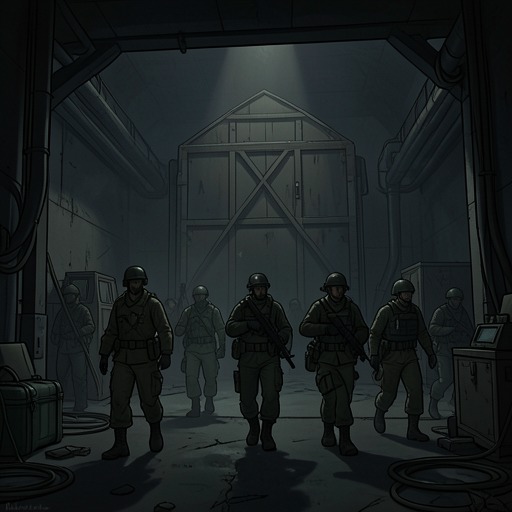
The dome stands in the future city that contains the Time Bridge, an immense structure with giant doors retracted into its outer shell. The passageway is housed inside the facility, where a large frame holds the Time Bridge itself. The building’s scale and its heavy doors make the connection between the two eras a physical, defensible threshold rather than an abstract route. When the doors are open, forces and equipment can move through; when they meet, the structure is sealed.
The facility’s importance is inseparable from its surroundings. The city lies on the far side of the passage from the past, and the dome’s position makes it a strategic objective for forces operating in both eras. The Sounders expect that once their operation begins, the United States Air Force will try to stop them. Even if they gain control of the Time Bridge from the future side, the Air Force can attack from the past, where its colonization camp has heavy artillery and drones. The dome is therefore not simply a place to occupy: holding it means defending a vulnerable connection against pressure from two directions.
Traffic and Military Presence
The interior is also a working military transit point. When the group enters, a hovering Retro-style attack aircraft is positioned in front of the frame, ready to pass through to the past. Retro soldiers guard the structure, while gear, aircraft, and personnel continue to move through the Time Bridge. The guards seem bored rather than tense, but their routine presence reveals how thoroughly the passage has been integrated into the military’s operations. The facility’s danger lies partly in this ordinary flow: an attack aircraft can be ready to cross even as opponents prepare to bring a nuclear device into the same strategic space.
The streets leading toward the dome reinforce the scale of that military activity. In a reconstructed account of events three hundred years in the future, a small United States Air Force group walks toward it along a wide street, five kilometers ahead of the narrator’s party. Colonel Pike leads the group, accompanied by Airman Eric Lewis, Airman First Class Olivia Kinsey, and civilian nuclear engineer Liger. They pass a queue of giant black aircraft waiting to make the journey into the past. The group does not openly react to the planes, but their presence heightens its anxiety and resolve. The approach to the facility thus places the planned operation amid the visible machinery of the invasion it is meant to oppose.
Strategic Objective and Risk
The Sounders’ operation depends on using the dome as the destination for a nuclear device. Their plan is to breach a depot, secure one of the devices, move it into position, arm it, and seal the dome before the United States Air Force can overwhelm them. The intended sequence gives the facility two roles: it is the place where the device is brought and armed, and the enclosure that must be closed before detonation. Surprise and speed matter because the Sounders expect to have only a limited time to defend the site and cover the engineers.
That plan has a severe structural constraint. The giant doors must be shut for the blast to be contained; if the dome remains open, the entire city might be wiped out. Sealing is consequently not a secondary precaution but a condition on which the operation’s intended outcome depends. The open entrance that facilitates movement through the Time Bridge also creates the possibility of catastrophe beyond the immediate combatants. The Sounders must hold off the military long enough to get the device into place and close the facility, while the battle outside threatens to interrupt the very action required to contain the blast.
Sealing the Dome
The closure comes under fire. As the doors draw together, the last Sounders continue fighting to prevent the United States Air Force from reaching the dome before it is sealed. The closing gap becomes a visible measure of the operation’s remaining time: first only a sliver of light remains on the floor, then the doors meet with a final metallic thud. The horn stops blaring and the red lights cease flashing. The account marks the result plainly: the dome in 2324 is sealed.
That ending resolves the facility’s central tension without making the struggle seem effortless. Its doors are both a physical barrier and the decisive mechanism by which the Sounders try to contain the consequences of their plan. The sequence moves from a crowded passageway, where aircraft and personnel cross between eras, to a sealed structure whose closure is secured by a desperate rear-guard fight. The Time Bridge Dome Facility therefore concentrates the conflict’s military and civilian stakes: control of the route determines who can move between past and future, while the state of its doors determines whether the nuclear blast stays contained or destroys the city.