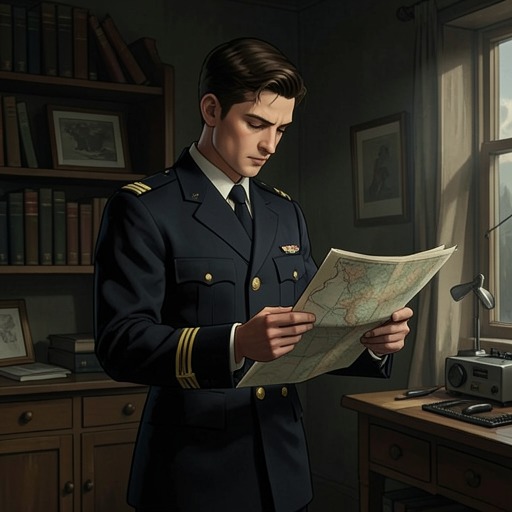
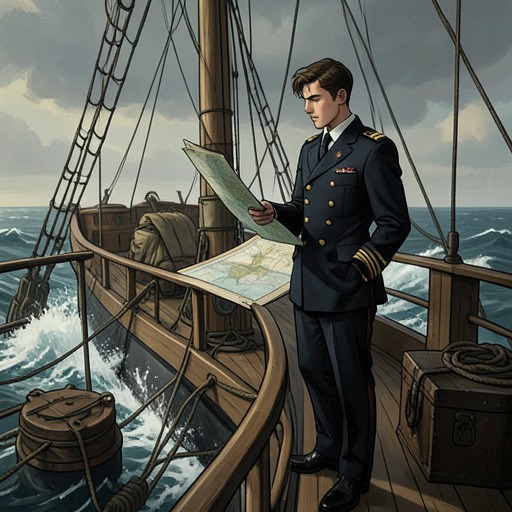
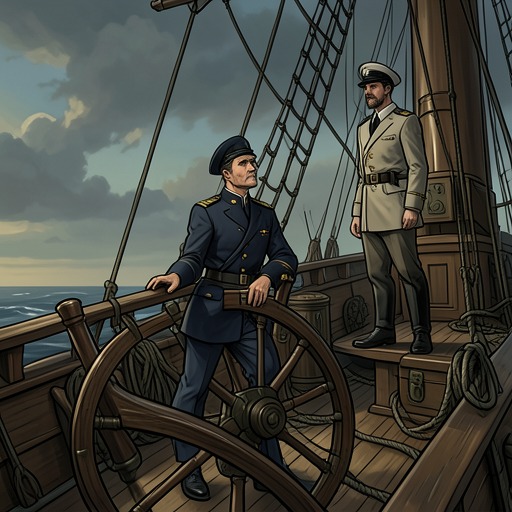
1944, before the opening of the main narrative
The Caine Mutiny Begins
The novel opens by framing the Caine affair as an extraordinary wartime act of command relief, later known throughout the service as the Caine mutiny. The Navy’s rules allow a subordinate to remove a commanding officer only under narrowly defined circumstances, when delay in seeking higher authority is impracticable and the danger is clear.
December 1942
Willie Enters the Navy
Will Keith left his comfortable home, traveling from [Manhattan](entity:location-recall-location-5e470c74b89c), where he had returned after the war, to Farnell Building to attend the training for the reserve officer school. His mother tried to feed him and protect him until the naval chief prevented her from entering further; this separation made him feel that the
Spring 1942, in the earlier history of their relationship
Willie Meets May Wynn
Before joining the navy, [Willie Keith](entity:character-recall-character-willie-keith-094cf7d72534) met Mei Wen at the Tahiti Club, who was there to try out for a singing role. Her performance of a Mozart arias, her lively intelligence, and her striking beauty broke his coldness; he took her to dinner, and the two began a relationship
1942, after their first meeting
The Romance Takes Shape
Will and Mei continued dating; her nightclub work allowed her to perform in [New York City](entity:location-recall-location-new-york-city-65df0a129d4c) and beyond, where Will returned and reconnected with Mei. Mei began studying at [Hunter College](entity:organization-recall-organization-947dea6bbe85); although Will was still attracted to her, he avoided seriously considering marriage, in part because he felt ashamed of her working-class
December 1942
Willie Enters Midshipmen School
At the Farnell Building, a physical examination nearly ended Will's naval career, as a medical officer raised objections to his back and rapid pulse. The second examination cleared him; Will also found that although he had not been willing before, he indeed wanted to stay in the naval command and discipline system
Winter 1942–43
The Roommates Survive Training
Will and anxiety lived with Ed Kassinger, who was eccentric, and Roland Kiefer, who was easygoing, in the same dormitory. He memorized a difficult textbook passage and gained a reputation in the weapons class; all three passed the school's elimination stage and became candidates for officer
Early 1943
Willie and May Break Apart
During her vacation, Mei questioned Willi why he would not admit their relationship to his family or commit to a shared future. She asked him if he would like to marry her; Willi could not answer, and Mei left him. He hurried back to Fernald Tower, arriving late and accumulating
Early 1943, after the leave violation
Willie Earns a Second Chance
Facing the threat of expulsion, Will truthfully told Major Merton about his troubles with Mei. Merton gave him a strict chance to stay: Will must remain at school, not break any rules, and prove he can finish his courses
Early 1943
Willie Refuses an Army Commission
Willy's father revealed that he could secure a safer position in the [United States Army](entity:organization-recall-organization-7d50e40c9fd9) through family connections. Willy asked his father to cancel this arrangement and stated that if he did not succeed in the Navy, he would rather enlist as a sailor than take the easier path
Spring 1943, at graduation from midshipmen school
Orders Send Willie to the Caine
Willy hoped to get a shore duty position, Keggs was ordered to go to a destroyer mine sweeper, and Roland got a communications position. Willy's order sent him to the USS Kane (DMS 22) — a ship in poor condition, far from the safe position
Spring 1943, after Willie reaches Pearl Harbor
The Caine Is Lost in the Paperwork
Will arrived in [Hawaii](entity:location-recall-location-hawaii-ea53a8e2a05b), but learned that the ship Kane had already left the port. He attended several weeks of gatherings with Roland, and afterwards a acquaintance of a admiral arranged for him to take temporary officer training instead of being sent immediately to sea service
Spring 1943, during Willie’s temporary duty
Dr. Keith’s Letter
Will opened the letter sealed by his father; his father had told him to read it when he reported for duty on the Kane. [Dr. Keith](entity:character-recall-character-dr-keith-5af7f6086f23) wrote in the letter that he was on the brink of death due to melanoma, reflected on the life and ambitions he had not pursued, and advised Will
Spring 1943, days after opening the letter
Willie Learns His Father Is Dead
A telegram from his mother told Will that [Dr. Keith](entity:character-recall-character-dr-keith-5af7f6086f23) had died. Will requested to leave his comfortable post and join the ship Kane, but was refused; he remained at [Pearl Harbor](entity:location-recall-location-pearl-harbor-03ca7d7f55af), and in sorrow, became more aware that his safe assignment was at odds with his father's challenge
September 1943
Willie Reports Aboard
Captain Paine woke Will at dawn and ordered him to report to the Kane for departure. Will boarded the old mine-sweeper from a nearby destroyer and met the ship's eccentric officers, including Communications Officer Tom Kiefer
September 1943, his first night aboard
Willie’s First Watch
Willy's first watch saw him witness the lax discipline on the Kane, the tired sailors, and the harsh life aboard the ship. He tried to enforce the watch regulations, but the captain's casual attitude and the crew's resistance made him unsure how to exercise authority
September 1943, during the Caine’s exercises
The Moulton and Iron Duke Sammis
When the Caine encounters the Moulton, Willie visits Keggs and sees the contrast between the ships: the Moulton is immaculate, while Keggs is cowed by its severe captain, Sammis. The visit complicates Willie’s early judgment that [Captain de Vriess](entity:character-recall-character-captain-de-vriess-dac136bea1bb) is simply a tyrant and raises questions about what good command looks like.
September 1943, during a minesweeping exercise
Willie Loses an Action Dispatch
A radioman hands Willie an action dispatch while the Caine is recovering its sweep gear and Lieutenant Maryk swims out to retrieve a lost float. Willie forgets the message in his wet clothes; when the delay is discovered, it proves serious enough to expose the ship to potential danger and damage Willie’s standing.
September 1943, after the lost dispatch is discovered
De Vriess Reprimands Willie
[Captain de Vriess](entity:character-recall-character-captain-de-vriess-dac136bea1bb) gives Willie an unfavorable fitness report and confines him to the ship. Willie initially takes the punishment as proof that the Caine’s captain is a malicious bully, but the episode forces him to confront the consequences of carelessness.
September 1943, while Willie is confined
The Bible Reaches Willie
Mail finally catches up with the Caine, bringing the Bible [Dr. Keith](entity:character-recall-character-dr-keith-5af7f6086f23) had promised to send. Inside, Willie finds his father’s final note directing him to Ecclesiastes and connecting its injunction to work with all one’s might to Willie’s duties aboard the ship.
September 1943
Queeg Replaces De Vriess
Lieutenant [Commander Queeg](entity:character-recall-character-commander-queeg-e8dd3962fb14) arrives without warning and assumes command. [De Vriess](entity:character-recall-character-de-vriess-74facb58260d) departs after five years aboard the Caine, accepting a watch the sailors have bought him and acknowledging that the ship and crew have their own rough methods of getting results.
September 1943, shortly after taking command
Queeg Announces His Rules
Queeg tells the wardroom that loyalty must run upward and downward, that the ship will follow his way, and that excellent performance is the standard. His friendly manner cannot soften the ultimatum, and the officers quickly sense that routine aboard the Caine is about to change.
September 1943, Queeg’s first departure from Pearl Harbor
The Caine Grounds in West Loch
While maneuvering away from the Moulton, Queeg grounds the Caine in shallow water and damages the neighboring ship. He gets the Caine to a fueling dock without further incident, but chooses not to report the grounding until higher authority demands an explanation.
September 1943, soon after the grounding
Pago Pago Orders Are Canceled
The Caine receives orders to remain at [Pearl Harbor](entity:location-recall-location-pearl-harbor-03ca7d7f55af) and tow targets instead of proceeding to [Pago Pago](entity:location-recall-location-9687c82fc25f). Queeg suspects the change is connected to the grounding and dispatches Gorton to investigate, but his inquiry brings him no useful information and increases his anxiety about his standing.
Autumn 1943, during target-towing duty
Queeg Loses the Ship in Fog
Queeg takes the Caine out in dense fog, becomes confused during a turn, and lashes out at the helmsman even though the sailor is trying to follow his earlier instruction. The ship narrowly avoids collisions before emerging into clear weather, giving the crew its first unmistakable glimpse of Queeg’s panic under pressure.
Autumn 1943, during a target-towing exercise
The Towline Breaks
After Queeg orders a sharp turn, the Caine cuts its own towline and loses the target. Maryk offers to recover it, but Queeg declines the attempt, sends the ship back to port, and asks higher authority for instructions rather than making the decision himself.
Autumn 1943, after the lost target
ComServPac Rebukes Queeg
[Captain Grace](entity:character-recall-character-captain-grace-82ac71c3f35b) challenges Queeg about the lost target and the ship’s earlier grounding. Queeg denies that the towline was cut by his own turn and refuses to admit uncertainty; Grace nevertheless stops short of recommending that he be relieved.
Autumn 1943, after returning from the investigation
Queeg Tightens Discipline
Queeg imposes new rules, including a demand that sailors tuck in their shirts and a policy of collective punishment when he believes orders have been ignored. He appoints Willie morale officer, turning him into the messenger for a regime that the crew outwardly obeys but largely resents.
Late 1943, on arrival in San Francisco
The Caine Crashes at the Pier
In a difficult tidal current, Queeg repeatedly misjudges the approach to the [San Francisco](entity:location-recall-location-san-francisco-8a14902ce523) pier and crashes the Caine into the wharf. Willie sees May waiting on the dock, but the collision and Queeg’s ensuing punishment of the crew turn the homecoming into a public humiliation.
Late 1943, during the Caine’s San Francisco leave
Willie Reunites with May
Willie introduces May to his mother, and the couple spend time together in [San Francisco](entity:location-recall-location-san-francisco-8a14902ce523) and [Yosemite Valley](entity:location-recall-location-yosemite-valley-708fe17d0bc2). They sleep together; afterward Willie proposes, but he is unsure whether love or guilt is driving him, and May refuses to accept a rushed promise as a settled decision.
Late 1943, during the same leave
Mrs. Keith Opposes the Marriage
Willie’s mother argues that May’s background and ambitions are incompatible with the future she imagines for her son. Willie is shaken by the argument and agrees not to marry during this leave, leaving May and himself in an ambiguous engagement as he returns to the Caine.
Late 1943, while the Caine is being repaired
Maryk Grants Stilwell Emergency Leave
A telegram claims that [Stilwell](entity:character-recall-character-stilwell-2ceafdb088b1)’s mother is dying, and Maryk grants him a seventy-two-hour pass without Queeg’s approval. Willie believes the emergency is a pretext to let Stilwell address fears about his marriage, but Maryk takes the risk because he cannot bring himself to deny a desperate sailor a chance to go home.
Late 1943, after the emergency leave
Stilwell Returns Late
[Stilwell](entity:character-recall-character-stilwell-2ceafdb088b1) returns just after Queeg arrives, and Maryk admits that he granted the unauthorized pass. Queeg threatens Maryk’s fitness report and tells him to choose sides; Maryk promises future obedience, beginning the long period in which he tries to hold the ship together by complying with Queeg.
December 1943
Caine Returns to the Pacific
The Navy shortens the Caine’s overhaul, and the ship leaves [San Francisco](entity:location-recall-location-san-francisco-8a14902ce523) with a reduced crew. Willie says farewell to May and returns to the ship, which he now regards as home despite its cramped quarters and deteriorating condition.
Early 1944, during the Pacific campaign
Queeg’s Circle of Compliance
As the Caine moves into a more active war zone, the crew learns to comply with Queeg’s rules only when they fall within his sight and hearing. Outside that circle, the ship keeps its old, informal habits; officers meanwhile unite in private mockery of the captain, with Maryk caught between them and Queeg.
January 1944
The Caine Approaches Kwajalein
The Caine joins the vast task force bound for the [Marshall Islands](entity:location-recall-location-marshall-islands-7ed7fe7383fc). Willie takes pride in his growing competence as an officer of the deck, while the ship’s quiet place in the anti-submarine screen gives him a false sense of security about the coming battle.
January 1944, first morning of the Kwajalein operation
Willie Leads the Assault Boats
The Caine is assigned to guide a group of landing craft toward the line of departure. Queeg retreats from the exposed side of the bridge, and Maryk has to intervene when the captain’s uncertainty threatens to carry the Caine too close to the beach.
January 1944, during the Kwajalein landing
The Yellow Marker Incident
Queeg turns the Caine away and drops a yellow dye marker to indicate the departure point, leaving the landing craft to make their own approach. Afterward, [Tom Keefer](entity:character-recall-character-tom-keefer-2b828cd4cb56) argues that Queeg’s maneuver amounted to a retreat, and Willie realizes that he never saw the captain on the side of the bridge facing the island.
January 1944, during the battle for Kwajalein
The Ice Cream and Ammunition Blast
Willie listens to combat broadcasts and witnesses a huge ammunition explosion while eating ice cream. The contrast unsettles him, but he cannot fully escape his comfortable distance from the men dying ashore; Keefer insists that war places some people in danger while others watch.
Early 1944, after the Kwajalein operation
Queeg Blocks Rabbitt’s Orders
[Rabbitt](entity:character-recall-character-rabbitt-79d9a8f13e15) receives orders to join a new minesweeper, but Queeg delays his departure because he doubts the readiness of Rabbitt’s replacement. Queeg’s insistence on perfect standards keeps a capable officer aboard the Caine and deepens the crew’s sense that the captain uses rules to exert personal control.
Early 1944, en route to Funafuti
The Water Famine
After the crew’s water consumption rises during the Kwajalein operation, Queeg bans personal water use for forty-eight hours, even as heat and stack gas make the ship nearly unbearable. Sailors secretly obtain water in the engine room, while Maryk fails to persuade Queeg to end the punishment early.
Early 1944, at Funafuti
Willie Meets Acres Again
At the destroyer tender Pluto, Willie meets his former instructor Acres, now a comfortable tender officer. The visit shows Willie how radically different naval assignments can be and brings him a stack of long-delayed mail, as well as news of his promotion to lieutenant junior grade.
Early 1944, after the water famine
Stilwell’s Court-Martial
Queeg expects [Stilwell](entity:character-recall-character-stilwell-2ceafdb088b1) to plead guilty and wants him punished severely for sending a false telegram. Willie discovers that the confession may be unusable under the rules in [Courts and Boards](entity:object-recall-object-courts-and-boards-08ab9c3969c8), but Queeg pressures Stilwell into reaffirming it; Stilwell’s summary court ends with a token sentence that enrages Queeg.
Early 1944, after Stilwell’s trial
Maryk Keeps a Secret Log
Maryk secretly records Queeg’s eccentricities, punishments, and command decisions, preserving a detailed history of his service aboard the Caine. The log gives Maryk a way to examine whether his suspicions are justified, but also becomes the basis for his later attempt to seek outside intervention.
Spring 1944, during extended escort duty
Queeg Withdraws from Shipboard Life
The Caine spends months shuttling between South Pacific bases, and Queeg becomes increasingly secluded and irritable. Maryk continues the log, while exhaustion and monotony erode the officers’ judgment and make the captain’s repeated conferences and minor punishments feel like an inescapable routine.
June 1944, during the invasion of Saipan
The Saipan Shore Battery
A Japanese shore battery opens fire on the destroyer Stanfield. Willie sees Queeg turn the Caine away without firing, despite having guns manned and a possible line of fire; he reports the episode to Maryk, who records it in the secret log.
October 1944, during the Battle of Leyte Gulf
Roland Keefer Dies at Leyte
A damaged carrier returns with word that [Roland Keefer](entity:character-recall-character-roland-keefer-700b146cf386) died of burns after taking charge of damage control aboard the Montauk during an attack. Tom hears that his half-brother acted bravely, and must confront the distance he had placed between himself and Roland by dismissing him as less intelligent.
October 1944, at Ulithi
Queeg Investigates the Strawberries
After strawberries disappear from the wardroom, Queeg launches an elaborate investigation, convinced that someone has made a duplicate key. He interrogates sailors and officers, demands statements, and organizes a shipwide search, even though the case rests on his untested assumption that a key must exist.
October 1944, during the Caine’s passage to Guam
The Search Finds No Key
Queeg’s search strips and searches the crew and produces no key. Willie learns from Ducely that the mess boys ate the strawberries, but Maryk’s attempt to tell Queeg cannot dislodge the captain’s conviction; the search collapses into a farce and sharpens the question of whether Queeg remains fit for command.
October 1944, after the search
Maryk and Keefer Seek Halsey
Maryk gives Keefer the secret log and asks him to accompany him to report Queeg to Admiral Halsey. Aboard the New Jersey, Keefer loses his nerve and refuses to take part; Maryk returns without appealing to the admiral, while the possibility of relief remains unresolved.
December 18, 1944
The Caine Enters the Typhoon
The Caine sails with a tanker force into worsening weather. Queeg distrusts Willie’s typhoon chart, and the storm intensifies until the task force’s attempt to refuel in dangerous seas is abandoned and the ships turn to escape the weather.
December 18, 1944, morning
The Caine Broaches to
As the fleet changes course, the wind drives the Caine broadside and overwhelms its rudder. Maryk repeatedly proposes ballasting and turning into the wind, but Queeg clings to fleet course, argues with his subordinates, and loses touch with the ship’s immediate danger.
December 18, 1944, shortly before 10 a.m.
Maryk Relieves Queeg
With the Caine shipping water and no longer answering its engines, Maryk takes the telegraph from Queeg and turns the ship toward the wind. He formally relieves Queeg under Article 184, and Willie supports the decision, while Queeg protests that the act is mutiny.
December 18, 1944, after the relief
The Caine Rescues the George Black Survivors
Maryk keeps the Caine under control, circles a capsized destroyer, and rescues its survivors. Queeg remains aboard and continues to challenge Maryk, but the executive officer’s command keeps the Caine afloat long enough to save men from the wreck.
Late December 1944
The Caine Returns to Ulithi
After the typhoon, the Caine reaches [Ulithi](entity:location-recall-location-ad6233b7b870) battered but operational. Queeg is medically examined and declared fit, while Maryk faces investigation for removing him; the ship’s officers learn that the apparent crisis at sea has become a legal battle over authority and judgment.
Early 1945, in San Francisco
Greenwald Takes Maryk’s Case
The district legal office struggles to find a lawyer willing to defend Maryk. [Barney Greenwald](entity:character-recall-character-barney-greenwald-ad81a87904ca) accepts reluctantly, interviews the executive officer, and concludes that the case turns on whether Maryk acted without criminal intent while trying to save the ship.
Early 1945, before Maryk’s court-martial
Willie Returns to New York
Willie receives leave and travels home intending to end his relationship with May face to face. His recollection of the investigation has stripped away his fantasies of public vindication, leaving him frightened of the legal consequences and painfully aware of how he has treated May.
Early 1945, during his New York leave
Willie Ends the Romance
May is tired, ill, and struggling to support her family when Willie finds her. He sees her hardship as confirming his doubts about marriage, even as they share an intimate night; he then tells her he cannot marry her, and she asks whether their relationship is finished.
The end of the same leave
Willie Asks May for Advice
Before returning to the Caine, Willie visits May again and tells her about the mutiny case. May believes the Navy will understand that the officers acted to save the ship, and the two share a final passionate kiss, though Willie still does not admit that he wants a life with her.
Early 1945, first day of trial
Maryk’s Court-Martial Begins
The prosecution calls Queeg, who presents the relief as an unjustified seizure of command by a disloyal subordinate. Keefer testifies that he did not believe the log justified action against Queeg and admits that Maryk had previously been warned not to proceed.
Early 1945, second day of trial
Willie Testifies About Queeg
Challee draws out Willie’s dislike of Queeg and his willingness to disobey orders when he believed [Stilwell](entity:character-recall-character-stilwell-2ceafdb088b1) was being persecuted. Willie eventually admits that he cannot separate his support for Maryk from his hostility toward Queeg, nearly undermining the defense.
Early 1945, during Willie’s cross-examination
Willie Accuses Queeg of Cowardice
Under [Greenwald](entity:character-recall-character-greenwald-30127f0f4d0a)’s questioning, Willie describes Queeg’s retreat from shore batteries and the dye-marker episode at Kwajalein. The testimony gives the court concrete reasons to question Queeg’s courage and judgment, rather than relying only on psychiatric labels.
Early 1945, second day of trial
The Psychiatrists Examine Queeg’s Fitness
Navy psychiatrists state that Queeg is not psychotic and is fit for command, yet their testimony describes a paranoid and obsessive personality shaped by insecurity and a need to avoid blame. [Greenwald](entity:character-recall-character-greenwald-30127f0f4d0a) presses them on whether a man can be functioning in ordinary circumstances but become disabled under the exceptional stress of command.
Early 1945, third day of trial
Queeg Contradicts Himself
On the stand, Queeg changes his account of the Kwajalein marker and the Caine’s lost towline, while insisting that his decisions were sound. [Greenwald](entity:character-recall-character-greenwald-30127f0f4d0a) exposes his false denial about the liquor crate and the money taken from Willie, then makes Queeg’s shifting explanations visible to the court.
Early 1945, conclusion of the trial
Maryk Is Acquitted
After deliberating for just over an hour, the court acquits Maryk. The verdict ends the immediate threat of imprisonment, but does not resolve the Navy’s judgment of the relief or the damage to Maryk’s career.
The evening of Maryk’s acquittal
Greenwald Rebukes Keefer
At a celebration arranged by Keefer, [Greenwald](entity:character-recall-character-greenwald-30127f0f4d0a) praises the captain he had attacked in court: Queeg had helped defend Greenwald’s mother by serving in the Navy during the war. He accuses Keefer of provoking Maryk to act and then protecting himself, and throws wine in Keefer’s face.
Late June 1945, off Okinawa
Willie Is Shaken by the Kamikaze
A Japanese kamikaze strikes the Caine amidships, setting the after fireroom ablaze and triggering explosions. Keefer orders the crew to abandon ship, and Willie realizes that, if he dies, his deepest regret will be losing May for good.
Minutes after the kamikaze strike
Willie Saves the Caine
Willie takes charge after Keefer jumps overboard, restores the public-address system, coordinates damage control, and persuades sailors to remain aboard. The crew saves the ship, though Horrible dies in the flooded fireroom; Willie’s actions earn him a Bronze Star and confirm a maturity he had once lacked.
The evening after the kamikaze attack
Keefer Confronts His Failure
Keefer acknowledges that his decision to abandon ship will define him, and recognizes the difference between his response and Roland’s bravery at Leyte. He gives Willie part of his novel manuscript and asks him to read it, while Willie privately begins a long letter asking May to marry him.
Late June 1945
Willie Proposes by Letter
Willie writes May an unguarded proposal, admitting that he had judged her by class and appearance and that he now wants a life with her. He imagines returning to school and teaching, and acknowledges that his experiences at sea have changed both his ambitions and his understanding of himself.
Seventeen days before Japan’s surrender
The Caine Sweeps Its First Mine
The Caine finally encounters real mines in the [China Sea](entity:location-recall-location-28ca8efc902d). The crew destroys several mines, but a fuel-pump failure forces the ship to leave the sweep and return to [Okinawa](entity:location-recall-location-okinawa-fc57eb168687), ending its brief chance to perform the job for which it was built.
August 10, 1945
Japan’s Surrender Is Announced
A radio bulletin announces Japan’s surrender, and the Caine’s crew erupts into celebration. Willie feels the relief of having survived, but also recognizes that his dream of becoming a captain may end when the war and the ship’s service are over.
August 1945, after the surrender announcement
The Caine Repairs Its Pumps
With wartime repair priorities disappearing, the Caine is at risk of being left to decay in [Okinawa](entity:location-recall-location-okinawa-fc57eb168687). Willie rallies the black gang to fix the fuel pumps themselves, restoring enough power for the ship to travel and strengthening his claim that he can command it.
Autumn 1945, after the demobilization point system is issued
Willie Takes Command
As the Navy begins releasing servicemen, Keefer seeks permission to leave and recommends Willie as the Caine’s successor. The Bureau approves the change, and Willie becomes captain of the ship that had once seemed the least promising assignment in the Navy.
Autumn 1945, shortly after Willie becomes captain
The Caine Rides Out Another Typhoon
A typhoon strikes [Okinawa](entity:location-recall-location-okinawa-fc57eb168687), and Willie remains on the bridge for thirty hours, steering the Caine through the storm and keeping it from dragging anchor. The ship survives while others wreck, and the crew begins to regard Willie as a capable captain in his own right.
Autumn 1945
Willie and Keggs Head Home
Willie persuades [MinePac](entity:organization-recall-organization-minepac-9660d12eba64) to send the Caine and Moulton back to the United States instead of leaving the damaged minesweeper in [Okinawa](entity:location-recall-location-okinawa-fc57eb168687). He wins the argument by stressing both the safety of the crew and the ship’s remaining value, then begins the long voyage home.
During the return voyage, autumn 1945
The Navy Reviews the Trial
The Navy reviews Maryk’s acquittal and disapproves the verdict, concluding that his relief of Queeg was improper and that Willie supported the action wholeheartedly. Willie receives a formal reprimand that will remain in his promotion record, despite also receiving a Bronze Star for saving the Caine.
After the Caine reaches Pearl Harbor
Willie Learns May Has Disappeared
Willie calls the [Bronx](entity:location-recall-location-49bc6b1cb0b8) candy store and discovers that May and her family have moved away. The disappearance gives force to his fear that his long-delayed proposal arrived too late, even as he completes the trip that will return him to New York and civilian life.
October 27, 1945, at Bayonne
The Caine Is Decommissioned
The Caine is formally decommissioned after its worn-out machinery and battle damage make further service impractical. Willie delivers a farewell speech crediting the ship’s ordinary, menial duties with helping win the war, then leaves the vessel and returns to his mother’s car.
Navy Day, after Willie’s return to New York
Willie Finds May at the Brill Building
Willie finally locates May through [Marty Rubin](entity:character-recall-character-marty-rubin-a7e8c40b59b5) and learns that she is singing under the name Marie Minotti, with [Walter Feather](entity:character-recall-character-walter-feather-6aa43c6a6a5a). May is reluctant to speak with him, but Feather gives them privacy; Willie discovers that May has not married and that she has been emotionally involved with the bandleader.
The same day, after Willie finds May
May and Willie Reconsider Marriage
Willie asks May to marry him, insisting that he is prepared to build a life around teaching rather than his mother’s wealth. May points out that he has already hurt her and that their former intimacy cannot simply be restored; nevertheless, their attraction and affection return during the conversation.
Navy Day, shortly after his meeting with May
Willie Joins the Navy Parade
Willie leaves the lounge and watches the Navy parade move down [Fifth Avenue](entity:location-recall-location-fifth-avenue-8d4ed85e1762). He no longer imagines himself as a spectator waiting to return to his old life: his feelings remain with May, and he is determined to make her his wife despite uncertainty about their future.