Sanhedrin
The Sanhedrin, the supreme religious and judicial council of ancient Judea, appears in Bulgakov's novel as the institutional engine that condemns Yeshua Ha-Nozri to death and, through its president Joseph Kaifa, forces the hand of Pontius Pilate. Its decisions are not merely legal but theological, and its confrontation with Roman authority shapes the moral catastrophe at the heart of the Yershalaim chapters.
Composition and Authority
The Sanhedrin is composed of the high priest and other leading priests and elders of Jerusalem. In the novel, it is referred to both as the Sanhedrin and, in one instance, as the "Lesser Sanhedrin" . Its authority extends to capital cases, though under Roman occupation a death sentence requires confirmation by the procurator. The high priest Joseph Kaifa serves as its president and speaks for the body in all dealings with Pilate . The Sanhedrin's power is not merely judicial but also religious: it guards the temple and the faith, and its members are deeply suspicious of any teaching that might undermine either.
The Trial of Yeshua and the Confrontation with Pilate
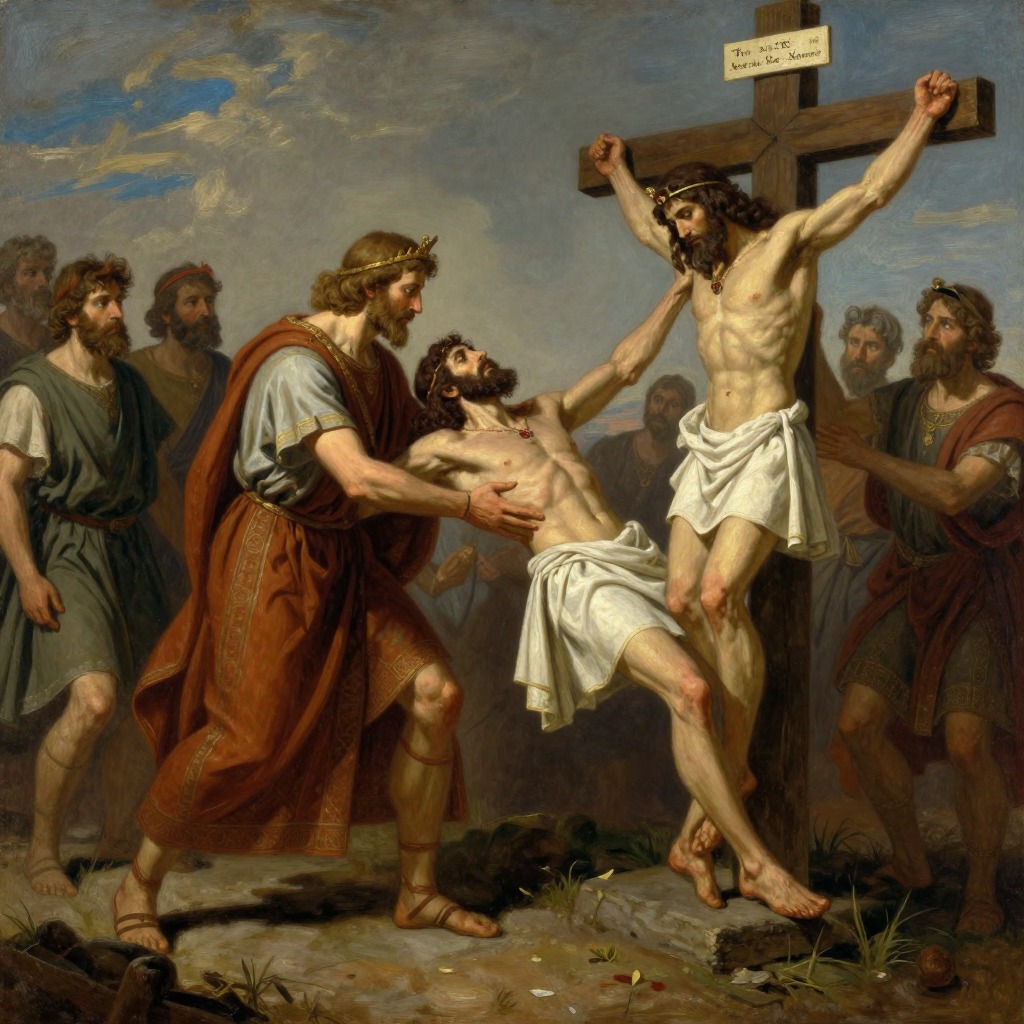
The Sanhedrin has already passed a death sentence on Yeshua Ha-Nozri before the case reaches Pilate. The procurator, suffering from hemicrania and troubled by his conversation with the prisoner, attempts to have the sentence overturned. He summons Kaifa to a private meeting on the upper terrace of the palace garden, where he argues that Yeshua is a harmless madman and that the far more dangerous rebel Bar-Rabban should be executed instead. Kaifa, speaking for the Sanhedrin, refuses: "The Sanhedrin asks that Bar-Rabban be released" . Pilate presses him three times, each time receiving the same answer. The high priest's refusal is absolute and unyielding, and Pilate, though furious, is forced to confirm the Sanhedrin's choice .
The Release of Bar-Rabban and the Execution of Yeshua
As a result of the Sanhedrin's insistence, Bar-Rabban is freed and Yeshua is led to execution on Bald Mountain. Pilate, in a rage of impotence, warns Kaifa that he will complain directly to the emperor Tiberius about the Sanhedrin's sheltering of criminals, but the high priest remains unmoved . The Sanhedrin's decision is thus the proximate cause of Yeshua's death, and Pilate's subsequent anguish—his two-thousand-year wait on the path of moonlight—is a direct consequence of his yielding to its will.
The Sanhedrin in the Moscow Narrative
The Sanhedrin also appears, transformed, in the Moscow sections of the novel. In Nikanor Ivanovich Bosoy's dream, a theatre of currency confiscation is presided over by a master of ceremonies who functions as a kind of secular high priest, interrogating and exposing those who hide foreign currency. The dream's structure—a public, ritualized exposure and punishment—mirrors the Sanhedrin's public condemnation of Yeshua, but here the crime is economic rather than theological . The dream's theatrical setting and the master of ceremonies' relentless questioning echo the Sanhedrin's judicial authority, now turned to the purposes of the Soviet state.
Thematic Significance
The Sanhedrin represents the fusion of religious and political power that condemns truth to death. Its refusal to release Yeshua is not merely a legal decision but a theological one: Kaifa declares that Yeshua is a "seducer of the people" who would "outrage the faith" and bring Roman swords upon the nation . The Sanhedrin thus chooses political stability and religious orthodoxy over the dangerous truth that Yeshua embodies. In the Moscow narrative, the Sanhedrin's function is secularized but not abolished: the state's institutions of judgment and punishment continue to operate, now targeting currency speculators rather than prophets. The novel thus suggests that the pattern of institutional violence against truth is not confined to ancient Judea but recurs in every age.