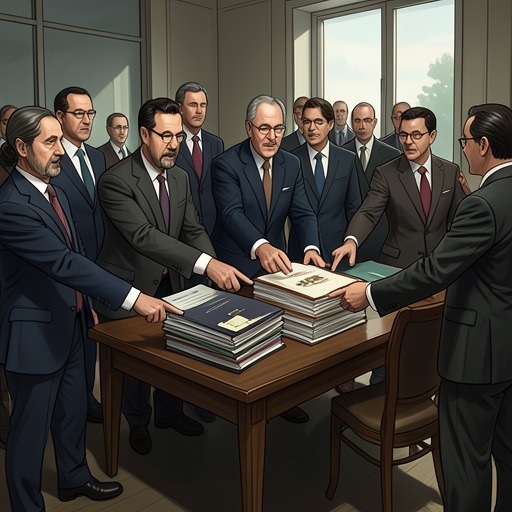
Congressional oversight
TrumanCongressional oversight, as practiced by Harry S. Truman, was not simply a matter of exposing waste: it was an effort to make public scrutiny serve effective government without allowing investigators to take over executive responsibilities. His wartime committee investigated defense procurement while disclaiming authority over military strategy and personnel. Later disputes over emergency powers, military orders, and congressional support showed the other side of the principle: oversight mattered, but so did the limits of legislative intervention and the President’s responsibility to act.
Wartime oversight and the Truman Committee
On February 10, 1941, Truman proposed a special Senate committee to investigate the awarding of defense contracts. He had spent weeks preparing, consulting other senators and seeking suggestions from friends and staff. The proposal answered a sprawling defense effort with no clear administrative system or single person in charge. Defense work was being managed from the White House, while the War Department worried that congressional investigations could generate bad publicity, complicate the program, and delay production. Chief of Staff George C. Marshall offered a countervailing view: Congress’s members should be presumed as patriotic as the administration.
Truman also saw hazards in investigation. His study of the Civil War had taught him how the congressional committee investigating that conflict could interfere with presidential decisions, including the selection of commanders and military strategy. He had gone to the Library of Congress to examine the records himself. He likewise blamed Senator Gerald P. Nye’s postwar inquiry into the First World War and munitions makers for strengthening isolationist feeling and contributing to inadequate preparedness. Truman distinguished that retrospective scrutiny from the inquiry he wanted: investigate problems during the current emergency, while there was still time to correct them.
The proposal met institutional resistance. Resolution 71 passed through committees, but its progress could have stalled under James F. Byrnes, who was close to the administration. A competing House proposal from Eugene Cox sought a joint committee with a much broader remit to investigate all national-defense activities. At the White House, Byrnes argued that the President would be better served by an inquiry led by Truman. Franklin D. Roosevelt agreed, but Byrnes initially sought to limit the committee’s resources to $10,000. Truman objected and obtained only a small increase, to $15,000, despite the more than $13 billion expected to be spent on defense in 1941. The Senate adopted Resolution 71 unanimously in March; a week later, it passed the Lend-Lease Act, authorizing another $7 billion in spending.
Boundaries, fairness, and civilian authority
Truman defined oversight as investigation rather than a competing command structure. The committee’s findings were to be presented as the work of the full committee, not as the personal product of its chairman. It would have no authority over military strategy, military personnel, or the size or disposition of the defense effort. When a senator suggested that Truman resented a question, Truman made clear that he did resent it, because the committee was not conducting an indiscriminate fishing expedition. Hugh Fulton’s honesty and work proved valuable, but the book emphasizes that Truman, not Fulton, supplied the committee’s driving force.
The distinction between scrutiny and command also shaped Truman’s stance on wartime production. In backing a single head for procurement, he accepted that the committee might support an administrator even when it disagreed with him. Pushing beyond that role, Truman believed, risked dictating policy and repeating the intrusions he associated with the Civil War committee. His insistence on civilian control arose from the same concern. As military contracts rapidly expanded, he watched senior officers acquire influence over industry and agriculture and worried about the political and economic consequences after the war. His position was that generals and admirals should identify what they needed to fight, while civilian authorities retained control of the larger effort.
The committee’s advisory limits mattered in other wartime decisions as well. During consideration of the atomic bomb, Henry L. Stimson stressed that the committee could advise but that the responsibility for recommending a course to the President was his. The episode underscored a related principle: consultation could inform a decision without dissolving the responsibility of the official charged with making it. Truman’s account of the episode likewise emphasized that the final judgment could not be transferred to the committee.
Results and limits of investigation
The Truman Committee’s record combined failures exposed, improvements secured, and cases in which wartime priorities constrained accountability. Its intervention helped press the Navy’s Bureau of Ships to adopt the hinge-prowed Higgins landing craft, which could land troops on varied shallow beaches rather than only at established harbors. The committee also reported that German U-boats had destroyed 12 million tons of American shipping in 1942—one million tons more than the shipyards were then producing. The Navy disputed the figure publicly, but Secretary of the Navy Frank Knox acknowledged its accuracy in an executive session.
Its scrutiny did not prevent every wasteful project or guarantee penalties for every failure. The Canol pipeline, planned to run 1,200 miles from Canada to Alaska, continued despite the committee’s concerns and ultimately cost $134 million. At one point it involved 4,000 troops and 12,000 civilians, diverting manpower and materials as well as money. Some corporations and agencies found to have bungled work or committed fraud were let off the hook so that production could continue. The committee’s work with aluminum producer Alcoa similarly reflected the priority of obtaining needed material rather than accepting excuses.
Later estimates credited the committee with saving as much as $15 billion, but the book cautions that no exact figure can be established and that this estimate was probably exaggerated. Its less quantifiable effect may have been more important: the prospect of investigation and public exposure encouraged people in government, the military, and industry to do their jobs properly. The committee also provided the public with information about the war effort and, under Truman’s chairmanship, offered witnesses a fair hearing. Its reputation rested not only on what it uncovered, but on close attention to evidence and restraint in exercising its authority.
Oversight beyond the committee
Truman’s experience with Congress continued to involve both resistance and negotiation. As President, he responded to repeated congressional rebuffs by pressing again rather than abandoning proposals, including national compulsory health insurance and universal military training. In a meeting with congressional leaders about aid to Greece and Turkey, he heard George C. Marshall describe the danger of allowing Soviet influence to spread and agreed that the choice was action or default. The episode illustrates oversight as part of a political process in which a President had to make a case to legislators and win support, not merely invoke authority.
The Korean War sharpened the question of when to seek congressional authorization. Averell Harriman urged Truman to request a war resolution while public support remained strong; Dean Acheson argued that the President should rely on his constitutional authority as Commander in Chief. Truman sided with Acheson, reasoning that an appeal to Congress during the emergency could make it harder for future presidents to respond to crises. Harriman later believed the decision had been a mistake, but also recognized that Truman was considering the precedent his choice would set for presidential authority.
The confrontation with Douglas MacArthur presented a different boundary problem. MacArthur issued a public statement on foreign policy in defiance of directives and of Truman’s orders as President and Commander in Chief. Truman initially chose a restrained reprimand rather than immediate dismissal, taking account of the political risks and MacArthur’s public standing. When House Minority Leader Joseph Martin later made public a letter from MacArthur advocating a more expansive war in Asia, Congress became a channel through which the commander’s challenge reached the public. Together, the episode and Truman’s response show the limits of oversight as a single institutional mechanism: legislative debate could expose a conflict, but the President still bore responsibility for enforcing civilian authority and deciding how to act.