Jackson County road-building program
TrumanThe Jackson County road-building program was a countywide infrastructure plan that Harry S. Truman developed as presiding judge of the Jackson County Court. It proposed replacing a failing patchwork of roads with a planned network of concrete highways, paid for by a bond issue and built under bipartisan engineering supervision. Its importance lay not only in the miles constructed, but in the promise that public money would be spent honestly: voters approved the road bonds by a three-to-one margin, and the completed system came in below the engineers’ estimate.
The problem and the plan
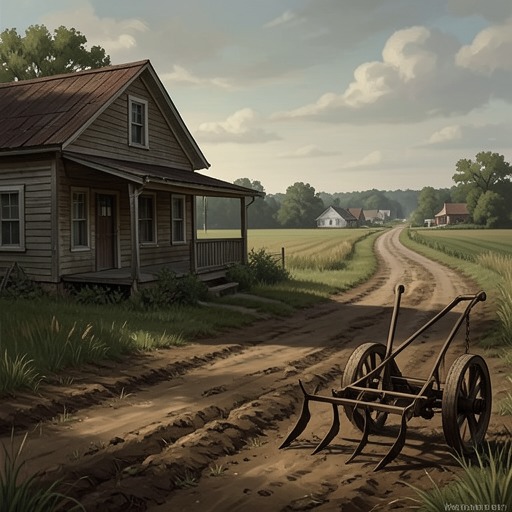
Within days of taking office, Truman appointed two civil engineers, Colonel E. M. Stayton and Republican N. T. Veatch, Jr., to survey the roads throughout Jackson County and devise a countywide plan. No comparable survey had previously been made. Truman accompanied them on much of their work, which covered hundreds of miles. Their report, issued three months later, found 350 miles of “ ‘pie crust’ roads clearly inadequate to stand the demands of modern traffic.” Even maintaining the existing roads would cost more than the county could expect to raise through taxes.
The engineers proposed 224 miles of new concrete roads, arranged so that no farmer would be more than two miles from at least one improved route. The estimated cost was $6.5 million, to be raised through a bond issue—a financing method seldom used for roads in Jackson County. Earlier bond proposals of various kinds had often fared poorly, so the scale of the plan made public confidence central to its prospects. Truman believed voters would support it if they could be assured of honest contracts and first-rate construction.
Winning support and setting terms
The proposal met skepticism from both the Kansas City Star and Tom Pendergast. When Truman sought Pendergast’s approval, Pendergast warned that voters would assume he intended to steal the money. Truman’s answer was to tell the public plainly what he intended to do; he took Pendergast’s response—that he could tell voters whatever he liked—as a sign of agreement. The exchange left Truman to make the case directly to the electorate, with the credibility of the plan resting on what he promised about its administration.
Truman travelled from town to town to explain how the work would be awarded and supervised. He told voters that contracts would go to low bidders and that bipartisan engineers would oversee construction. The timing helped make the need tangible: the campaign took place in early spring, during mud season, when the condition of the roads was immediately apparent. Each voter received a map showing where improvements were planned, turning a countywide proposal into a visible account of which routes would change.
The bond issue also included proposals for a new Kansas City courthouse and jail, a county hospital, and a home for children with intellectual disabilities. Voters rejected the courthouse, jail, and children’s home, but approved the roads and hospital. The decision came on Truman’s forty-fourth birthday, May 8, 1928. The three-to-one vote in favor of the bond issue was a striking endorsement of the projects that passed, especially the road plan, whose cost and breadth had prompted doubts.
Construction and performance
Truman followed through on the contracting promise. The first contract, worth $400,000, went to a construction firm from South Dakota; subsequent work also went to companies not usually selected for public projects in Jackson County. The arrangement made the commitment to low bids consequential: the contracts were not confined to the firms customarily chosen for local public work. The bipartisan engineering board had responsibility for supervising a system planned in advance rather than leaving road improvements as disconnected responses to immediate complaints.
The roads were completed, and the account emphasizes that they were built extremely well. Five years after the vote, the Independence Examiner reported that every road promised in the plans had been built as proposed, and that the work remained within both the amount voters approved and the engineers’ estimates. The program was completed on schedule and, as Truman noted privately, for less than the original estimate. Its record therefore answered the chief doubts raised before the vote: the promised routes were delivered, construction met the plan, and the bond money was not exceeded.
The effort also included a landscape ambition beyond paving. Remembering roads in France, Truman arranged for seven thousand seedling elms and poplars to be planted along the new routes. The trees were intended to give the county roads a more finished, scenic character, but local farmers mowed them down. That response marked a limit to the project’s aesthetic vision: the road system could be planned and financed at county scale, while the intended transformation of the roadside landscape depended on local acceptance.
Legacy and wider vision
Truman’s broader conception of planning appeared in a substantial, handsomely designed booklet, Results of County Planning, which documented the county in more than a hundred pages of photographs. It pictured schools, farms, industry, main streets, the growing Kansas City skyline, bridges over the Missouri, Blue, and Little Blue rivers, and roads crossing the rolling countryside. Its presentation connected transportation improvements to the county’s shared landscape and history, rather than treating roads as an isolated engineering project. Truman imagined future parks and recreation grounds as further benefits of coordinated county development, though these were aspirations in the report, not accomplishments of the road bond itself.
The program’s success helped establish a basis for another bond issue, this time covering additional roads, a Kansas City courthouse, and extensive remodeling of the courthouse in Independence. The later courthouse proposal was linked to a broader Ten-Year Plan for civic construction in Kansas City. In that sequence, the roads were both a material achievement and a precedent: a large public works program, initially regarded with suspicion, had been approved after Truman made its costs, routes, contracting principles, and supervision legible to voters—and then completed within the promised financial limits.