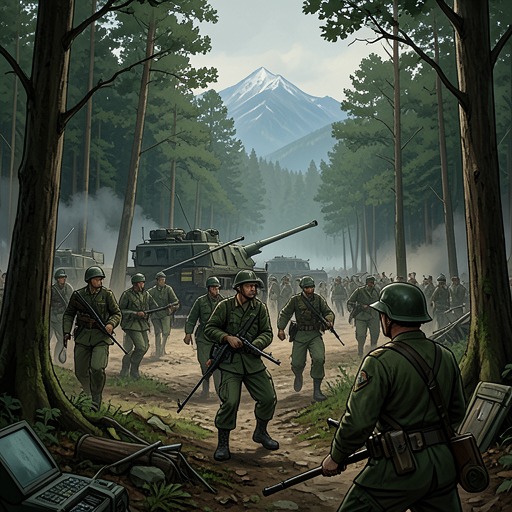
Voluntary repatriation principle
TrumanThe Voluntary repatriation principle made a prisoner’s choice—not simply the end of hostilities—the basis for deciding whether that person would be sent home. In the Korean War armistice negotiations, Harry S. Truman insisted that North Korean prisoners who did not wish to return should not be forced to do so. The principle shaped the eventual settlement and gave the argument over prisoners a human and political weight that a routine exchange would have concealed.
The dispute over prisoners
At Panmunjom, the fate of 132,000 North Korean soldiers held by the United Nations Command became a sticking point in the peace talks. The original agreement had called for an immediate exchange of all prisoners when hostilities ended. The United States later opposed that arrangement because nearly half of the prisoners—about 62,000 people—did not wish to be repatriated. Truman insisted that they be given a choice about whether to go home.
His position was sharpened by the danger he associated with involuntary return. At the end of the Second World War, Stalin had executed or sent to Siberia thousands of Soviet soldiers whose only crime, as Truman put it, was to have been captured by the enemy. Truman declared, "We will not buy an armistice by turning over human beings for slaughter or slavery," and would not yield on the issue. The exchange was therefore not, in his view, merely a matter of matching lists of prisoners; it risked delivering unwilling people into punishment or captivity.
From impasse to settlement
The negotiations shifted in 1953 amid signs of a possible change in the political climate. On March 5, Stalin died. Ten days later, his successor, Georgi M. Malenkov, said that no issue between Moscow and Washington was beyond peaceful resolution. Two weeks after that statement, the Communists in Korea agreed to exchange wounded prisoners and said the move should lead to a peaceful settlement of the broader prisoner question.
In the final week of July, an armistice was signed at Panmunjom. It retained voluntary repatriation, while leaving the dividing line between North and South Korea at the 38th parallel. The policy thus became part of the settlement that ended the fighting: the armistice did not require the forced return of prisoners who refused to go home.
Political and historical significance
The final agreement resembled the settlement Dwight D. Eisenhower achieved after taking office, which Truman’s Republican critics would have called a no-win agreement. Senator Paul Douglas observed that Truman would have been harshly attacked in Washington if he had accepted the agreement then in force. That comparison underscores the political risk attached to Truman’s position: insisting on voluntary choice prolonged a difficult negotiation, but accepting the same terms earlier could have been portrayed as surrendering under pressure.
The war’s human cost gives the prisoner question its wider context. The book reports estimates of as many as 2 million civilian deaths and 4 million casualties overall, alongside 33,629 Americans killed in battle and another 20,617 American deaths from other causes. Against that toll, Truman wanted the war ended; nevertheless, he refused to treat an armistice as sufficient if it required turning unwilling prisoners over for possible punishment. The Voluntary repatriation principle was both a specific condition of the Korean settlement and a limit he placed on what the United States should accept in order to secure it.