The “common man” presidential image
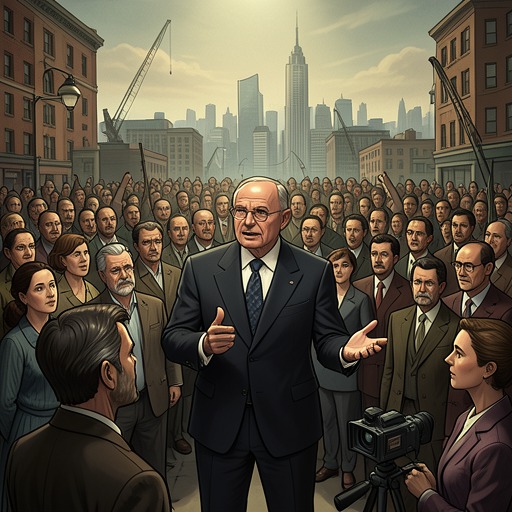
TrumanThe “common man” presidential image made Harry S. Truman’s national leadership legible through modesty, accessibility, and ties to ordinary life rather than through a claim of personal grandeur. The book’s scenes give the image both its appeal and its limits: Truman could be at ease in domestic routines and appear unassuming, yet he also commanded congressional attention, persisted when Congress resisted him, and exercised restraint in moments of political and military danger.
Meaning and setting
The book’s index explicitly identifies Truman as a “common man” president, while the cited titles “Everyman in the White House” and “Harry Truman, Small-Town American” preserve related framings in the literature listed at the back of the book. These labels point to a public image built around familiarity and an unpretentious manner. They do not, by themselves, establish that Truman was politically ordinary or that his authority depended on simplicity; the narrative instead sets the recognizable persona alongside demanding decisions and formal power.
That persona also sits within a world shaped by inherited local memory. The account of Independence emphasizes its Civil War traces and a continuing Southern atmosphere, while family stories about wartime loss and displacement passed down through generations. The book describes those stories as formative to family feeling. This is a context for Truman’s local and familial associations, not proof of a single cause for his public image: the narrative links his identity to a particular community without reducing him to it.
Familiarity in public and private
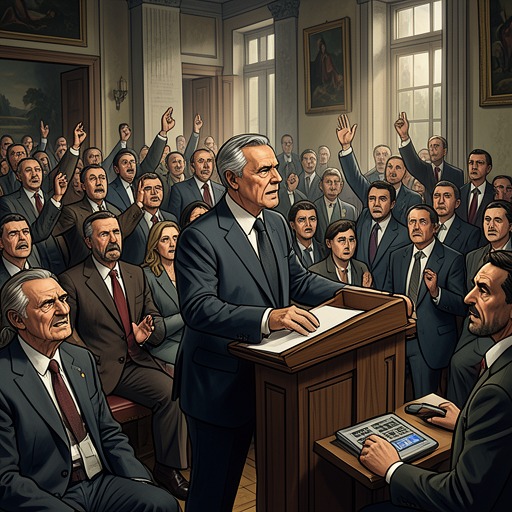
Truman’s appearance before Congress on April 16, 1945, shows how quickly an unceremonious manner could coexist with national authority. He began his address before the introduction was complete, prompting Speaker Samuel Rayburn to interrupt and present him; the brief mix-up became an amusing and poignant moment recalled for years. The speech itself lasted fifteen minutes and drew applause seventeen times. Its reception suggests that familiarity did not prevent Truman from commanding attention in a formal setting.
The narrative also gives the presidency a domestic scale. In the evenings, Truman and Bess Wallace Truman relaxed with cocktails in the sitting hall, and the White House staff had to learn their preferences. After the butler’s first versions of Bess’s old-fashioneds were too sweet and then unsatisfactory, he tried a double bourbon on ice. The anecdote makes the presidential household recognizable through ordinary matters of taste and routine; it does not present domestic informality as evidence that the office itself was simple.
Truman’s mother supplied a compact public expression of confidence in him after Franklin D. Roosevelt’s death. She said she could not be glad he was president while grieving Roosevelt, but believed Harry would get along all right. Truman admired her response and judged it especially apt. The moment holds together personal loyalty, grief, and reassurance: the new president was not celebrated without reservation, yet his capacity to manage the office was affirmed by someone who knew him closely.
The ordinary image and the exercise of power
The book repeatedly places Truman’s unassuming reputation beside visible political competence. As chairman of the Senate committee investigating wartime administration, he gained stature by scrutinizing powerful interests and insisting on fair treatment for witnesses. Senator Claude Pepper remembered him as a Missourian willing to demand proof from the military-industrial complex. Truman’s growing recognition did not make him seek the limelight; the narrative stresses that he neither pretended to superiority nor wanted the presidency.
His legislative conduct likewise complicates any picture of mere affability. When Congress rejected his proposals, Truman asked again rather than changing tactics. He sought national compulsory health insurance funded through payroll deductions and called for universal military training for young men aged eighteen to twenty, arguing that preparedness was necessary to preserve peace. His persistence joined a familiar, plain-spoken public manner to a willingness to press an ambitious program despite poor prospects of passage.
In foreign-policy discussions, his authority operated through meetings and persuasion as well as formal office. When congressional leaders met with him amid the crisis over aid to Greece, he listened to George C. Marshall’s warning that inaction could allow Soviet domination to spread, and then emphatically agreed with the need to act. In a later meeting over a grave policy question, Marshall’s blunt opposition brought the discussion to a halt. Truman showed no visible emotion, acknowledged the dangers and political risks, and proposed that the participants sleep on the matter. These scenes depict a president who could hear forceful disagreement without surrendering responsibility for the decision.
Restraint, limits, and significance
Truman’s handling of Douglas MacArthur’s defiance further distinguishes the image from a simple story of decisive personality. Despite anger and the constitutional challenge posed by MacArthur’s public statement, Truman did not immediately dismiss him. He dictated a restrained reprimand reminding the general of the existing order requiring public statements to be cleared with Washington. The account presents this caution as open to more than one interpretation: political calculation or a refusal to act impulsively under pressure. Either way, the episode shows executive authority being exercised with attention to public reaction, military prestige, and the consequences of escalation.
The image therefore works as a contrast, not a substitute for political analysis. Truman’s modest manner and recognizable private routines helped make the presidency seem accessible, but the narrative’s evidence also shows public acclaim, policy persistence, committee oversight, difficult consultation, and controlled executive action. His ordinariness is most significant as a way of presenting responsibility: the familiar figure remains answerable for decisions whose reach is anything but ordinary.