Two-Term Presidential Tradition
TrumanThe Two-Term Presidential Tradition was the custom that a president should leave office after two terms, whether or not the Constitution compelled him to do so. Harry S. Truman treated its restoration as a matter of republican principle: although he could legally seek reelection in 1952, he privately decided not to run, presenting voluntary restraint as a defense against the concentration of power and a standard of honor for future presidents.
An unwritten limit and a constitutional exception
The tradition had become politically consequential well before it was written into the Constitution. In 1947, the Republican-controlled Eightieth Congress passed the Twenty-second Amendment as a rebuke to the memory of Franklin D. Roosevelt, who had served four terms. The amendment limited presidents to two terms, but its wording did not apply to Truman. Once the states ratified it, in 1951, he would remain eligible to run again in 1952. Many people assumed he would.
That exception sharpened the difference between a legal restriction and a political custom. Truman could invoke the amendment’s terms and still stand for reelection; instead, he believed that the convention ought to continue even without a constitutional rule binding him. In his view, voluntary adherence mattered precisely because the choice remained his. The standard was not merely a limit imposed on a president but a test of what a president would choose not to do.
Truman’s private decision
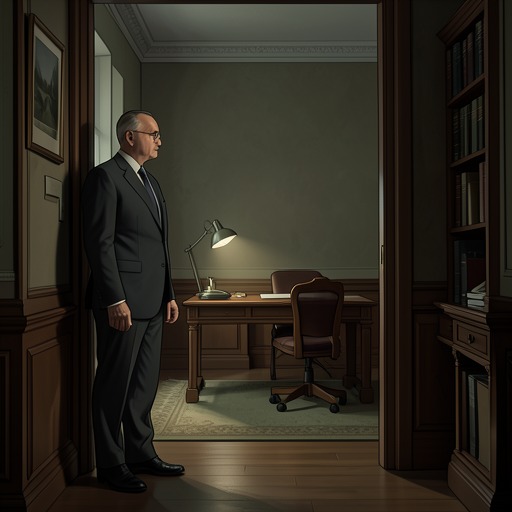
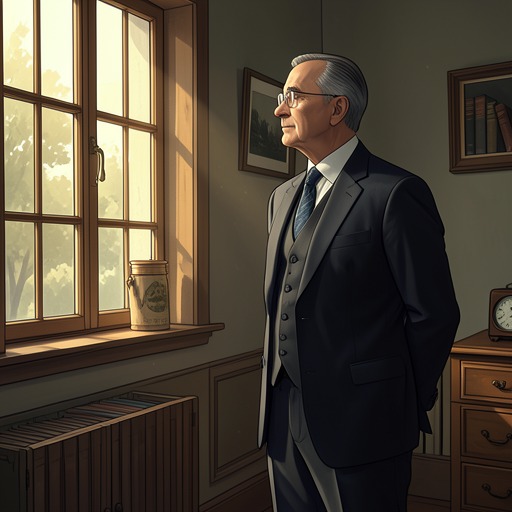
On April 9, 1950, amid the spring blossoms around the Tidal Basin, Truman drafted a statement in his own hand for release two years later. April 11 would mark the end of his fifth year in office, and he planned to announce his retirement from electoral politics in the spring of 1952, when he would be sixty-eight. He discussed the decision only with his wife; the two handwritten pages were put away, and he said nothing publicly about the matter.
The draft set his decision against the length of his public service. Truman listed his first election to office in November 1922, two years in the armed forces during World War I, ten years in the Senate, and his brief service as vice president before becoming president. He described himself as having spent well over thirty years in public life and nearly two full terms as president. The accounting made retirement appear not as a response to a passing disappointment, but as the conclusion of a long career in service.
He also made clear that the choice was deliberate rather than forced by an expectation of defeat. Truman wrote that he knew he could be elected again and continue the departure from precedent associated with Franklin D. Roosevelt. Whether that confidence was entirely sincere or partly meant to prevent his retirement from being read as a retreat is uncertain. The account nevertheless emphasizes that his decision was neither an impulsive reaction nor a whim: he had considered the attraction of power and had settled on leaving office well before he announced it.
Cincinnatus, honor, and the danger of power
Truman drew on the example of Cincinnatus, the Roman general who turned away from power, and on the example of George Washington. He regarded the two-term limit as a safeguard that should endure through custom, rather than depend solely on a constitutional amendment. If the country forgot the precedents set by Washington, Thomas Jefferson, and Andrew Jackson, he argued in the draft, it would risk moving toward dictatorship and ruin. The force of the principle lay in repeated self-restraint: a president who could continue in office had to choose not to do so.
His draft distinguished this customary standard from a fixed constitutional prohibition. Truman opposed the Twenty-second Amendment, yet argued that a president should refuse another term even if an interpretation of the amendment left him free to seek one. In his formulation, the tradition would be maintained by the honor of the person holding office. The rule’s authority thus depended on the conduct of presidents, and its survival on whether they treated the example of their predecessors as binding.
Historical judgment and significance
Truman acknowledged a history of departures from the custom, naming Ulysses S. Grant, Theodore Roosevelt, and Franklin D. Roosevelt as presidents who had attempted to break it; Franklin D. Roosevelt had succeeded. The draft’s tone was, the book observes, somewhat self-congratulatory, and its implied criticism of Roosevelt sat uneasily with Truman’s own changing position. He had opposed a third-term bid in 1940, but in 1944 he was Roosevelt’s running mate. That tension complicates the statement without erasing the conviction it records.
The decision therefore had significance beyond Truman’s immediate prospects. He understood the presidency as an office whose occupant could be drawn toward continued power, and the two-term custom as one way of keeping that attraction from becoming an enduring feature of republican government. His planned retirement would establish an example rather than obey a rule that applied to him. The evidence presents that commitment as sustained: Truman kept the decision private, prepared its explanation years in advance, and did not treat it as a passing response to the political weather.