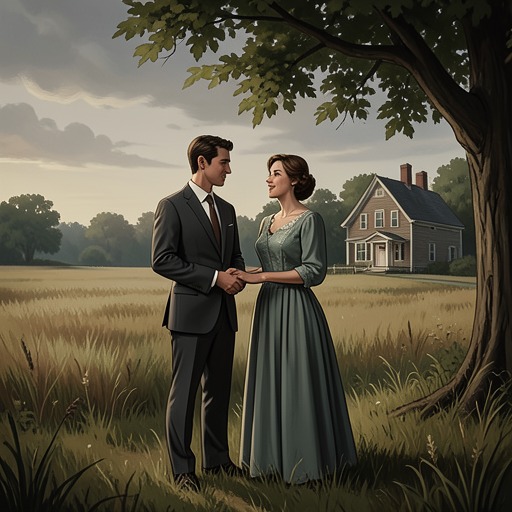
Harry S. Truman–Bess Truman marriage and partnership
TrumanHarry S. Truman–Bess Truman marriage and partnership joined a deeply private family life to an increasingly public political career. Its defining pattern was not simply Bess’s presence beside Truman, but the contrast between her guarded independence and the work, counsel, and emotional support she gave him as his responsibilities expanded—from soldier and local politician to President and national candidate.
A decision that changed their shared future
In 1917, when Truman chose to enter military service, he could have stayed on the farm: he was beyond the new Selective Service Act’s age limit, had been out of the National Guard for nearly six years, and his eyesight fell below service standards. He was also the sole supporter of his mother and sister. His decision shifted those responsibilities to Mary Jane Truman, whose life, the account stresses, was consequently narrowed to family care and Grandview. Truman later acknowledged that his choice had dealt his mother and sister a serious blow.
Bess responded to his decision by proposing that they marry at once. Truman refused because he did not want her bound to a man who might return disabled or not return at all. They would wait until he came home whole. The choice made his concern for Bess explicit, but it also placed their future on hold while he went to war.
Nine years after the night he returned the pie plate, Truman was thirty-five and Bess was thirty-four. Their honeymoon took them through Chicago, Detroit, and Port Huron. The days beside Lake Huron remained for Truman an enduring image of happiness. The trip ended sooner than planned because Bess worried about her mother’s health. At Madge Wallace’s wish, the newlyweds moved into 219 North Delaware Street, where Bess had her old room and the wider Wallace family lived close together. Truman arrived with clothes, books, and a trunk of Army belongings. Bess regarded the arrangement as temporary, intended to give her mother time to adjust to the marriage.
Private life and family strain
The household remained quiet and closely bound, but its domestic calm did not erase disappointment. Bess had suffered miscarriages in 1920 and again in 1923, a private fact withheld from most people. During the second, she took no part in Truman’s political campaign. Friends knew that the couple wanted children; Truman sometimes deflected speculation about the difficulty with a joke. Their correspondence during a summer separation in 1923 gives another view of the marriage: Bess’s affectionate letter from bed, after she had dealt with a bug herself, ended with many good-night kisses for her “Old Sweetness.” The episode conveys intimacy through ordinary domestic detail rather than public display.
That reserve remained characteristic as Truman’s career advanced. During the war years, Bess enjoyed Washington’s faster pace and worked one day a week at the USO. Truman placed her on his Senate office payroll at a salary of $2,400, although he had criticized another politician for a similar practice. Staff members differed over how much office work she performed; Truman privately suggested that she come in to sign letters. The arrangement gave the family additional income, while also exposing a tension between her public employment and his stated criticism of the practice.
At home in the White House, the couple’s evening routine offered a small, domestic counterpoint to presidential business: before dinner, they relaxed together over cocktails in the sitting hall. Staff had to learn their preferences. After the first old-fashioneds proved too sweet and a revised recipe displeased Bess, the butler eventually served her a double bourbon on ice. The anecdote shows her willing to state what she wanted, even in the formal household around the President.
Counsel, privacy, and periods of distance
Bess guarded her privacy closely, but that did not mean she was marginal to Truman’s life. J. B. West recalled that she advised him on decisions and that he listened. Margaret Truman likewise described her father as acutely attentive to her mother’s views, often discussing matters with her and seeking her approval. At public gatherings, Margaret observed, Truman would try to catch Bess’s eye to see whether she approved of what he was saying or doing.
That account of influence coexists with a more painful account of exclusion. Margaret wrote that Bess felt increasingly superfluous during Truman’s first months as President, particularly because he had not discussed his decision about the atomic bomb with her. The sense of being shut out, combined with Bess’s original opposition to his becoming President, contributed to what Margaret described as an emotional separation and may help explain Bess’s long absences from Washington. The marriage therefore contained both sustained consultation and consequential silences: Bess could be a trusted adviser without being included in every decision that mattered most.
The campaign partnership
On the 1948 campaign journey, Bess joined the traveling party at Des Moines after Truman left Union Station in Washington. At the close of his speeches, he made a family introduction part of the routine. He introduced Bess as “Miz Truman”; she stepped from behind the blue curtain, took his hand, and stood beside him without speaking. At especially small and friendly stops, he called her “the Boss.” He then presented “Miss Margaret,” whose appearance brought a particularly strong response from the crowd and who tossed roses to spectators. Truman leaned over the brass rail to take outstretched hands before the family waved as the train pulled away.
The recurring scene made the Trumans’ private attachment legible to voters without turning Bess into a campaign speaker. Richard Rovere described the closing image as the “Three Traveling Trumans,” a tableau that audiences would remember beyond the election. The family’s presence reinforced an image of Truman as loyal, approachable, and connected to ordinary Americans through the people closest to him.
Bess did break her usual public silence once the warmth of a reception moved her to step to the microphone and thank the crowd. The moment was notable precisely because it departed from the established routine. Her campaign role was thus both carefully bounded and personally felt: she stood at Truman’s side, helped give his public appearances a family center, and occasionally spoke for herself when the occasion prompted her to do so.