Harry Truman–Bess Wallace relationship
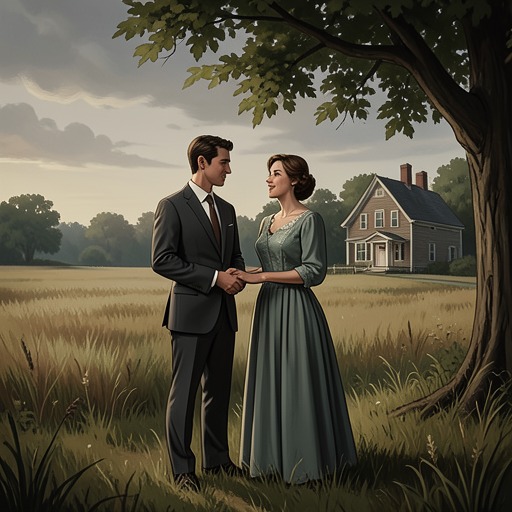
TrumanThe Harry Truman–Bess Wallace relationship began in childhood, when Harry S. Truman became fascinated by a girl he was too shy to speak to, and by 1911 had become an earnest courtship conducted largely through long letters and determined visits. Its early history is marked by an imbalance: Truman’s attachment had endured for years, while Bess Wallace was popular and accustomed to attention from other young men. His proposal and her refusal exposed how much of his hope for a future, and for becoming someone of consequence, had become bound up with her response.
Childhood Fascination and Distance
When the Truman family moved to Independence, Missouri, Harry met Bess at Sunday school in the First Presbyterian Church. He was immediately captivated, but it took him five years to say a word to her. His shyness with girls contrasted with his ease among the women in his family and household; he could joke and tell stories with them, while Bess remained the girl who left him nearly speechless.
They later attended the Columbian School together. Because pupils were seated alphabetically, Bess’s desk was directly behind his year after year, a constant proximity that did not overcome his reserve. She lived nearby on North Delaware Street, but her world seemed more polished and socially assured than his. Truman remembered carrying her schoolbooks as a major advance in his efforts to approach her. He admired her athletic ability as well as her appearance: she played baseball, excelled at tennis, outran her brothers, and skated and danced with a confidence he felt he lacked. Watching her play tennis at Woodland College for Women or skate on its pond let him observe from a distance the ease and competence that made her his ideal.
His closeness to his cousins Ethel Noland and Nellie Noland gave him confidantes, but not a substitute for Bess. The sisters knew that his feelings had persisted. Their companionship, formed through reading and shared time at the Noland house and on the family farm, offered a contrast to the restraint of his courtship: among them, he could be relaxed and companionable; with Bess, even carrying books home counted as progress.
The Courtship Reaches the Farm
By 1910, Truman was working on the family farm at Grandview, Missouri, sixteen miles from Independence. A routine errand gave him an excuse to see Bess again. When a cake plate needed to be returned to her mother, he volunteered at once, crossed to the Gates family house on North Delaware Street, and found Bess at the door. He stayed for two hours. The visit mattered enough that he later recalled it to Ethel and Nellie; to him, an ordinary delivery had opened a rare chance to speak with the girl he had admired since Sunday school.
Getting from the farm to Independence required effort. A horse-and-buggy trip took hours, while the train involved a walk to Grandview, a change in Kansas City, and unreliable connections. Truman nevertheless made the journey whenever he could, sometimes sleeping on a couch at the Nolands’. In Independence, Grandview was regarded as the sticks, a distance that sharpened the social and practical divide between his rural life and Bess’s town setting. She invited him to Sunday dinner with her family, and he played piano afterward. She also accepted invitations to concerts and the theater in Kansas City and met his former piano teacher, Grace White. But she did not visit the farm to meet his family during this period.
Truman tried to make Grandview attractive to her. He proposed building a grass tennis court near the house, bought a heavy roller in Kansas City, and asked Bess for instructions because nobody on the farm knew how a proper court should be made. He hoped she would bring friends for a Labor Day visit; his mother planned a chicken dinner, and the family prepared the house, including having rooms papered. Truman worked on the court until it was ready and laid in watermelons. Bess did not come, sending word that it was raining in Independence, although the weather at Grandview was fine. When she later made an unplanned visit, the court proved too uneven for proper play. The episode captured the courtship’s recurring pattern: elaborate effort on his part, followed by an invitation whose success he could not control.
Letters, Proposal, and Refusal
Letters became the relationship’s principal channel. Truman found that he could write what he could not say in Bess’s presence; telephone calls were no alternative, since he disliked the telephone and a party line meant neighbors could listen. He wanted her to write back, and told her that her replies were the main reason he wrote so often and at such length. Hundreds of letters accumulated over time, but Bess’s letters from this period did not survive. Her side of the correspondence can therefore only be inferred from Truman’s responses, and the surviving account cannot establish its tone directly.
The letters carried more than courtship. Truman and Bess discussed writers: he admired Mark Twain, while she urged him to read Dickens. During the summer of 1911, after breaking his leg, he told her that reading David Copperfield had awakened an appreciation of Dickens. The exchange gave him a way to share his thoughts and the details of his life from the farm, while the leg injury also left him more time to read and write.
In June 1911, Truman proposed by mail. He described himself self-deprecatingly as a farmer who doubted he would amount to much, then confessed that he had loved her since their Sunday-school days. His letter made clear that the feelings were not a passing flirtation: he had compared other girls with Bess and found them wanting. After three weeks without a reply, he wrote to ask whether he had offended her. She turned him down, apparently by telephone. In his letter of July 12, he said that he was almost happy because she had refused him seriously rather than mocked him. He feared losing even the possibility of her friendship, and promised not to trouble her again with such declarations. His response joined hurt to gratitude: being rejected was painful, but being treated with seriousness spared him the humiliation he most feared.
Money, Ambition, and the Relationship’s Limits
Truman repeatedly brought up money, debt, and the wish to improve his circumstances. He wanted an automobile for the trips between Grandview and Independence, coveted an overcoat he had seen in Kansas City, and imagined that if he became rich he would live in Independence. In a confidential letter before Christmas 1911, he told Bess that his father carried a heavy burden of debts. He later described two reasons for wanting wealth: to repay those debts and build his mother a fine house, and to win Bess.
Her response to the question of a man’s prospects intensified the pressure he already felt. Bess and Mary Paxton had concluded that a woman should seriously consider only a man able to support her in style. Truman chose to read this as encouragement, whether or not she intended it that way. The moment shows how he converted uncertainty into hope, but also how directly his romantic ambition was tied to a desire to prove himself financially. He did not yet know what he wanted to do with his life, and worried about whether he could become the hero of his own story. Bess’s attention seemed to offer both a personal prize and a measure of whether he could rise beyond the limits he associated with farm life. The evidence from this period ends with the proposal rejected and the courtship still unsettled; it records the intensity of his pursuit, not a resolution of their relationship.