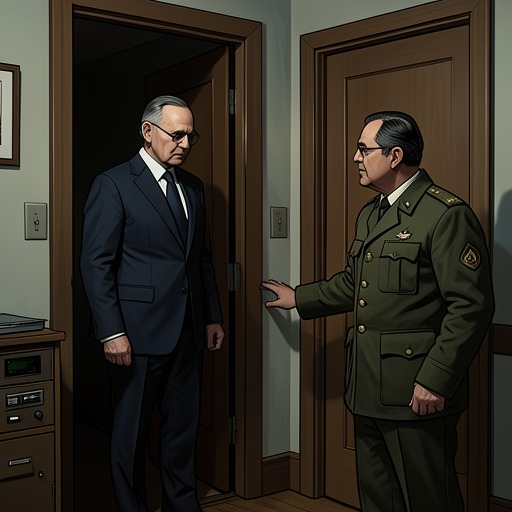
Harry S. Truman–Harry Vaughan friendship
TrumanHarry S. Truman–Harry Vaughan friendship became a test of how Truman’s personal loyalties could shape his conduct as president. Vaughan’s closeness to Truman gave him access and standing, but also made his questionable favors a public liability. When scandal exposed his poor judgment, Truman did not distance himself from his aide: he defended him, took pleasure in his defiance of reporters, and rejected his offer to resign. The friendship’s defining feature was not simply affection, but a loyalty that Truman struggled to separate from the public responsibilities of his office.
Political Origins and Mutual Standing
The relationship belongs to a political world in which personal contact and reciprocal support mattered. In Jackson County, the Pendergast organization supplied practical help to residents and expected gratitude at the polls; its precinct network was active throughout the year. Harry Vaughan later described Truman’s early value to the organization in similarly practical terms: Tom Pendergast wanted a respectable public face, and Truman’s reputation for honesty made him useful as political window dressing. That recollection does not explain the origins of Vaughan and Truman’s friendship, but it shows Vaughan as an informed observer of Truman’s political position, able to interpret the difference between the candidate’s public respectability and the organization’s purposes.
By the time both men entered the White House, their connection had become a close personal and working alliance. During the later controversy, Truman’s own account of their shared tenure was decisive: they had come into the White House together, he said, and would leave together. The formulation made Vaughan’s position more than a matter of administrative appointment. Truman presented their service as a joint undertaking, and Vaughan’s continued presence as a matter of loyalty between companions.
Access, Favors, and the Hoey Investigation
Vaughan’s position as Truman’s military aide gave him a general’s rank, access to the White House telephone, and a place in the President’s personal circle. Witnesses before the Senate subcommittee chaired by Clyde R. Hoey described how he used that standing to smooth the way for people seeking government favors. The beneficiaries included James V. Hunt, a former Army officer Vaughan counted among his closest friends, and John Maragon, another old friend who had been so frequently seen around the West Wing in the first weeks of Truman’s presidency that some took him for a member of the staff.
The favors were concrete, and their circumstances made them especially vulnerable to criticism. Vaughan helped Hunt obtain scarce lumber for a California racetrack while restrictions were limiting construction materials needed for housing. He secured a permit for Maragon to buy scarce molasses. For a Chicago perfume manufacturer who was a Hunt client, he arranged priority passage to Europe by military transport just after Germany’s surrender, when transport facilities were largely reserved for military use; the manufacturer returned with perfume essence valued at $53,000. When evidence showed that Hunt had improper influence with senior Army officials, Truman ordered the retirement of one and the suspension of another. That immediate response to the officers did not extend to Vaughan himself.
The investigation also revealed that the perfume manufacturer, David A. Bennett, had given Vaughan a deep freezer worth about $400. At Vaughan’s suggestion, Bennett sent five additional freezers: one to the First Lady, which broke down and had to be discarded; others to Treasury Secretary Fred Vinson, J. K. Vardaman, Matt Connelly, and John Snyder, who returned his. Vaughan told the committee he had merely connected people with officials who could hear their requests. The account notes that his activities were not illegal and that public officials commonly received gifts from friends and constituents. Truman himself accepted many kinds of gifts, including a Ford automobile during his first year in office. Yet the freezers had been kept confidential, and Vaughan’s use of his privileged position looked inappropriate even without proof of corruption. The distinction between illegality and poor judgment did not prevent the episode from becoming damaging.
Truman’s Public Defense and Private Loyalty
Truman had already shown how personally he took attacks on people around him. When columnist Drew Pearson criticized Vaughan for accepting a decoration from Argentine dictator Juan Perón, Truman publicly insulted Pearson. The decoration was not unique to Vaughan; Generals Eisenhower and Bradley had received the same honor earlier. But Truman objected to the press deciding when a member of his staff should be dismissed. He insisted that he, not a columnist, would determine when his aides had to go, and he took satisfaction in making that point openly.
The Hoey hearings sharpened the problem. Vaughan’s conduct, though not shown to be criminal, was increasingly understood as an embarrassment to the administration. Eben Ayers and Charlie Ross agreed that Vaughan was responsible for the trouble he had brought upon himself and others, yet believed he did not grasp the harm he had caused. The proceedings also gave Vaughan opportunities to answer reporters in a style Truman enjoyed. At Union Station, Vaughan warned the press that they might someday need favors from the White House; when asked about his links to the influence brokers, he replied that it was nobody’s business. Truman was so pleased by the response that he pinned a mock decoration on Vaughan for Operation Union Station. The gesture turned a damaging confrontation into a private joke between the President and his aide, while revealing how readily Truman read scrutiny of Vaughan as an attack to be resisted.
The Cost of an Unbroken Alliance
When Vaughan offered to resign, Truman told him not to raise the subject again in his presence. Their shared entrance into the White House, Truman maintained, meant they would leave it together. This was the clearest expression of the friendship’s strength, but also of its political cost: Truman would not treat Vaughan’s resignation as a necessary way to protect the administration’s standing. Alben Barkley later judged Truman too kind and loyal to certain old friends who took advantage of him and whose actions did the administration no credit. The narrative likewise concludes that Truman’s refusal to sacrifice Vaughan was a mistake.
The relationship thus joins personal trust to presidential responsibility without resolving the tension between them. Truman’s attachment to Vaughan did not erase the substance of the criticism: the aide had used the influence of his office for acquaintances and accepted gifts whose secrecy made them look worse. Nor did the absence of evidence of corruption make the conduct seem proper. Truman’s loyalty, which he understood as standing by a friend, instead left Vaughan in place as the controversy damaged the President and his administration. Their friendship endured as an alliance, but its public consequences exposed the danger of treating loyalty to an old companion as sufficient defense of official conduct.