Haunted Forest
UndineThe Haunted Forest is the dark, sparsely traversed wood behind The Fisherman’s Peninsula, feared for its solitude and supernatural inhabitants. It is both a physical barrier around The Fisherman’s Cottage and a threshold into a world where appearances shift, paths mislead, and elemental powers can determine who travels safely. Sir Huldbrand of Ringstetten enters it as a lost human rider; Undine’s passage through it after her marriage reveals that the forest is also part of her kin’s domain.
Setting and Reputation
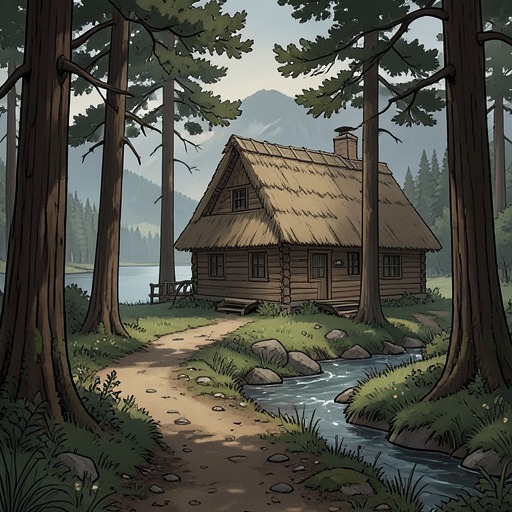
The forest begins behind a green tongue of land that reaches into The Lake. The peninsula’s open pasture, flowers, and trees make a striking contrast with the wood’s gloom and pathless solitude. Few people visit the pleasant lakeside home of the fisherman and his family, while the forest itself is avoided except when necessity demands crossing it. Stories of wonderful creatures and illusions give that isolation a supernatural charge: the danger lies not only in losing one’s way but in encountering things that resist ordinary explanation.
For the fisherman, however, the forest is a familiar route rather than an impassable boundary. He carries choice fish from his home to a large town beyond its limits and has made the journey many times without disturbance. The narrative attributes his safety to the religious character of his thoughts and his habit of singing holy songs, in a clear voice and sincere heart, as he enters the shadowed wood. His confidence is particular to him; it does not make the forest safe for others. Instead, it sets up a contrast between pious passage and the knight’s vulnerable, increasingly bewildered ride.
Sir Huldbrand’s Passage
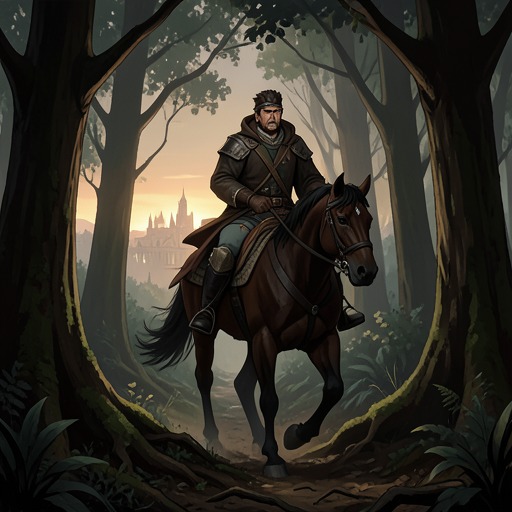
Sir Huldbrand recounts his forest adventure to the fisherman’s household after arriving at the cottage. His story concerns a ride begun the previous morning, following his stay in the Unnamed Imperial Free City, where he had competed in a tournament and met Bertalda, the duke’s foster-daughter. At first, the forest seems almost inviting: morning light reddens the tree trunks, the turf is green, and the leaves seem to whisper cheerfully. Only after he has ridden deep enough to lose sight of the plain does he recognize that he may lose his way.
The forest turns his confidence into alarm through a succession of apparitions and threats. A black shape in the branches of a lofty oak first seems to him a bear; it speaks in a harsh human voice, mocks him as potential food, and makes the branches rustle until his horse bolts. In another episode, he sees through the soil as if it were green glass and glimpses Goblins playing with silver and gold underground. His strange companion asks them for heaps of gold, then throws the treasure back into the abyss. When the Goblins laugh at the piece of gold Huldbrand has given the figure and swarm toward him, rider and horse flee again in terror. These encounters make the forest’s threat both bodily and disorienting: the knight cannot establish what he sees or trust the apparent solidity of the ground beneath him.
Later, as evening cools the wood, Huldbrand spots a pale path that he thinks will lead toward the city. A white, indistinct face keeps appearing between the leaves wherever he turns. When he rides at it, it gushes foam over him and his horse, half-blinding them and driving them away from the path. The pursuing presence nevertheless leaves one direction open. Huldbrand follows it until the face resolves into a gigantic white figure, which he repeatedly mistakes for a moving stream. Nodding as if to approve their course, it impels the exhausted knight and horse to the forest’s edge, where the figure disappears and the cottage, turf, and lake come into view.
The Forest as Barrier and Threshold
At the cottage, Undine explains why Huldbrand cannot simply retrace his route. The forest stream has overflowed, and its water carries stones and tree trunks at such speed that crossing it would be fatal. The fisherman will not venture far enough into The Lake to provide another way out. The flooded water therefore turns the surrounding terrain into a temporary enclosure: the knight has been delivered to the peninsula, but cannot choose when to leave it. The forest’s danger is not confined to uncanny beings; its changing waterways also govern movement and make the landscape itself an obstacle.
That enclosure changes after Huldbrand and Undine marry. When they set out with Father Heilmann, the stream channel is dry, and the travellers walk through it into the forest. Undine weeps as she leaves the foster-parents who raised her, while the old couple grieve loudly; the departure gives the route out of the forest the emotional weight of a severed home. The young couple travel under the trees with the priest, but a fourth figure joins them unobserved, showing that the forest remains inhabited and that the apparent safety of the road is provisional.
Kuhleborn and the Hidden Inhabitants
The stranger identifies himself as Kuhleborn, Undine’s uncle, and recalls having carried her through the region. He says he has come as a guide because spirits of the earth haunting the forest might otherwise play tricks on her. He also tells Father Heilmann that he was the water-spout that carried the priest out of a boat and washed him safely ashore for the wedding. In this exchange, the forest’s supernatural geography connects to the water that has already controlled the travellers’ movements: the guide’s power reaches beyond the trees to the river journey and the priest’s rescue.
Undine asks Kuhleborn to leave. She says the forest’s end is visible, his help is no longer needed, and he is the only thing that alarms them. When he turns frightening and grins at her, she calls to her husband; Huldbrand draws his sword and strikes at him, only for the blade to pass through a waterfall rushing down from a crag. The splash soaks the travellers. The scene turns the forest guide into a shape-shifting presence that cannot be opposed by ordinary force, and it complicates the distinction between landscape and supernatural being: what appears to be a hostile relative becomes falling water at the instant of attack.
Narrative Significance
The Haunted Forest repeatedly tests the reliability of sight and the limits of human control. Huldbrand’s encounters move from an apparent animal and a seemingly transparent earth to a foaming face and a white giant whose identity remains uncertain even to him. The later disclosure of Kuhleborn’s relationship to Undine gives these dangers a personal dimension: the beings encountered in the wood are not simply obstacles to the knight, but belong to the hidden network surrounding his wife. For the old fisherman, devotion makes passage possible; for Huldbrand, escape depends on being driven by an unrecognized power; and for the newly married Undine, the forest is a route homeward through a world in which even a guide may become a threat. Its boundary is never merely a line between wilderness and safety: water, kinship, and supernatural authority cross it in both directions.