Ringstetten Castle
UndineRingstetten Castle is the stronghold to which Sir Huldbrand of Ringstetten brings Undine after their marriage, and later the home where Bertalda becomes his second bride. Its ramparts and galleries frame the water spirits’ haunting, while a sealed courtyard fountain temporarily bars their access. When that protection is undone, the castle’s familiar rooms become the setting for Sir Huldbrand’s death in Undine’s presence.
Setting and Arrival
After the waters that had isolated the Fisherman’s Cottage are led back into their ordinary channel, Undine tells Sir Huldbrand that he can travel home dry-shod. The next morning, he leaves with his wife; Father Heilmann offers to accompany them, and the couple crosses the dry bed of the forest stream into the woods. Their destination is Ringstetten Castle, reached after a journey of several days. The passage from the secluded cottage to the castle marks a change in setting and in the couple’s circumstances: the isolation that had encouraged Sir Huldbrand to imagine himself already accepted by Undine gives way to a household with servants, vassals, and obligations.
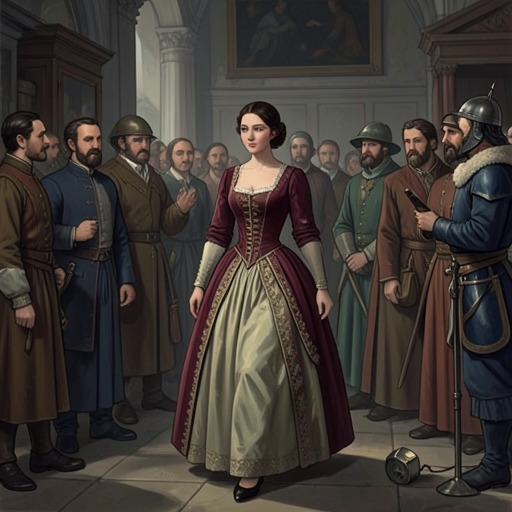
The castle is not presented only as a refuge. Soon after their arrival, Sir Huldbrand has business with his overseers and vassals, leaving Undine and Bertalda together. They go up to the ramparts and admire the extensive landscape of fertile Swabia. From this elevated boundary, the castle appears to command an ordered human world; yet the first disturbance comes close at hand, when a tall man approaches the two women and then withdraws after Undine angrily waves him away.
The Galleries and the Water Spirits
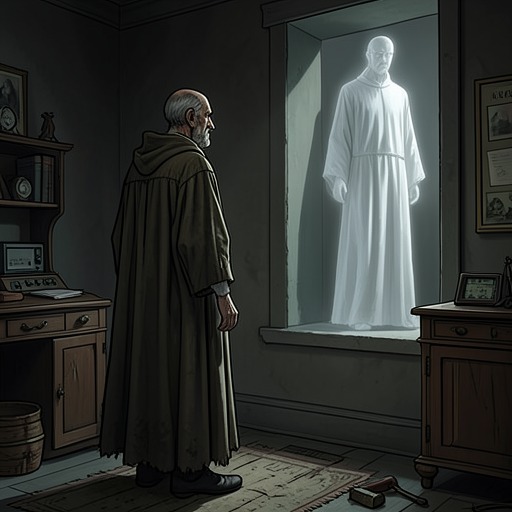
Bertalda recognizes in the stranger a likeness to the master of the fountain in the Unnamed Imperial Free City. The resemblance becomes more troubling when Undine’s forceful dismissal sends him retreating with a shaking head. Later, the tall white figure repeatedly appears in the castle’s vaulted galleries. Sir Huldbrand recognizes him as Undine’s uncle, Kuhleborn, while Bertalda associates him with the spectral fountain master. The castle’s interior, which should offer shelter from the outside world, becomes a route through which the supernatural intrudes.
The apparitions especially frighten Bertalda. Her terror makes her ill on several occasions, and she considers leaving the castle, but remains because Sir Huldbrand is dear to her and she has nowhere else to go. She also believes herself innocent: no words of love have passed between them. The repeated appearances thus unsettle both the household’s sense of safety and Bertalda’s confidence in her place there. The galleries make the danger recurrent rather than distant, bringing the unresolved conflict into the everyday spaces shared by the residents.
The Courtyard Fountain and Its Seal
Undine responds to the threat by summoning the household servants and ordering them to cover the magnificent fountain in the castle-yard with a large stone. The servants object that the closure will force them to fetch water from the valley, but Undine apologizes for the added labor and insists that the fountain must be shut to avert a greater danger. Her calm manner does not weaken her resolve: as mistress of the household, she claims the authority to arrange its affairs, answering to her husband rather than to Bertalda.
Bertalda objects for a personal reason: the fountain’s water benefits her complexion, and she does not consent to its closure. She also appeals to the beauty of the water and its supposed purpose as a mirror for human faces. Undine nonetheless has the stone set in place and characters inscribed upon it. She explains that the fountain is the only route by which Kuhleborn can reach the castle; separated from nearby water spirits by the valleys, his realm begins farther away on the Danube. The inscription cripples his power and prevents him from intruding upon Undine, Bertalda, or Sir Huldbrand. It does not, however, stop human beings from lifting the stone with ordinary effort. The barrier therefore depends on the household choosing to maintain it.
Sir Huldbrand understands the cost of Undine’s action: she has shut out a formidable protector, even though Bertalda has reproached her for doing so. He embraces Undine and agrees that the stone should remain. The episode briefly restores tenderness between husband and wife, as Undine receives the affection she has long lacked. She also warns him against anger toward her on or near water, explaining that such conduct would give her relatives a claim to take her away. The fountain’s closure protects the castle, but the conversation makes clear that its safety rests on fragile conditions beyond its walls as well as on the stone itself.
A Household Divided
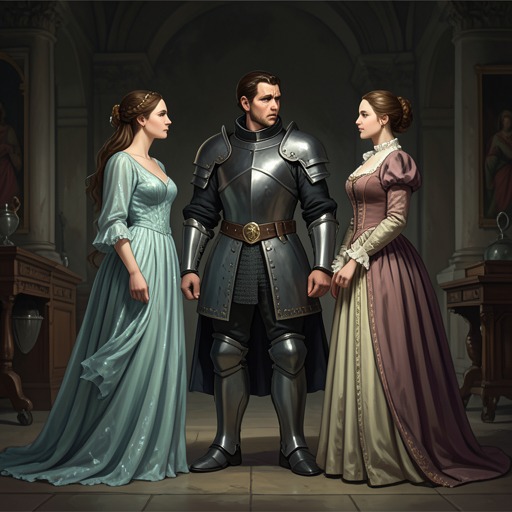
Over time, Sir Huldbrand’s affection turns from Undine toward Bertalda, whose own feelings for him grow stronger. The narrator passes over much of this period rather than detailing each change, but describes the resulting arrangement at the castle: Undine is sad, Bertalda increasingly assumes an imperious manner, and Sir Huldbrand encourages her behavior. Bertalda interprets Undine’s resistance to thwarted wishes as jealousy, while the injured wife yields in sorrowful submission. The domestic order Undine had defended as mistress of the house thus becomes a setting for her diminished authority and for the widening emotional distance between the couple.
A letter from the old fisherman further connects the castle household to the life Undine left behind. He writes that he has become a poor widower since his faithful wife’s death, and accepts that Bertalda is better off as Sir Huldbrand’s guest than alone with him. His condition is also protective: Bertalda must do nothing to harm Undine, or she will incur his curse. Bertalda discards that warning but keeps the portion concerning her absence from her father. The castle consequently gathers relationships formed elsewhere—Undine’s foster family, Bertalda’s uncertain place among them, and Sir Huldbrand’s divided loyalties—without reconciling them.
Weddings, Reopening, and the Castle’s Change
At the marriage feast of Sir Huldbrand and Bertalda, the company feels that the person most deeply missed is Undine. Guests repeatedly look toward opening doors, only to find servants bringing dishes or wine. The castle has been secured against the water spirits, so no apparition interrupts the gathering; nevertheless, the absence of Undine weighs on the celebration. Bertalda, the bride, is the most carefree guest, but even she recalls the fisherman’s warning that Undine might lie dead in the Danube or be carried toward the ocean. The feast ends early, subdued by grief and foreboding rather than by the bridegroom’s decision.
The protection does not last. On Sir Huldbrand’s wedding night, Bertalda’s attendants see a strange, tearful wanderer reach the castle and pass up its familiar stairs and through its halls. Sir Huldbrand stands before a mirror in his chamber after dismissing his attendants. He recognizes the gentle tap at his door as one Undine used when playfully teasing him, but initially dismisses the sound as fancy. Then the door opens, and Undine tells him that the spring has been opened and that he must die. The return of the water’s access turns the castle’s threshold from a defended boundary into an entry point. The familiar stairways, halls, and private chamber no longer protect Sir Huldbrand; they bring Undine back to him, and the castle’s history of refuge and attempted separation ends in his death.