Unnamed Imperial Free City
UndineThe Unnamed Imperial Free City is the social and ceremonial setting linking Sir Huldbrand of Ringstetten’s courtship of Bertalda to the revelation of her birth family. A tournament introduces Huldbrand to the young woman who will become his rival in love; later, the city’s fountain and an open-door feast turn private mysteries into public events. The city’s role is not merely to shelter these encounters: its spectators, servants, and conventions make personal feeling visible, and give Bertalda’s recognition scene an audience before whom its consequences unfold.
Setting and First Encounter
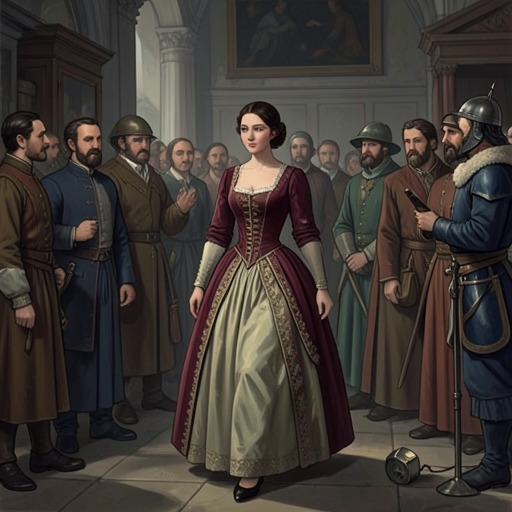
Huldbrand says that he rode into the Unnamed Imperial Free City about eight days before telling his story. The city lies on the other side of the forest, a position that places it in sharp contrast with the dangerous, shadowed country through which he has recently traveled. Soon after his arrival, he takes part in a splendid tournament and a contest at the ring. While resting beside the lists, he notices Bertalda, richly dressed in a gallery reserved for spectators. A neighbor identifies her as the foster-daughter of one of the powerful dukes who live in the country.
The city provides the setting for their first mutual attraction. Huldbrand sees Bertalda watching him and rides on with renewed confidence; that evening, he dances with her and remains her partner throughout the festival. The encounter is brief but consequential: it gives his later journey into the forest an emotional context, and helps explain Bertalda’s distress when he disappears. The city’s tournament and dance also establish Huldbrand as a figure admired for more than skill at arms. After his disappearance, his servants and other admirers remember his ability in the lists and at the dance, as well as his gentle and agreeable manners.
Disappearance and Return
When Huldbrand vanishes from the city, his servants stay behind rather than leave without their master. None dares to search for him in the forest’s shadowy recesses, so they wait in their quarters and mourn him. Violent storms and floods make his destruction seem likely. Bertalda openly grieves for him and blames herself for having drawn him toward the forest. Her foster-parents, a duke and duchess, come to take her away, but she asks them to remain until news of Huldbrand’s fate can be obtained.
Bertalda tries to persuade several young knights who court her to search for Huldbrand. She will not promise her hand as the reward, however, because she still hopes to belong to the missing knight; neither a glove, a ribbon, nor a kiss can induce anyone to risk his life to bring back such a dangerous rival. Her response makes the city’s courtship customs part of the episode’s stakes: affection and competition are publicly legible, but her loyalty to Huldbrand prevents her from turning a rescue into a bargain.
Huldbrand’s unexpected return with Undine reverses the city’s expectations. His servants and nearly everyone else rejoice, and many are pleased that he has brought back a beautiful bride. Father Heilmann, who witnessed the marriage, accompanies the couple. Bertalda alone cannot share the general welcome. She truly loves Huldbrand, and the grief she had displayed during his absence has made that love conspicuous; his return with a wife leaves her sorrow exposed as well as renewed.
Nevertheless, Bertalda conducts herself with restraint and lives on friendly terms with Undine. The citizens regard Undine as a princess whom Huldbrand has rescued from an enchantment, while the couple avoid inquiries into what happened in the forest. Father Heilmann returns to his monastery soon after their arrival and does not contribute to idle gossip. The city is thus full of conjecture, but the people closest to the mystery do not explain it. Even Bertalda knows no more than the rest.
The Square and Its Fountain
Undine’s growing affection for Bertalda gives the city’s public spaces a more intimate function. She often tells Bertalda that their closeness must have some deep, secret cause, since she has loved her from their first meeting. Bertalda, despite having reason to resent Undine as a successful rival, feels a tender confidence in her. Their mutual attachment leads them to postpone their departures: Bertalda and Undine each persuade her own family or spouse to wait, and a visit to Ringstetten Castle is proposed.
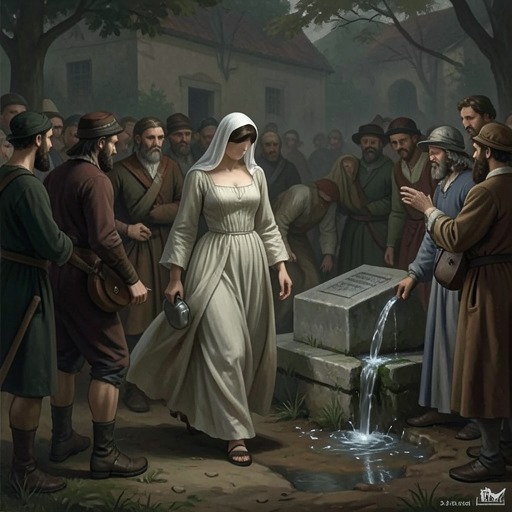
One evening, the three walk beneath the trees in the large square of the Imperial city. They admire the fountain at its center, whose rushing, bubbling water accompanies their conversation. In the evening’s calm, the previously difficult question of Bertalda’s visit seems easy to settle. The scene briefly brings the three women and men into an apparent harmony, with the fountain forming the setting for a plan to travel together.
That agreement is interrupted by a tall stranger who approaches and speaks privately to Undine. She steps aside with him and seems to converse in a foreign tongue. Huldbrand stares at the man, thinking he recognizes him, while Bertalda asks what is happening. Undine suddenly claps her hands, laughs, and leaves the stranger; he shakes his head, withdraws in displeasure, and vanishes into the fountain. Huldbrand becomes certain of his suspicion, and later asks whether the master of the fountain was Kuhleborn. The scene identifies no explanation to the city’s other inhabitants, but it connects the ordinary urban landmark to the supernatural forces that have followed the couple from the forest. Undine promises that Bertalda will learn the reason two days later, on the anniversary of her name-day, and invites her and her foster-parents to dine.
Public Recognition and Departure
The name-day dinner makes the city’s social hierarchy part of Bertalda’s discovery. She sits between Undine and Huldbrand, adorned with flowers and jewels given by her foster-parents and friends. When the meal ends, the doors are left open according to an old German custom, allowing common people to watch and share in the nobles’ celebration. Servants distribute cake and wine among the spectators. The gathering is therefore not a secluded family announcement: Bertalda’s identity will be disclosed in a hall where the public can witness both recognition and refusal.
Undine delays her explanation while Huldbrand and Bertalda wait, then sings a narrative song. Its effect leads Bertalda to ask where her parents are, convinced that Undine has discovered them. Undine turns toward the door and asks where the waiting parents are. The old fisherman and his wife come forward from among the spectators. Undine identifies Bertalda as their daughter, and the two embrace the child they had recovered. The revelation joins Bertalda’s unknown origins to the foster family and public standing she has known, while the old couple’s presence makes her former life tangible before the assembled company.
Bertalda tears herself from the old couple’s embrace. She had hoped for still higher honors, and interprets the recognition as a deliberate attempt by Undine to humiliate her before Huldbrand and the crowd. She denounces Undine and the fisherfolk as deceivers and impostors. The fisherman’s wife nevertheless feels that Bertalda is her child, while the fisherman silently prays that the proud and angry young woman is not. Undine, who had expected a joyful reunion, is devastated by Bertalda’s rejection. She asks whether Bertalda has a soul and, when the dispute grows louder, requests permission to speak in her husband’s hall. The occasion exposes a breach between the affection Undine feels and the identity Bertalda is willing to accept.
The city’s judgment does not immediately reach the couple. Others who hear the story are disgusted by Bertalda’s conduct, but Undine and Huldbrand do not yet know this; public approval or condemnation is painful to Undine either way. They decide to leave the old city behind. At dawn, as Huldbrand leads Undine toward a carriage and their horses wait at the gate, a fisher-girl crosses their path. Huldbrand says they do not need fish because they are setting out; only when she begins to weep do he and Undine recognize Bertalda. She explains that her foster-parents have withdrawn their protection after her conduct, though they have given her a rich portion. The fisherman, handsomely rewarded, has already left with his wife for their secluded home. Thus the city’s sequence of welcome, celebration, and public exposure ends in departure, with Bertalda newly separated from the foster household that had defined her life.