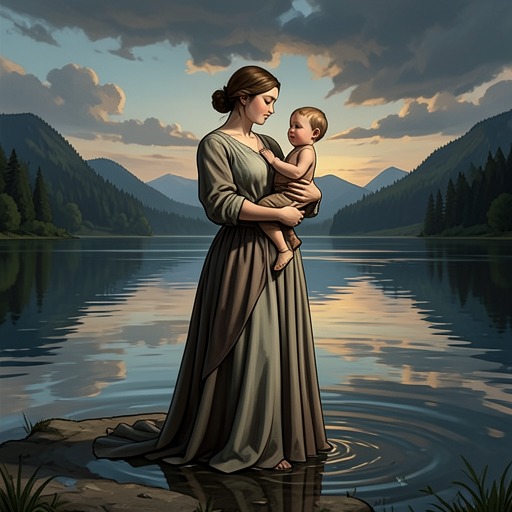
The Lake
UndineThe Lake frames the fisherman’s home as both a sheltered refuge and a place exposed to forces beyond human control. Its clear waters embrace the green tongue of land where the cottage stands, but its shore is also where a child disappears, floodwater cuts the family off from the world, and water spirits can claim a connection to Undine. The Lake is not merely scenery: its changing conditions repeatedly alter what the characters can do, where they can go, and what their relationships demand of them.
Setting and Landscape
The fisherman’s home occupies a small, unusually beautiful peninsula. Its greensward reaches into The Lake, which seems to encircle the pasture in return; grass, flowers, and trees complete a landscape whose loveliness arises from the meeting of land and water. The household is nearly alone there. Behind the cottage lies the Haunted Forest, a wild and pathless region reputed to harbor strange creatures and illusions, while the water opens another boundary around the family’s secluded home.
That setting is also practical. The fisherman catches choice fish at home and carries them to a large town near the forest’s edge. He often makes the journey through the forest, relying on his religious thoughts and songs for courage. The Lake is thus part of the family’s everyday livelihood, even as the forest and water together make the peninsula feel distant from ordinary human society.
Shoreline, Loss, and Adoption
The shore becomes the site of a devastating loss in the fisherman’s account of his family. His wife had been playing with their little child at the edge of The Lake when the child leaned toward something beautiful in the water, reached out, and suddenly slipped from her mother’s arms beneath the surface. The parents searched, but found no trace of the child. The water’s reflective beauty, which had belonged to the peaceful landscape, is suddenly inseparable from grief.
That same evening, after the couple had sat weeping in their cottage, a richly dressed little girl appeared at the threshold with water dripping from her golden hair and clothes. The fisherman and his wife took her in, warmed and cared for her, and later baptized her Undine, the name she said her parents had given her. She described falling from a boat on a great lake and recovering under the trees near the cottage. Her arrival does not undo the parents’ bereavement, but it brings a new child into the household through the very element associated with their loss.
The Lake’s shore also becomes a point of danger when the brook from the forest swells. During the storm that follows Undine’s disappearance from the cottage, the brook pours into The Lake, while wind lashes the water and bends the peninsula’s trees. The old fisherman and Sir Huldbrand of Ringstetten rush out in different directions to search for her. The scene turns the landscape that had sheltered the household into a violent, shifting environment in which the girl’s absence is all the more alarming.
Floodwaters and Isolation
Later, the swollen forest brook and The Lake transform the peninsula itself. Undine tells Sir Huldbrand that he cannot leave: the torrent is carrying stones and tree trunks too swiftly to cross, and the fisherman’s boat cannot venture far enough out onto The Lake. Sir Huldbrand tests what she says and finds it true. The former point of land has become an island, temporarily separated from the surrounding world by water.
The isolation is not simply a matter of distance. A priest arriving after a storm describes being forced by floods onto a circuitous route, then taking a small craft with two boatmen across an overflowing arm of the water. The tempest breaks as soon as the boat touches the waves; the oars are torn from the men’s hands, the craft spins, and the priest is carried helplessly over the water until a wave casts him beneath trees on the island. His account confirms that the flood has disrupted travel far beyond the cottage and made the water’s force a danger to strangers as well as the household.
Yet the floodwaters also produce an unexpected provision. When the fisherman and Sir Huldbrand have run out of wine, Undine goes out during threatening weather and discovers that the forest stream has driven a cask ashore in a sheltered creek. The men roll it back toward the cottage as rain breaks over them, and they reach the hearth dry with the cask. The same watery upheaval that isolates the household can also carry something useful to its shore, though the characters cannot control what it brings.
Water, Kinship, and Constraint
The Lake matters to the story not only as a physical setting but as the medium through which Undine’s divided circumstances become consequential. She warns Sir Huldbrand that he must not behave angrily toward her on or near water. If he does, her relatives will claim a right over her, either taking her below to dwell in their crystal palaces or sending her back to him under circumstances she fears even more. Water therefore marks a boundary between marital life on land and the authority of Undine’s kindred.
That warning gives ordinary actions near water a heightened significance. On a later journey by river, Bertalda trails a gold necklace across the surface; a huge hand rises from the water, takes it, and vanishes. Sir Huldbrand curses the unseen beings and nearly directs his anger toward Undine, but she pleads with him not to scold her there. She then brings up a brilliant coral necklace, apparently offering compensation. He rejects the gift, hurls it back into the river, and calls her a sorceress. Undine leaves him, disappearing into the water as its small waves seem to repeat her farewell. This scene takes place on the Danube, not at The Lake, but it develops the same perilous relation between water, Undine’s kin, and her marriage.
Narrative Significance
The Lake’s significance lies in its power to make boundaries unstable. It gives the fisherman food and defines a peaceful home, yet the child’s drowning reveals that its beauty offers no guarantee of safety. Flooding changes a peninsula into an island, interrupts journeys, and carries a priest to the cottage; the shore can yield a cask as unexpectedly as it can swallow a child. Water repeatedly changes the terms of human action rather than serving as a passive backdrop.
The movement between domestic refuge and elemental danger also shapes Undine’s story. Her arrival links the household to a lake beyond its familiar shore, while her later warnings make proximity to water a condition of her fragile marital security. In this way, the landscape’s physical divisions echo a conflict the characters cannot settle by remaining at home: the water around the peninsula is at once livelihood, barrier, threat, and a reminder that Undine belongs to a world extending beyond the fisherman’s cottage.