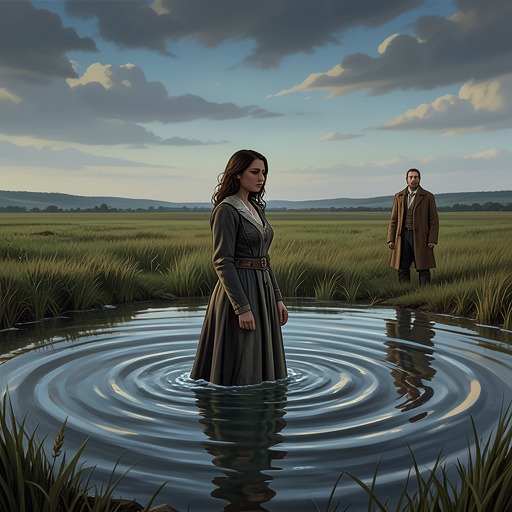
Mediterranean Sea
UndineThe Mediterranean Sea is both the domain of Undine’s powerful water-prince father and the underwater setting of a dream-vision through which she warns Sir Huldbrand of Ringstetten. Its significance lies in joining her supernatural origins to the soul she gained through human love: beneath its waters, she remains bound to the laws of her element, yet can weep, remember, and act to protect the man she loves.
Supernatural Domain and Undine’s Origins
Undine identifies her father as a powerful water-prince in the Mediterranean Sea. She is his only daughter, and his desire that she possess a soul sets the sea within the story’s central distinction between elemental beings and human life. Undine explains that beings like her and her counterparts in the other elements are similar to humans in form and culture, but lack souls. When they die, they vanish into dust, body and spirit, leaving no trace; unlike mortal humans, they do not awaken to a purer life afterward.
The sea is thus associated with a supernatural family and a different condition of existence, not merely with a distant landscape. Undine says that her father wished her to gain a soul even though doing so would expose her to suffering. An elemental being can acquire one only through the closest union of affection with a human. Her marriage to Huldbrand has changed what she is: she is now a soul-endowed woman, capable of grief as well as love. Her father’s underwater realm marks the origin she might return to if Huldbrand rejected her, but not the state of feeling she had before that transformation.
The Mediterranean Vision
The sea returns near the end of the story as the setting of Huldbrand’s dream. Between night and dawn, he lies half-awake, repeatedly startled from sleep by spectral terrors. When he tries to rouse himself, he senses the fanning of swan wings and hears water; eventually he dreams that swans bear him over land and sea. Their song identifies the Mediterranean Sea, and its waters become clear as crystal, allowing him to see down to the bottom.
Below the surface, Huldbrand sees Undine sitting beneath a crystal arch. She is weeping bitterly. His vision connects her present sorrow with memories of their earlier happiness at Ringstetten Castle, especially the beginning of their life there and the time shortly before their unhappy journey on the Danube. The sea’s transparent water makes visible a grief that Huldbrand can witness in the dream, although Undine does not appear to perceive him.
The scene makes the underwater realm a place of separation without severing emotional connection. Huldbrand is not shown physically traveling to the sea; he hovers over it in spirit while asleep. The swans carry him into a vision in which he can see Undine and hear her conversation, turning the sea into the setting for knowledge he could not otherwise obtain.
Undine’s Grief and the Elemental Law
Kuhleborn approaches Undine beneath the water and is about to rebuke her for weeping. She answers with a commanding dignity, insisting that she brought her soul down with her and therefore may grieve. Her tears express a human capacity that the elemental beings around her do not understand: for a person with a true soul, she declares, even tears are blessed. The sea therefore holds a contrast between Undine’s acquired emotional life and the elemental condition she has left behind, while she remains physically subject to its laws.
Kuhleborn reminds her that those laws require her to kill Huldbrand if he marries again and proves unfaithful to her. Undine replies that Huldbrand is still a widower and that his sad heart continues to hold her dear. Kuhleborn counters that Huldbrand is already betrothed and that, once the priest blesses the marriage, Undine will be obliged to take his life. His warning makes the underwater conversation a confrontation between her attachment to Huldbrand and the demands of her elemental kin.
Undine answers that she cannot carry out that duty because she has securely sealed the fountain against herself and her race. Her decision does not erase the threat of the law, but it establishes a barrier to its fulfillment. The Mediterranean scene thus connects the danger surrounding Huldbrand’s future marriage to the protective measure Undine has already taken.
The Sea as a Medium of Warning
Undine reveals that Huldbrand’s presence above the Mediterranean is intentional: she has arranged for him to hover there in spirit and dream of the conversation as a warning. The sea is consequently more than the place where she resides beneath the waves. It becomes a medium through which she can reach a husband who is far away and make him aware of the danger attached to remarriage, while also showing him that she continues to suffer and love him.
Kuhleborn reacts furiously when he realizes Huldbrand is witnessing the exchange. He threatens the knight, stamps his feet, and darts beneath the waves, seeming in his rage to swell to the size of a whale. The swans then carry Huldbrand away over mountains and streams until he reaches Ringstetten Castle and wakes in his own bed. The dream’s passage from the Mediterranean back to the castle completes its warning: the underwater world has entered Huldbrand’s consciousness, and Undine has used the distance between sea and home to make its laws, her grief, and her protection of him known.