The Fisherman’s Peninsula
UndineThe Fisherman’s Peninsula is a small, secluded tongue of green pasture extending into The Lake, where the fisherman’s family lives beside the Haunted Forest. Its beauty comes from the meeting of land and water, but its changing shores also shape the story: a storm cuts it off as an island, separates Huldbrand from Undine, and then gives them a sheltered place to find one another again. The peninsula is at once a home, a refuge, and a landscape whose apparent calm can be overturned by natural forces.
Setting and Character
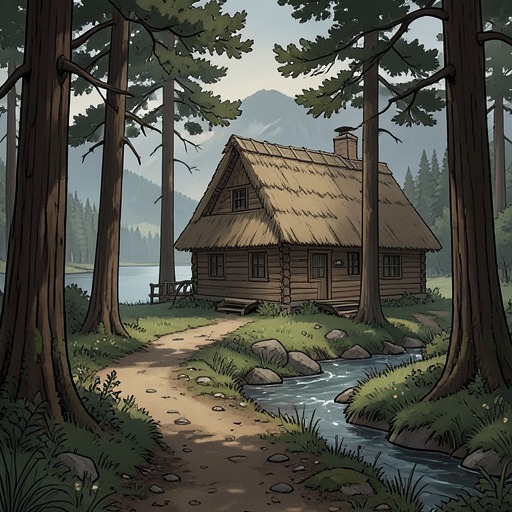
The peninsula is described as a greensward reaching far into blue, clear water. Grass and flowers grow among trees that offer refreshing shade, while the lake seems to embrace the pasture. The landscape’s appeal lies in this reciprocal arrangement: land and water appear to welcome one another, and their closeness makes each seem more beautiful. The Fisherman’s Cottage stands on the grassy point, with the water on one side and the forest behind it.
The family lives in unusual solitude. The narrator presents the fisherman and his household as the only people encountered in this pleasant place, rather than as part of a settled community. Beyond the peninsula lies the Haunted Forest, feared for its gloom, pathless solitude, and supposed supernatural creatures and illusions. The contrast gives the cottage’s setting two distinct aspects: its open, pastoral frontage looks toward the lake, while its back borders a wilderness most people avoid except when necessity drives them there.
The fisherman nevertheless crosses the forest to carry his best catch to a large town near its edge. His passage is made easier, the narration says, by his religious cast of thought and the holy songs he sings when he enters the forest’s reputedly evil shades. The peninsula is therefore not wholly cut off from the human world, but its connection to that world depends on the fisherman’s repeated journey through a landscape others fear.
The Storm and the Island
During the storm, the peninsula’s familiar geography changes. The waves howl, trees crack, and the stream near the Haunted Forest swells and takes a course directly across the approach to the point. In moonlight, Huldbrand sees that the flood has turned the peninsula into an island. The transformation unsettles his understanding of the place: amid the tempest, he begins to wonder whether the cottage and its inhabitants might themselves have been an illusion. Yet the fisherman’s anxious calls for Undine and his wife’s prayers and singing remain audible through the weather, anchoring the scene in the family’s real distress.
Fearing that Undine may have gone into the forest and been cut off on the far side of the flood, Huldbrand scrambles down over rocks and fallen pine trunks to reach the water. The dangerous crossing is driven by the possibility that she is alone among the forest’s phantoms. From the opposite bank, however, he sees her on a little island beneath interwoven branches, smiling and nestled in the grass. He crosses the rushing water and joins her on a patch of turf screened by old trees. The storm has divided the ground, but within that division the leafy shelter becomes a private refuge where they can speak beyond the hearing of the older couple.
The reunion is followed by a return across the narrow passage that the stream has forced between the little island and the shore. Huldbrand carries Undine back to the fisherman, who reaches toward her across the water; his falling white hair briefly recalls to Huldbrand the white figure he had seen in the forest. The recognition does not prevent the reunion. The fisherman embraces Undine, his wife welcomes her, and neither reproaches her. By dawn the storm has passed, birds sing on the wet branches, and the family sits beneath trees that screen the cottage from the lake while Huldbrand begins telling his story.
A Place of Residence and Daily Life
The widening stream prolongs Huldbrand’s stay on the peninsula. He takes pleasure in the fact that the water grows wilder and broadens its bed each day, making his departure indefinitely uncertain. That change in the landscape is also a change in the tempo of his life: instead of passing through, he settles into a home shaped by the water’s gradual advance.
His days include hunting with an old crossbow that he finds in a corner of the cottage and repairs. He brings waterfowl back for the kitchen, and Undine reproaches him for killing birds, sometimes weeping at the sight of his catch. Yet when he returns empty-handed, she scolds him for his carelessness and lack of skill because the household must then live on fish. Her complaints are paired with affectionate caresses, making the cottage’s ordinary routine a source of playful contradiction as well as a mark of their closeness.
The peninsula’s domestic character depends on these small repetitions: hunting, returning to the cottage, eating what the lake or surrounding land provides, and remaining together as the water alters the route away. The same landscape that made Huldbrand’s arrival uncertain becomes the setting for a stay he welcomes. Its growing isolation is not presented simply as confinement; for him, the peninsula offers the calm and sense of home that he has been seeking.
Recurrence and Narrative Significance
The peninsula is more than a picturesque background because its physical boundaries repeatedly determine who can reach whom. During the storm, the flooded stream separates Huldbrand from Undine and makes his attempt to find her dangerous. After he discovers her, the same water becomes a narrow crossing over which he carries her back to the fisherman. Water thus both obstructs reunion and makes the scene of reunion possible, while the old trees and grass provide a sheltered center within the altered landscape.
The little island also returns as a place associated with Undine’s private speech. On a later occasion, Huldbrand carries her across to the same island where he had first borne her back to the fisherman. There she asks him to sit opposite her and listen as she explains the beings of the elements, including the water spirits who inhabit lakes, streams, and brooks. The location’s earlier role as a secluded refuge therefore gains a further narrative function: it provides a setting apart from the cottage in which Undine can disclose what ordinary human surroundings do not reveal.
The fisherman later describes the change plainly: the place had been a point of land, but the forest stream and lake have become so altered that it is now an island. This observation makes the setting’s instability explicit. The peninsula can offer grass, flowers, shade, and domestic peace, yet its outline is never wholly secure against the waters around it. Its shifts in access and isolation shape the characters’ movements and encounters, giving the landscape a consequential place in the story rather than leaving it as scenery alone.