Ringstetten Castle Fountain
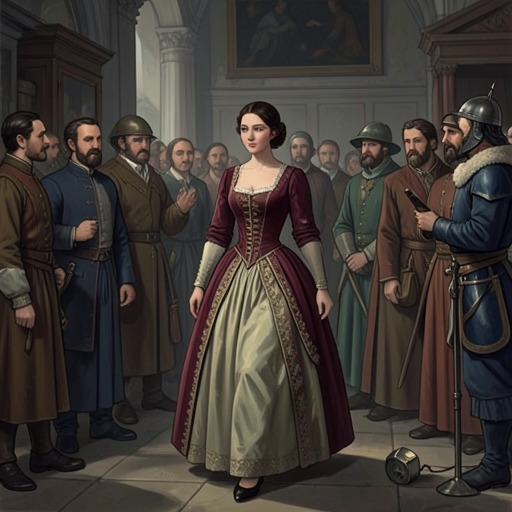
UndineRingstetten Castle Fountain is at once a practical feature of the castle courtyard and a supernatural threshold. Its water serves the household, and Bertalda prizes it for her complexion; for Undine, however, the fountain is the only entrance through which Kuhleborn can intrude. When she seals it to protect those around her, she turns an ordinary source of water into a barrier against danger. Its later reopening reverses that protection: a column of water rises from the opening, and Undine returns to the castle on the night of Huldbrand’s wedding to Bertalda.
Setting and Household Use
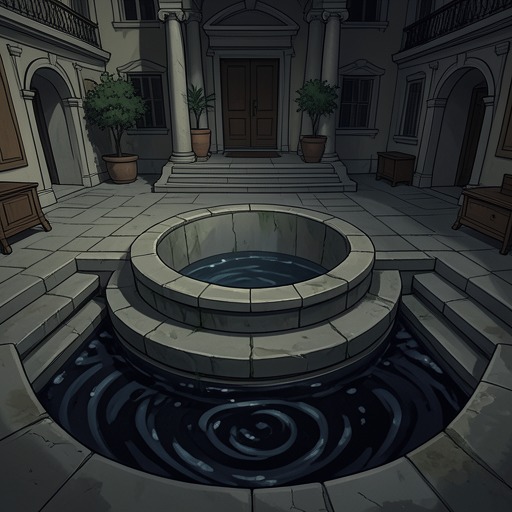
The fountain stands in the middle of Ringstetten Castle’s courtyard and is described as magnificent. Its importance is not merely decorative. When Undine orders it closed, the servants point out that they will have to carry water up from the valley below, a real increase in their daily labor. The objection makes the fountain’s ordinary value visible just as Undine asks the household to surrender it for a reason they do not yet understand.
Bertalda has a more personal use for its water. She believes that it is especially good for her complexion, and later longs for a flask of it when she notices freckles on her neck. The water thus becomes part of her beauty routine and a privilege associated with life at the castle. Her attachment to it gives the fountain’s supernatural importance a domestic counterpoint: what Undine sees as a dangerous passage, Bertalda sees as a useful and precious amenity.
The Fountain as a Supernatural Entrance
When Huldbrand is away, Undine summons the household servants and orders them to cover the fountain with a large stone. She apologizes for the work this will cause and says that the closure is necessary to prevent a greater evil, but she does not initially explain the danger. Bertalda arrives as the servants are raising the stone and demands that they stop, insisting on her right to the water. Undine remains gentle but asserts her authority as mistress of the household and wife of its lord.
The fountain itself seems to resist being closed. Its water hisses and churns as if something inside is struggling to escape. Undine nevertheless insists that the stone be put in place. Afterward, she bends over it and writes strange characters on its surface, apparently with a sharp instrument; the servants notice the marks when they approach the stone. The scene changes the fountain from a contested household resource into an object bearing a deliberate magical safeguard.
Undine later explains that the fountain is the only door through which Kuhleborn can enter the castle. He has frightened Bertalda into illness and intruded on the household; Undine says that words cannot dismiss him because he does not understand the inward life of human love and sorrow. The valleys nearby separate him from other Water spirits, while his domain begins farther away on the Danube, where some of his associates travel. The inscription on the stone weakens his power and prevents him from reaching Undine, Huldbrand, or Bertalda through the fountain. It does not, however, prevent human beings from lifting the stone with ordinary effort. The protection depends on the household choosing to keep the entrance shut.
Protection, Household Authority, and Water
The closure exposes a conflict between two understandings of the fountain. Bertalda wants to preserve access to water she values for her appearance; Undine sees that access as an opening for a threatening relative. When Bertalda objects, the fountain’s agitation lends physical force to Undine’s warning, but the servants ultimately obey their mistress rather than Bertalda. The stone’s strange characters make that decision consequential: the fountain is not simply out of use but actively barred as a route into the household.
Undine explains the closure to Huldbrand as an act of protection, even though it has brought her into conflict with Bertalda. Huldbrand recognizes her generosity and agrees that the stone should remain. Undine also asks him never to become angry with her while they are on or near water. If her relatives believe that one of their own has been injured, she warns, they could claim her for their underwater realm; she might be taken from him permanently or sent back to him under circumstances she considers worse. The fountain therefore belongs to a wider geography of peril: its entrance is sealed, but water remains the domain through which Undine’s kin can exert power.
That boundary is tested on the Danube. When a huge hand takes Bertalda’s necklace from the water, Huldbrand erupts in anger and challenges the beings responsible. Undine restrains him from directing his anger at her while they are on the river, recalling the danger she had described. She then brings up a brilliant coral necklace for Bertalda, but Huldbrand throws it back into the water and denounces Undine. Her departure follows. The river encounter is not an opening of the castle fountain, but it demonstrates that sealing one entrance does not remove the household’s connection to the wider power of water.
Reopening and Fatal Return
On the evening of her wedding, Bertalda again wants the fountain’s water. Seeing freckles in the mirror, she says that she could remove them if she had some of the water she considers purifying. A waiting-maid promptly fetches workmen to lift the stone. Bertalda knows Undine had refused this before, but now takes pleasure in the fact that her own wish can set the work in motion.
The workmen expect the enormous stone to be difficult to move, yet it rises with unexpected ease, as though a force within the spring were helping them. They describe the water as if it had become a leaping fountain. A solemn white column rises from the opening, then reveals itself as a pale, veiled female figure, weeping and wringing her hands. The servants flee; Bertalda watches from the window and thinks she recognizes Undine beneath the veil. The figure passes into the castle and through halls she once knew, making the reopened fountain the visible route of her return.
Huldbrand, alone in his room and preparing for the nuptial bed, hears a voice at the door and sees the white figure in his mirror. Undine tells him that the spring has been opened and that he must die. The fountain’s reopening thus completes the reversal begun when Undine sealed it: a safeguard meant to keep Kuhleborn out is removed for the sake of Bertalda’s beauty, and the freed passage admits Undine back into the castle. The fountain joins household convenience, contested authority, and supernatural consequence in one concrete object; its decisive role depends not only on the power of its water, but on who can close or reopen its threshold.