Arriane
UnforgivenArriane is a winged companion to Cam and Roland whose irreverence never cancels her loyalty. Across a chapel memorial, a reunion in Hell, and the world’s final collapse, she moves between prankster, confidante, and rescuer. Her path gives the story a measure of continuity: even when Cam doubts that he can love or be loved again, Arriane keeps open the possibility that their long histories need not dictate their endings.
Identity and Introduction
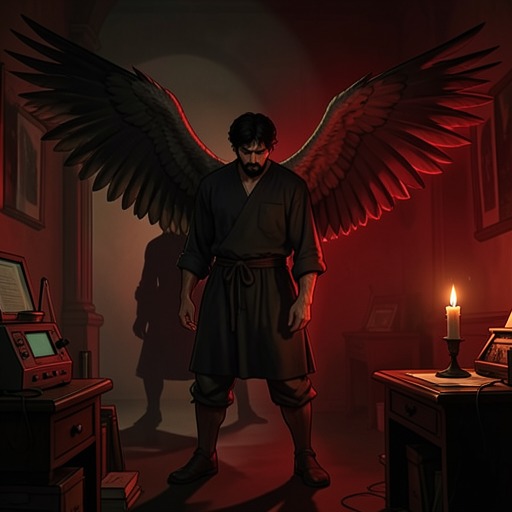
Arriane first appears in the chapel once used as the Sword & Cross librarian’s office, where her iridescent wings flex as she rises from the ground with a can of spray paint. On the wall she paints a girl in a glowing blue forest, dressed in black and looking toward a blond boy offering a white peony. She adds an inscription linking Lucinda and Daniel forever across the girl’s skirt. The image makes the chapel both an improvised memorial and a declaration of enduring love; Arriane’s wings and levitating movement place her beyond ordinary human life, while her paint can gives that otherworldly presence a direct, practical form.
The painting occupies a space already charged by grief. Roland is making a shrine at the site where Sophia murdered Penn, while a demon lights a tall glass candle depicting Santa Muerte. Arriane’s mural does not replace the shrine or erase the violence associated with the chapel. Instead, the intimate image of the peony and the couple becomes part of a shared act of remembrance, set beside the candle and Roland’s memorial work.
Later, Arriane introduces herself to Lilith beside a well, placing an arm around Lilith’s shoulders as she leans against it. She says that she and Roland have been traveling for a long time. The casual gesture makes their arrival feel less like a formal encounter than an offered welcome. When the conversation turns to a musical instrument Lilith can play, Arriane remarks that she and Roland have encountered no one else there who could play it. Her attention to Lilith begins with curiosity about a rare musical ability, a small point of recognition that helps establish the new connection.
Friendship and the Possibility of Love
After the events in Troy, Cam, Roland, and Arriane talk about what eternity might hold. Roland asks whether Troy has given Cam hope. Arriane answers by taking Cam’s uneaten taco and eating it, then argues that if Lucinda and Daniel could challenge the Throne and win a happy ending after thousands of years, happiness cannot belong to them alone. The interruption is characteristically playful, but the claim beneath it is serious: a love story that survived extraordinary time and opposition might make other futures imaginable too.
Cam resists. He says he may not be that kind of person, and Roland answers that they all carry parts of their journeys and learn from their mistakes. Arriane then touches the scars on her neck and groups herself with Cam and Roland as jaded birds of prey who may not know much about love. Roland insists that love is not the exclusive property of Lucinda and Daniel: they have all experienced it, and perhaps they will again. Cam rejects the reassurance. The exchange gives Arriane a distinct place in the conversation: she is neither simply optimistic nor untouched by pain, but a scarred friend willing to argue for hope while acknowledging the damage that makes hope difficult.
Reunion with Cam
Arriane and Roland reappear in Hell by staging a joke at Cam’s expense. Cam enters an apparently empty room expecting a meeting with Principal Tarkenton; the two friends leap from behind the door, laughing, and Arriane locks it behind him. She imitates Cam’s formal request to see the principal, while Roland delights in how funny the impersonation is. Cam responds by embracing them both. The prank is not a rejection of his distress: it breaks the tension of his arrival, and the hugs that follow make plain how grateful he is to see friends he had not expected to find there.
Arriane’s appearance makes the reunion unmistakable. Her head is shaved, she wears black, and the bright orange fringe of her false eyelashes is her only vivid color. She congratulates Cam for pursuing Lilith, then notices his swollen midsection and teases him about it. Cam explains that Lucifer arranged the transformation to make him unattractive, but that Lilith had not noticed the difference when she still liked him; he is uncertain what she thinks now. Arriane’s humor lets Cam speak about both the curse and his fear of rejection without turning the exchange into solemn confession. Roland explains that Lucifer’s idea of fun also accounts for how the two friends got into the place. Their presence gives Cam companionship inside the very trap designed to frustrate his attempt to reach Lilith.
Loyalty at the Ending
Arriane’s support continues into the final catastrophe. As Hell’s landscape burns around Cam and Lilith, demons fly overhead and Cam holds Lilith close. Arriane swoops into view on bright, glamorous wings. Cam tells her he thought she had gone; she answers that she would never abandon him in the final moments. Her reply makes loyalty concrete at the instant escape seems least certain: she is not merely a friend who has arrived to celebrate a possible reunion, but one who stays when the surrounding world is coming apart.
Lilith recognizes Arriane as an angel, and Arriane answers with a bow and an offer of service. She credits Cam with pulling the situation off, while also nudging Lilith and acknowledging their shared success. The lightness survives even here, but it accompanies a decisive revelation of what Arriane is and what she has chosen to do. Her wings, first seen above a chapel floor and later shining amid the flames, frame her movement from witness to active ally.
As Cam admits that leaving Lilith in Canaan was his greatest mistake and that losing her love is his only regret, Lilith answers that finding him is her redemption and tells him she considers him beautiful regardless of his appearance. Arriane is present for this mutual recognition, but does not take it over; she has helped Cam reach this moment and then leaves the declarations to the couple. Her narrative significance lies in that supporting presence. She challenges Cam’s despair, makes friendship tactile through jokes and embraces, and remains beside him when his history and Lucifer’s punishment appear to close off any future. In the ending, that constancy belongs to the same pattern of redemption as the lovers’ reunion: survival is not solitary, and hope is sustained by those who refuse to leave.