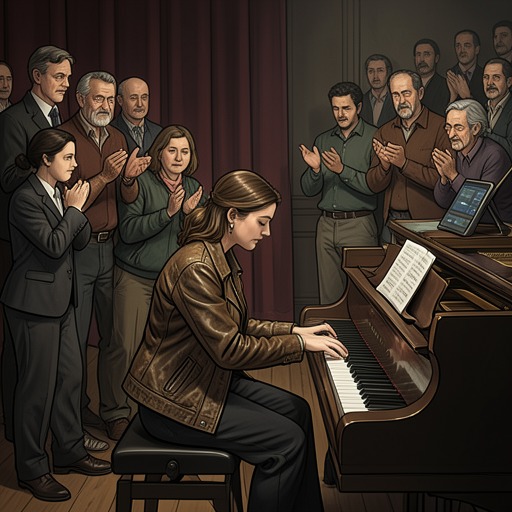
Luis
UnforgivenLuis is a freshman drummer in Revenge whose small, concrete acts help make Lilith’s music a shared practice rather than a private refuge. He brings rhythms and rehearsal focus to the band, makes room for Lilith among its members, and uses his work as a library aide to uncover evidence about the leak of her lyrics. At the climactic performance, his place beside his bandmates makes him part of both their musical unity and the revelation that follows.
Identity and Entry into Revenge
Luis first appears in the band room, struggling to set a huge copper timpani on its base. He is described as scrawny and dark-haired, with long hair nearly covering his eyes, almond-colored skin, and a tie-dyed T-shirt. When Jean Rah offers help, Luis waves it off. The moment introduces him through both his instrument and his self-sufficient, unceremonious manner: he is a young musician already trying to manage an unwieldy piece of equipment, not a polished performer being introduced with fanfare.
Jean soon presents Luis as a drummer who can join Lilith and Jean in making music. When Lilith proposes jamming, Jean asks whether she means it or is trying to make Cam jealous; the band is taking shape amid the tensions of Lilith’s personal life. Jean also asks whether Luis has a date for prom, linking the new drummer’s musical place in the group to the social event around which the band’s plans will gather. Luis’s recruitment is thus practical and immediate: he has the instrument the group needs, and his presence makes it possible to imagine a fuller band.
At an early rehearsal, Jean tries out new riffs on the synthesizer while Luis eats from an oversized bag of Doritos and offers some to Lilith. He treats the chips as brain food, turning the band room into an informal, ordinary gathering place. The contrast between Jean’s experiments, Luis’s snack, and Lilith’s photocopied song suggests a group still finding its habits as well as its sound. Luis contributes not only percussion but a relaxed social atmosphere in which rehearsal can include food, jokes, and the work of new songs.
Musicianship and Creative Work
Luis’s role becomes clearest through his attention to rhythm. While waiting in the lunch line, he tells Lilith that he has been working on a new beat for “Flying Upside Down,” tapping its syncopated rhythm on his tray. Lilith responds by suggesting a faster tempo. Their exchange shows collaboration at the level of musical construction: Luis brings a rhythmic idea, Lilith considers its pace, and the song develops through their back-and-forth rather than arriving as a finished composition handed down by its songwriter.
That exchange also takes place amid a small change in the group’s social arrangements. Luis goes to sit across from Jean, although Lilith has not seen the two boys sit together before, and both look up at her as she stands nervously nearby. The gesture makes space for her without requiring a formal invitation. For Lilith, who has often experienced music as company for someone otherwise alone, the rehearsal group offers a new kind of companionship: people can meet around the song, contribute to it, and make room for one another at the same table.
Luis also helps keep the band’s work moving. Through a microphone Jean has connected to his Moog, Luis reminds Lilith that the bell will ring in fifteen minutes, that they have time for one more song, and that the group needs to schedule its next practice. The reminder is modest but consequential: the band’s creative energy has to fit into school time and continue through planned rehearsals. Luis’s contribution is not limited to a single beat; he helps make songwriting into an ongoing collective commitment.
Friendship and Practical Support
Luis’s support for Lilith is especially visible in the way he treats her without making her feel scrutinized. At lunch, he pays for his burger while Lilith uses a coupon for free food. She is nervous that he might judge or mock her, but he says nothing about the difference. When he goes to sit with Jean, he does so as though the arrangement is unremarkable, and Lilith finds herself standing nervously beside them before the boys look up. His unselfconscious acceptance contrasts with the judgment Lilith expects, allowing music and ordinary shared company to bridge a difference she fears will be exposed.
His practical work outside the band also gives him a part in identifying who spread Lilith’s lyrics around school. As a library aide, Luis had to make copies and noticed that a job of roughly a thousand pages was ahead of his in the queue. A job that large required a code, and this one had been sent from an external computer under the King Media account. Luis does not claim to know who submitted it; he supplies the procedural details that let the others narrow the possibilities. Jean considers whether Chloe King or someone else was responsible, and Cam identifies the intern, Lucifer. Luis’s everyday knowledge of the copying system turns a confusing accusation into a traceable act and helps clear Cam of Lilith’s suspicion.
When Lilith has good news, Luis greets her with an open-armed welcome and hugs her. He brings Karen Walker and other friends into the circle, and he explains that he had come to meet Karen and was lucky to be there to toast Lilith. His teasing reference to Karen as his lady is paired with an uncomplicated expression of happiness for Lilith. The scene places him within a wider friendship group: he is not only present for rehearsals, but also helps make the celebration communal.
Ensemble and Public Performance
Luis’s humor remains part of his presence as the band encounters other performers. When Lilith and Cam help Death of the Author adjust its drums, Luis watches from the wings with Jean. The act’s singer performs a song called “Amalgamator,” and Jean remarks that the singer does not know what the word means. Luis agrees, then admits that he does not know either. The exchange is comic, but it also shows him responding to the performance as a listener, with the same informality he brings to rehearsal. The crowd, meanwhile, boos and drifts away before the song ends; Luis’s dry uncertainty about the lyric sits inside a broader picture of an audience unconvinced by the act.
Before Revenge takes the stage, Luis stands at Cam’s right while Jean stands at his left. Lilith is about to perform with the band, and the three musicians’ presence around Cam makes the moment belong to the group rather than only to the pair at its emotional center. Onstage, Lilith counts the band in. After the bridge, she reaches for the microphone, and Cam joins her in harmonies they have not practiced. Before the final couplet, Lilith raises her arm and stops playing; Jean, Luis, and Cam stop with her. When her arm comes down on the final chord, the band enters together. Luis’s importance in this sequence lies partly in that responsive coordination: the performance depends on the musicians listening and stopping as one, then arriving at the ending together.
The concert’s musical climax gives way to a more frightening one. After Lilith recognizes Lucifer, the other student performers have fled into the audience, but Luis and Jean remain at the edge of the stage. Their shoulders touch, and both are pale with horror as Lucifer reveals himself and the danger facing Lilith and Cam. Luis does not take control of the confrontation; the evidence instead keeps him in the scene as a witness who stays beside his bandmate. The pattern of his role holds to the end: he helps create connection through music, and when the shared performance is overtaken by a crisis, he remains present with the people beside him.