Jean Rah
UnforgivenJean Rah begins as Lilith’s near mirror and adversary: a social pariah, obsessed with music, mean, and weird, whom she would rather see disappear. Yet he becomes one of the people who makes Revenge possible and, in time, one of Lilith’s friends. His shift from hostility to shared laughter and trust gives the band’s story a human counterpoint to its contests and romances: connection first appears not as a declaration, but as the unlikely ease of making music together.
Identity and Introduction
Jean is described as half-French and half-Korean, and as an outsider much like Lilith. Their similarities do not initially draw them together. Each wishes the other would vanish, and Lilith interprets his scowl as evidence of a mutual dislike. At their first encounter, Jean is tuning the snare on a drum kit. He tells the intruders to leave and threatens to page Mr. Mobley, establishing both his guardedness and his readiness to defend his space.
His musical ability is unusually broad: the narration says he can play every instrument there is. The band room becomes the setting where that talent and his difficult personality meet. He later experiments with unusual riffs on the synthesizer, and his willingness to join a band is framed in the same irreverent, combative language that marks his first appearance. The account also gives him Buddy Holly glasses, a detail that helps make his distinctive look part of Lilith’s first, hostile impression of him.
From Antagonism to Revenge
When Cam responds to the proposed band name by imagining a large synthesizer and a disco ball, Jean answers with an enthusiastic, profane joke about synthesizing the school. He agrees to join; Lilith refuses, but Cam insists that she is in. Jean’s commitment therefore precedes any reconciliation with Lilith. The group begins as a practical musical alliance, not a friendship, and its formation puts three isolated students in a shared room before they know how to trust one another.
That arrangement changes in a small interruption. After a charged moment between Cam and Lilith, Jean appears and reminds them that the band room is open until one. A message on his phone tells him that Lilith pulled out Chloe King’s weave, and his surprised response prompts Lilith to laugh. Jean joins in, as does Cam; the three laugh until they are crying. The scene does not erase the earlier antagonism, but it briefly makes it irrelevant. For Lilith, the ease of that laughter is startling: a group that began in mutual dislike can feel, for a moment, entirely natural.
Music and Bandmateship
Revenge meets in the band room before school, where Jean tries new synthesizer riffs while Luis eats from an oversized bag of Doritos. Lilith arrives carrying photocopies of her song Flying Upside Down. The ordinary rehearsal details show Jean not as a symbol of musical talent but as a working bandmate: he experiments with sound while the others bring songs, rhythms, and their own habits into the room. Music gives their gathering a shared purpose without requiring them to become alike.
Jean’s friendship with Luis also becomes visible outside rehearsal. At lunch, Luis chooses to sit across from Jean, though Lilith has not seen the two boys sit together before. Jean pats the seat beside him and invites Lilith to join them. She accepts and experiences the cafeteria differently from her usual position outside the group: it seems warm, bright, loud, and fun, and lunch passes too quickly. Jean’s invitation is modest, but it helps turn companionship into something Lilith can occupy rather than merely observe.
Later, Jean challenges Lilith’s assumption that Cam sabotaged her. He tells her that Cam did not do it, acknowledges her embarrassment, and urges her to clear the air because the band needs Cam. The intervention is both practical and personal: Jean wants Revenge intact, but he also presses Lilith to reconsider a judgment that has divided the group. His advocacy helps reopen the possibility of Cam’s return without denying Lilith’s hurt.
Friendship, Performance, and Private Life
Jean’s practical place in the band extends beyond the rehearsal room. When the group needs somewhere to meet, he rules out his own home because he is the oldest of five children and warns that his twin siblings would make the visit difficult. He then suggests Cam’s place. The exchange gives a glimpse of Jean’s crowded family circumstances while showing him taking an active role in solving the band’s logistical problems.
He also drives the group in his Honda. After school, the car pulls into a Salvation Army parking lot, where Cam emerges from the back; the ride places Jean in the everyday network through which the band’s members spend time together. By the time of the Battle of the Bands, Jean has a girlfriend, Kimi. In Revenge’s dressing room, he briefly breaks away from kissing her to greet Cam and Lilith with a peace sign, then asks Cam if he is ready to rock. The scene places romantic intimacy and band solidarity side by side without suggesting that one displaces the other.
At the competition, Jean’s response to another act reveals how strongly he identifies with musical craft. He is miserable while Death of the Author performs a song called Amalgamator, objecting that the singer does not know what an amalgamator is. Luis admits he does not know either. Jean’s complaint is comic, but it distinguishes his technical attention from mere enthusiasm: he listens closely enough to care whether a song’s language means anything.
Revenge onstage and the Revelation
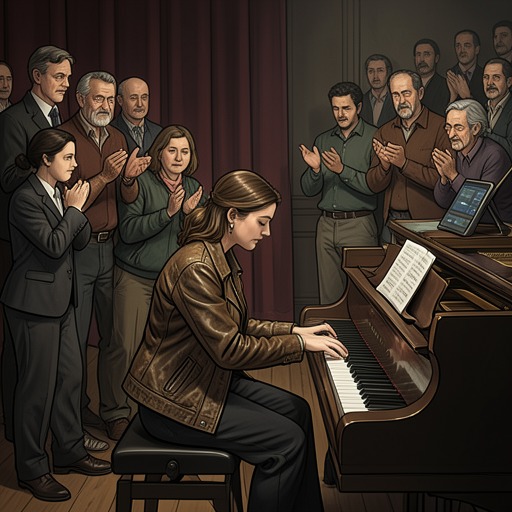
Before Revenge performs, Jean stands beside Cam as the crowd cheers for the end of Chloe King’s song. Cam feels Jean to his left and Luis to his right, and recognizes that the moment belongs to the band’s music. During Revenge’s performance, Lilith raises her arm and stops playing before the final couplet. Jean, Luis, and Cam stop with her. When Lilith’s arm comes down on the final chord, the band enters together, precisely on time, and the audience erupts. Jean’s role in the moment is part of a collective act of listening: the band follows Lilith’s gesture rather than forcing the song forward without her.
The performance is followed by a far more frightening interruption. When Lilith’s recovered memories lead to Lucifer’s appearance, Jean and Luis remain onstage with Cam and Lilith after the other student performers have fled into the audience. The two bandmates stand together at the edge of the stage, shoulders touching, their faces pale. Cam sees their fear and knows the night’s horrors are not over. Jean’s presence here carries the band’s earlier fellowship into a crisis its music cannot resolve: he is still beside the others when the ordinary school performance gives way to supernatural danger.
Character Arc and Significance
Jean’s change is conveyed through repeated acts of proximity. He begins by ordering Lilith out of the band room; later, he laughs with her, makes room for her at lunch, defends her against an unfounded accusation about Cam, and stands with her onstage. The evidence does not suggest that his sharpness disappears. Rather, the hostility that once defined his relationship with Lilith gives way to a more complicated bond in which teasing, candid disagreement, practical help, and shared work can coexist.
As a character, Jean helps make Revenge feel like a community rather than a backdrop for Lilith and Cam’s relationship. His musical inventiveness, blunt opinions, invitation to sit, and steady presence at the performance each contribute a different kind of support. The contrast between his first encounter with Lilith and the band’s synchronized final chord is especially telling: the boy who once wanted her out of the room becomes one of the musicians waiting for her signal. When the supernatural truth breaks into the concert, he remains there too, linking the story’s hard-won everyday belonging to its sudden danger.