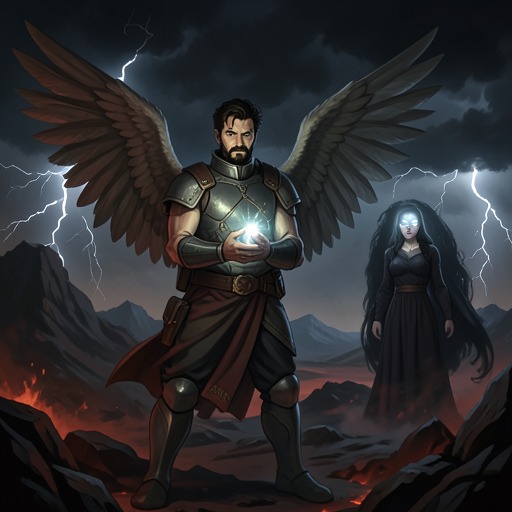
Lucifer
UnforgivenLucifer is the devil who engineers Lilith’s torment and makes Cam’s attempt to win her love into a wager. He moves between a charming human disguise and a monstrous true form, presenting himself first as a helpful promoter and finally as the power behind Lilith’s suffering. His control over the contest appears absolute until his body begins to disintegrate amid the flames, leaving his disappearance—but not a confirmed death—as the last image of his arc.
Identity and Guise
Lucifer first enters Cam’s immediate story as the voice that greets him after Cam has glimpsed Lilith and demanded that she be taken away. He reminds Cam that the visit was a favor: Cam had come asking about Lilith’s soul, and Lucifer had allowed him to see her because Cam was one of his favorites. The invitation to talk business turns that apparent privilege into the opening move of a transaction. Lucifer is not simply guarding access to Lilith; he is prepared to make her continuing torment the subject of a bargain.
At Aevum, which he describes as a state between time and eternity and also calls Limbo, Lucifer adopts the role of a food-court worker. He handles a spatula, flips food onto a cafeteria tray, and stands behind a plastic divider and cash register. The setting makes his authority look almost casually commercial: even this in-between realm comes with a service counter, a special offer, and a proprietor deciding what happens next. Later, he appears as Luc, a handsome, charismatic young man with freckles, and uses that mortal appearance to pass among students and school staff. The contrast between the approachable face and the power concealed behind it defines his method of access.
The Wager with Cam
Lucifer makes the terms of his bargain explicit: Lilith’s current Hell is due to expire in fifteen days, and he would enjoy watching Cam make her more miserable during the time remaining. He proposes that, if Cam can remove Lilith’s hatred and make her truly fall in love with him again before the deadline, Lucifer will stop creating bespoke Hells for her. The challenge is framed as a chance to end Lilith’s torment, but its terms force Cam to pursue a relationship with someone who does not know why she hates him. Lucifer stresses that the obstacle is not incidental: Lilith’s bitterness is directed at Cam, and Cam is its cause.
The wager therefore makes Lucifer both tormentor and arbiter. He has set the deadline, controls the threat of further tailored Hells, and chooses to make a possible reprieve depend on Lilith’s feelings. His interest is not limited to whether Cam succeeds; he says he would enjoy seeing Cam worsen her misery. When Cam later insists that Lilith has changed, Lucifer answers with a coffee in a steaming Styrofoam cup and calls Cam naïve. Although disguised as Luc, he lets his terrifying growl emerge when the two are alone, briefly stripping away the reassuring surface. His remark about the beauty of being number two accompanies his anticipation of what is about to happen, keeping their exchange poised between teasing banter and threat.
The Luc Persona and the Prom
Lucifer’s disguise lets him interfere in the school’s ordinary preparations while appearing to belong there. Introducing himself to Lilith as Luc, an intern with King Media, he says the company has partnered with Trumbull Prep to put on its best prom and suggests he may be hired full-time. Lilith tells him she is not going, but he redirects the conversation toward her interest in music. The encounter places him in the path of the person whose choices determine the wager, while concealing his identity and the stakes connecting them.
He also appears beside Cam on a tree branch at dawn, wearing sunglasses and watching the construction of a vast amphitheater on the school football field. The structure is modeled on a Roman arena, with three tiers of stylized arches around a space as large as the cafeteria. Lucifer explains that King Media thought the students deserved a grander venue for their gladiatorial battle and that the building is made of ash. The theatrical setting turns the prom’s band competition into an arena, lending the school event a scale and menace that match the wager being played out around it.
As the deadline narrows, Lucifer continues to supervise the performance under the Luc identity. Four days remain while Cam still does not know whether Lilith loves him, and the two have not kissed. Shortly before the bands are to appear, Luc waits in the hallway with a clipboard and headset, calls Cam Cambriel in his true, lower voice, and asks whether he is ready. He then resumes his smooth public manner to summon the bands to their positions. The switch is practical as well as theatrical: Lucifer can address Cam as the adversary who knows the stakes, then manage the public event as if he were only its organizer.
Exposure and Lilith’s Deal
During the performance, Ike Ligon begins a song called Vows for Lilith. She has never written a song by that title and has no time to determine whether it is a mistake before the band starts playing. The episode places a song associated with her at the center of the public contest, but the available scene does not establish that Lucifer arranged its appearance; its significance becomes clear through what follows. After Lilith recalls the deal, the scene returns to the Crossroads stage, where the audience is frozen, the Four Horsemen have disappeared, and Luc stands alone in their place. He restrains Cam and beckons Lilith toward him.
Lucifer makes clear to Lilith that the boy she knows as Luc is the devil who offered to bring her to Cam. He tells her that she did her best and that Cam did not want her; Lilith accepts this painfully. When she later understands that Cam’s return was bound up with the wager, she calls him selfish and says he has not changed. Lucifer agrees that she is right, then abandons his youthful guise. He grows until he dwarfs the stage and eclipses the moon; his fingers become claws, black scales cover his body, and he spreads tarnished green-gold wings. Lilith recognizes him, and he identifies himself as the maker of her misery. The disclosure confirms that her personal ordeal has been governed by a power that could appear, in everyday settings, to be merely another young man.
The revelation also converts the prom venue into a trap. Students find the exits locked and bolted as they try to flee or climb the walls, while Lucifer’s demons gather overhead. Jean Rah and Luis remain visible at the edge of the stage with Cam and Lilith, watching in horror. In that moment Lucifer’s spectacle is no longer a hidden contest between himself and Cam: the terror of the wager has overtaken the public event and endangered its audience.
Collapse and Narrative Role
When Cam calls on Lucifer to let them go, Lucifer’s wings have become thin and nearly translucent, with the flames visible through them. Their edges curl and singe; his body caves inward, his claws disintegrate, and his form shrinks until only an infinitesimal black hole remains at the center of a ring of fire. Lilith asks whether he is gone. The image strongly suggests that Lucifer has vanished, but the scene does not confirm what has happened to him beyond that disappearance.
Across these scenes, Lucifer’s changing scale supplies the arc’s central contrast: a food-court worker, a school intern, and a headset-wearing promoter are all faces of the power that commands Lilith’s Hell. His games depend on disguising coercion as opportunity, whether he offers Cam a wager or approaches Lilith about music and prom. The final transformation makes that hidden authorship explicit, while the collapse of his body unsettles the apparent certainty of his control. He is at once the architect of the trial and a presence whose own persistence is left unresolved.