Roland
UnforgivenRoland is a winged companion of Cam whose appearances connect intimate acts of friendship with the larger conflict against Lucifer. He makes a shrine at a place marked by murder, plays music that draws people toward love, and offers Cam both teasing companionship and support. At the climax, he leads fallen angels in pursuit of Lucifer, turning their long history of allegiance and conflict into open revolt.
Identity and Introduction
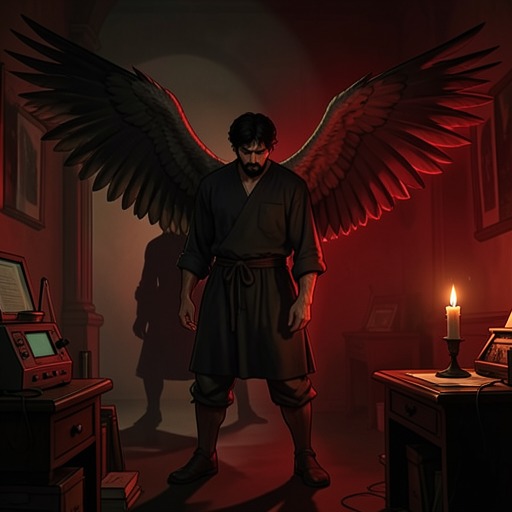
Roland first appears in a desecrated chapel where he is making a shrine at the site where Miss Sophia murdered Penn. A tall glass candle bearing the image of Santa Muerte, the goddess of death, forms part of the memorial. The setting’s danger is specific: fallen angels cannot enter a sanctuary without causing it to burst into flames and incinerate the mortals inside. This chapel, however, has been desanctified since Miss Sophia moved in. Roland’s presence there is therefore possible, and the shrine gives his entrance a purpose shaped by the place’s violent history.
The scene identifies Roland as a dark-skinned demon with dreadlocks, but his later appearances also give him conspicuous wings. At the chapel, Cam arrives through a broken window, spreads his own wings, and lands behind Arriane. Roland embraces him, and Cam does not pull away. Their ease with one another is immediate; Roland’s observation that finding Cam there is quite a coincidence carries the warmth of a friend who can greet him with curiosity rather than ceremony.
Music and the Earlier Gathering
Roland’s flute-playing is presented as exceptional. When Lilith plays a flute, she assumes that its sound must be magical and that anyone who tries it will sound as she does. Arriane corrects her: no one they have met besides Roland can play it at all. Roland responds that Lilith must have a great deal of soul. The exchange links the instrument not merely with technical skill but, in the characters’ understanding, with an inner quality expressed through music.
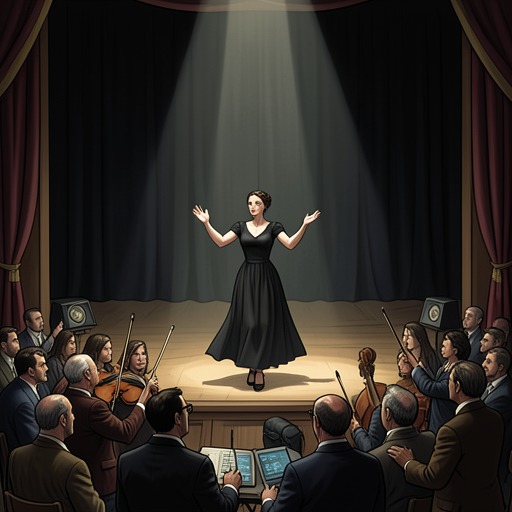
In a gathering beneath a starry desert sky, that musical ability becomes social and emotional. The young people of the village have assembled for a concert; Cam proposed the party, while Lilith arranged the performance as an expression of her love for him and their anticipated marriage at the harvest. Lilith and her sisters have woven a canopy of branches decorated with iris blossoms. Roland plays first, his eyes shining as his mysterious flute casts a spell over the audience with a sweet, sad song that puts them in a romantic mood. Cam raises a bronze goblet and leans toward Lilith; Dani holds Liat as she sways with her eyes closed, while Arriane rests her head on Tess’s shoulder.
Roland’s performance sets the emotional register for the gathering, but it does not displace Lilith’s own music. She follows with a lush, haunting melody she improvised during her first encounter with Cam. Once the applause subsides, Cam draws her close and kisses her. The sequence gives Roland a clear but supporting place in the scene: his music prepares a shared atmosphere in which other relationships can be felt and expressed.
Friendship, Humor, and Support for Cam
Roland’s friendship with Cam includes irreverence as well as loyalty. In one prank, Roland and Arriane hide behind a door after Cam enters hesitantly and calls for Mr. Tarkenton. They jump out laughing; Arriane locks the door and repeats Cam’s tentative appeal in an imitation of his voice. Roland declares the prank the funniest thing he has seen in centuries. The joke depends on making Cam’s formal, uncertain manner the performance, and on the conspiratorial ease between the three friends.
Elsewhere, Roland offers Cam a more earnest kind of companionship. When Arriane asks why Luce and Daniel could seize a happy ending against The Throne while others cannot, Cam doubts that he is the kind of person who can hope for one. Roland answers that everyone carries parts of their journey and learns from mistakes, then questions who could say they do not deserve happiness. When Arriane asks whether three jaded birds of prey know anything about love, Roland insists that love belongs neither exclusively nor permanently to Luce and Daniel: the others have experienced it and may experience it again. His reply does not promise Cam a particular outcome; it challenges the assumption that past mistakes or disillusionment rule out future happiness.
Roland also appears among those who help Cam prepare for prom night. When Cam tells Lilith he will wait outside, Arriane follows him onto the porch and says she is proud of and inspired by him, while calling to Roland for agreement. Roland responds from the open window of a limousine, dressed in a tuxedo with a navy bow tie. Cam thanks them. Arriane adds that her support holds regardless of what happens that night. Roland’s brief affirmation places him inside a circle of friends encouraging Cam without making their care conditional on the evening’s result.
Revolt and Narrative Significance
After Lucifer disappears into the darkness, the sky fills with an unholy din: demons and fallen angels stampede through it, black against the night. Roland leads the charge on mottled black-and-gold wings, his face marked by an unusually wild heedlessness. He asks which way Lucifer went; Cam answers that Lucifer has gone into darkness, as he always does. Roland’s question makes the pursuit immediate, while Cam’s reply frames it as part of a familiar pattern of evasion.
Arriane throws an arm around Roland and impulsively asks if he will marry her, then quickly takes the proposal back as the thrill of victory speaking. The brief joke sits beside Roland’s decision to pursue Lucifer, giving the uprising both exhilaration and personal warmth. When Cam asks what the army is doing, Roland says he is going after Lucifer. He calls the revolution long overdue, nods toward Lilith, and reaches out to shake Cam’s hand, addressing him as a brother. Cam answers in kind. Roland then tells him to check his wings, a final gesture that makes Cam’s own wings newly salient without explaining their condition in that moment.
Across these scenes, Roland’s functions are deliberately varied: he tends a memorial, supplies music, joins in a joke, argues that flawed people may still deserve happiness, and leads a rebellion. The changes in scale—from the candle at Penn’s murder site to a mass pursuit across the sky—do not erase his personal ties. At the climax, his appeal to Cam as a brother makes the revolt more than an organized attack on Lucifer; it is also an act of solidarity with a friend. The story leaves Roland moving into that conflict, leading the fallen angels after their former power rather than returning to the safety of private celebration.