Cam
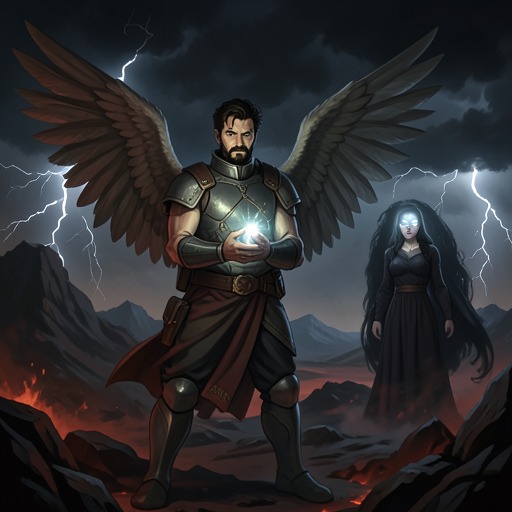
UnforgivenCam is a fallen angel whose defining struggle is not simply to win Lilith back, but to acknowledge the betrayal of trust that first separated them. He arrives in her Hell hoping to restore their love, yet the wager that gives him fifteen days also exposes the selfishness and fear entangled in that hope. His eventual offer to remain in Hell in her place turns pursuit into sacrifice; his reunion with Lilith begins only when he stops hiding who he is.
Identity and Return
At the story’s opening, Cam lands on the eaves of the old church at Sword & Cross Reform School beneath a cold, starry sky. Spanish moss hangs from antebellum trees, and the empty campus is still over winter break. He has flown in from Troy after a journey that seems to have been guided by an unknown force. Along the way, he finds himself humming a tune he has not allowed himself to remember for several thousand years. The place draws him back because it is where the fallen angels gathered to witness one of Luce’s cursed lives: her three hundred and twenty-fourth incarnation, and the three hundred and twenty-fourth time they had come together to see how the curse would unfold.
That return links Cam’s present to a history far longer than his immediate attempt to reconcile with Lilith. He is a figure shaped by repetition, memory, and the consequences of earlier choices. The tune he has suppressed makes the past audible before he has fully confronted it. When he finally says Lilith’s name among his friends, he recognizes that she is the only girl he has ever loved and that he once asked her to marry him. The proposal did not succeed, and hearing her song again intensifies his regret rather than resolving it.
Love, Loss, and the Wager
Cam’s connection with Lilith reaches back to Canaan, where their courtship was swift and passionate. He proposed marriage, and she looked forward to marrying him after the harvest. A celebration he organized became the setting for a concert she arranged as an expression of love. While Roland played his flute, Cam held a bronze goblet beside Lilith; iris blossoms decorated the canopy she had woven with her sisters. Their gathering placed their intended marriage among friends and music, making the promise of a shared life public as well as intimate. The later knowledge that the marriage never happened gives this remembered courtship the weight of a lost beginning.
In the present, Cam learns that Lilith’s soul is not in Heaven, as he had expected, but in Hell with Lucifer. Annabelle is the one who tells him, after he approaches her seeking news of Lilith’s condition in Heaven. The discovery changes his understanding of what became of Lilith and sends him toward her with urgent questions: how someone he remembers as pure and kind came to be in Hell, and whether she remains the person he loved. When he finds her, he sees the same expressive soul he remembers from Canaan. Lilith, however, sees him as the kind of boy who hurts girls and has no desire to invite more pain into her life.
Lucifer turns Cam’s return into a wager. Lilith’s current Hell is due to expire in fifteen days; if Cam can remove her hatred of him and persuade her to fall genuinely in love with him again before then, Lucifer promises to end the bespoke Hells made for her. The challenge makes Cam’s desire legible as both devotion and self-interest: a successful reconciliation could save Lilith from further tailored torment, but it is also a contest with a deadline, set by the very being who controls her suffering. Lucifer insists that Lilith hates Cam because of what Cam did, even though she does not know why. Cam accepts the task knowing that he must face a wound whose cause has not yet been disclosed to her.
Care and Conflict in Crossroads
Cam’s days in Crossroads are spent trying to counter Lucifer’s interventions, which are designed to make Lilith despise him more. He recognizes that Lilith has suffered much longer than he has, even as he struggles to get close to her when she shows him mostly anger. His response is not limited to pleading. He watches for moments when a practical kindness can create room for her to be herself without demanding immediate forgiveness.
One such gesture is the antique rolltop desk he brings into her Hell. Unable to travel elsewhere for a present, he has stolen it from Chloe King’s attic in the affluent part of Crossroads. He leaves Lilith a note and irises, an old favorite. From above, he watches her handle the paper, smell the flowers, take out her notebook, and begin writing a new song. The scene fulfills his hope for her: not that she will instantly accept him, but that she might have a little peace and return to making music. Its quietness stands against the wager’s clock and Lucifer’s repeated attempts to provoke hostility.
The prom setting also places Cam among the ordinary obligations of the life Lilith inhabits in Crossroads. Tarkenton steers him to the cafeteria table where Chloe King and the other members of her band are sharing pizza, because Cam has skipped five prom-court meetings. He resents being made to brainstorm balloon-banner colors and asks whether he can give up his place. The scene shows his reluctance to perform a normal teenager’s role even as the prom approaches. On the night of the show, Lucifer appears backstage disguised as Luc, carrying a clipboard and headset. Cam answers with confidence, but privately knows he has not felt ready to win the wager until he held Lilith in his arms the night before. For him, intimacy has made the possibility real without guaranteeing the outcome.
Confession and Sacrifice
At the Colosseum, Lilith confronts Cam with the pain his return has reopened. She asks whether he came to taunt her or take pleasure in her suffering. Cam tells her that he loves her, that he had thought she was dead, and that he came as soon as he learned she was in Hell. He also admits the wager and the hope that she might fall in love with him again during those fifteen days. The confession does not win her trust. Lilith calls the arrangement selfish and concludes that he has not changed.
Lucifer then casts aside his youthful disguise and appears in his true, enormous form. Cam’s own transformation is exposed as well: his fingers are gnarled, and his appearance becomes that of an aging demon with a decrepit body and repulsive wings. The revelation returns Cam to the fear at the center of his earlier failure. He explains that long ago he was afraid Lilith would not love him if she knew what he really was. Lilith answers that he never gave her the chance to love the real him or to decide whether she could accept him. Their conflict is no longer only about what Cam did at the end of their earlier relationship; it is also about the truth he withheld and the choice he denied her.
As the stage shakes and the lip of the crater approaches, Cam refuses to return as Lucifer’s second in command. He proposes a new bargain: he will remain in exile in Hell as Lucifer’s subject if Lilith is set free. Lilith grabs him by the jacket and asks why he would sacrifice himself for her. Cam says he would do anything for her, and she does not pull away when he reaches for her hand. The offer changes the wager’s terms in spirit. Instead of making Lilith’s love the price of his success, Cam accepts a cost that may leave him trapped and asks nothing from her in exchange.
Change and Ending
Arriane arrives rather than abandoning Cam in the final moments, and Lilith recognizes her as an angel. Cam holds Lilith close and names his failure plainly: he let her go in Canaan, and losing her love is his only regret. Lilith answers that finding his love is her redemption. She touches his chest and face and tells him that his appearance does not alter what she sees in him. The acceptance reverses the fear that governed Cam’s concealment, but it does not erase the history between them; their reunion is built around the truth that he should have trusted her with his real self from the beginning.
Cam remains a fallen angel. When Lilith calls him an angel, he corrects her and identifies himself as fallen, adding that he is hers. The distinction preserves the consequences of his past even as the couple’s future opens. Lilith acknowledges the sorrow of the life she has left behind, but meets the unknown ahead with hope. Cam kisses her softly and tells her they have not yet begun. His ending is therefore not a return to the old Canaan marriage or a claim that every wound has vanished. It is a new beginning grounded in disclosure, chosen loyalty, and a love that can look directly at the shape he once feared to reveal.