Gurd
WaspGurd is a suspicious, money-minded associate of Skriva whose role in Mowry’s operations combines blunt bargaining with direct violence. The novel gives him little biographical background; instead, it defines him through sharp exchanges, a hurried knife killing, and the recurring hazards of working alongside people he does not trust. His eventual capture, followed by a later appearance in wrist chains, makes his fortunes a measure of how quickly the group’s clandestine activity can turn against its participants.
Identity and Introduction
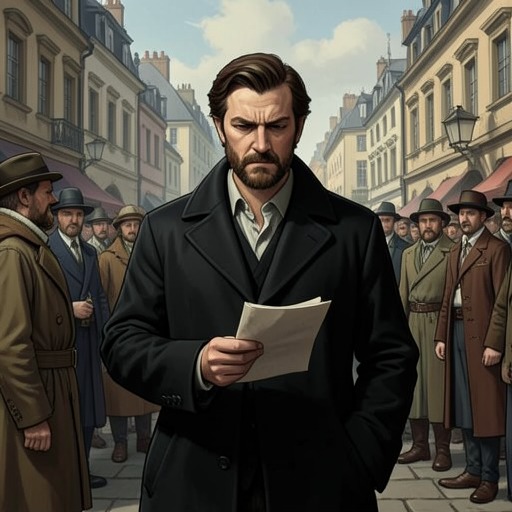
Gurd first enters the account as one of the companions whom Butin Arhava introduces to Mowry, alongside Skriva. Mowry has just explained that a police raid delayed him; the group’s arrival therefore takes place under the immediate shadow of street policing. Gurd does not begin with an account of himself. Instead, he asks Mowry for his name, speaking between long, narrow teeth. When Mowry refuses to give it, the exchange establishes the terms of their acquaintance: Gurd is curious, but Mowry intends to remain an unknown quantity.
The narration frames Gurd and Skriva together as men who might sell one another into slavery if they could do so without risking a knife in return. That image makes their partnership less a bond of trust than a wary accommodation sustained by the danger of retaliation. Gurd’s narrow-toothed speech and the narrator’s measure of mutual treachery give him an immediately recognizable edge, even though the book supplies no fuller personal history.
Money, Suspicion, and the Bargain with Mowry
Skriva cuts off Gurd’s questioning by insisting that money matters more than the identity of the person paying it. Gurd accepts this principle, affirming that money is money regardless of who provides it, and tells Skriva to be quiet. When Gurd then says he only wanted to know, his subdued retreat shows that he can yield in the moment without ceasing to be inquisitive. The exchange also distinguishes the two men’s manner: Skriva states the practical rule and polices the conversation; Gurd tests the situation, then backs down when checked.
Their dealings with Mowry are governed by the same distrust. Mowry openly anticipates that Gurd will take revenge at the first opportunity, and Gurd confirms that he will. The threat is not disguised as loyalty or softened into a joke; it is part of the bargain’s stated conditions. Mowry counters that a deception by Gurd would cut off the flow of substantial payments, giving the arrangement a material restraint in place of personal confidence. Gurd’s willingness to accept money from an unknown man and his declared intention to retaliate if he can thus coexist. He is neither represented as a faithful subordinate nor as someone indifferent to the deal: he participates because the reward is valuable, while preserving the expectation of future conflict.
Gurd’s suspicion also surfaces when he asks why Mowry wants a particular man removed. The target is described as a senior Kaitempi figure, and Gurd remains sullen and distrustful as he demands the reason. Before Mowry can answer, Skriva responds fiercely that he has already explained it to Gurd. The moment shows that Gurd’s skepticism is not limited to Mowry, and that information within the group is unevenly shared or repeatedly contested. It also sharpens the contrast between Gurd’s demand for an explanation and the operation’s practical momentum: the question is interrupted before Mowry supplies an answer.
Violence and Its Immediate Aftermath
A later scene makes Gurd’s capacity for violence concrete. When the lights reveal the result of a killing, Mowry reacts with shock; Skriva describes the work as ragged and explains that the victim had a tough neck, the knife was blunt, and Gurd was in a hurry. The account directly connects Gurd with the knife and the rushed execution. It does not present the killing as polished or detached: the blunt tool, physical difficulty, and haste leave the act visibly rough.
Skriva’s explanation is matter-of-fact, and his question about whether Mowry is squeamish places the focus on the observer’s reaction as well as the deed. Mowry’s stomach-jolting response registers the scene’s force, while Skriva treats its imperfections as practical details. Gurd himself is not shown explaining the act in this exchange. His hurried violence therefore contributes to the portrait through what others report: he can carry out lethal work, but the method is urgent and inelegant rather than controlled spectacle.
Capture, Chains, and a Return to Motion
Later, Skriva tells Mowry that the authorities have caught Gurd. The brief announcement changes the group’s immediate circumstances: Mowry sits up and asks how and when it happened, conveying that the news matters to him, though the excerpt does not provide the circumstances of the arrest. Gurd is subsequently seen entering with companions, shuffling under the rattle of wrist chains. A guard unlocks their manacles and takes them away. The scene places Gurd within an enforced procedure, where restraints and a guard’s key replace the precarious freedom of the earlier street meetings.
In another tense passage, Gurd grumbles that a worthless fellow has told him to shut up. The complaint preserves his familiar combative voice even in a situation where others are moving quickly; immediately afterward, the group zigzags through a dozen side streets without encountering a radio-alarmed patrol car. The account does not establish the precise connection between this flight and the earlier chained appearance, so the episodes do not settle into a simple, fully explained escape chronology. Together, however, they show the instability surrounding Gurd: he can be taken into custody, appear in restraints, and still be associated with hurried movement through streets where a patrol may be encountered.
Narrative Role and Characterization
Gurd’s importance lies less in a developed private history than in the friction he brings to the operational group. He asks questions, accepts payment, threatens retaliation, challenges the reason for a killing, and is himself implicated in a rushed murder. Each detail makes cooperation seem conditional. Even his alignment with Skriva carries the narrator’s image of mutual betrayal held in check by the prospect of a knife, while Skriva’s interruptions show that Gurd does not control the group’s explanations or its rules of speech.
The sequence also places Gurd at the intersection of two recurring pressures: money as the basis of cooperation and force as the means by which that cooperation may be enforced or undone. His blunt acceptance of payment does not make him dependable; his threat to retaliate makes that plain. His hurried killing gives the threat a bodily counterpart, and his later chains show that the violence and police pressure surrounding the operation can reach its own participants. The result is a compact but consistent portrait of a man whose practical usefulness is inseparable from suspicion, danger, and the possibility of capture.