Skriva
WaspSkriva is an associate of Butin Arhava and Gurd whom James Mowry recruits for clandestine work on Jaimec. His importance lies less in a disclosed personal history than in the practical role he takes on: he speaks plainly about payment, accepts dealings conducted out of public view, and remains in contact with Mowry as assignments change from a proposed killing to other, less fully specified work. Through him, Mowry’s campaign depends not only on his own improvisation but on a small network willing to act for money and return when called.
Introduction and Characterization
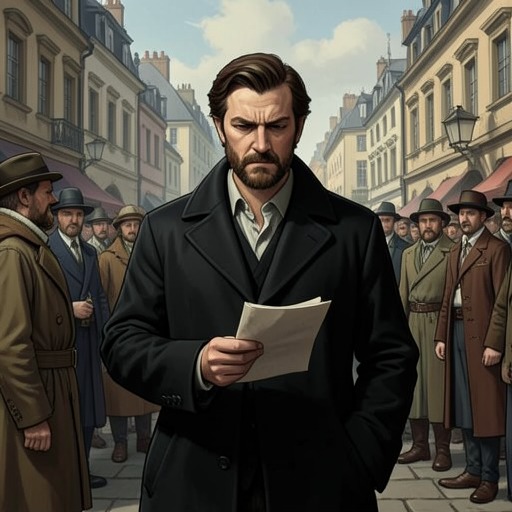
Skriva first appears with Gurd in Butin Arhava’s company. When Mowry arrives after being delayed by a police raid on the street, Arhava casually introduces the two men. The scene places Skriva inside an existing association rather than presenting him as a lone operative: he is one of the companions Mowry is being asked to consider for a job.
His first distinguishing contribution is an answer to Gurd’s question about who is paying. Skriva says that money is money regardless of who hands it over, then tells Gurd to stop asking. Gurd backs down, saying that he only wanted to know. The exchange gives Skriva a direct, impatient manner and shows that he is prepared to treat the payer’s identity as irrelevant. It does not establish that he is unaware of the risks; rather, the dialogue shows him shutting down that line of inquiry while the group discusses employment.
The Proposed Killing and Its Price
When Mowry says he wants someone to kill a man, regardless of whether the target is in prison, Skriva and the others respond that they can take care of it. Skriva adopts what the narration describes as his toughest expression, theatrically claiming the air of someone who had killed a bear when he was three, and names a price of fifty thousand. The pose makes his assurance deliberately performative: the scene presents bravado as part of bargaining, not as proof of a particular record of violence.
Mowry counters by saying he is outbidding the Kaitempi by a large margin and asking whether the men want to get rich. Skriva says he hates the idea, then asks to see the five thousand. Mowry slips him a package under the table. That discreet transfer follows the group’s talk of a much larger price and gives the negotiation a concrete first payment, though the passage does not specify the package’s contents beyond the surrounding reference to five thousand.
Mowry promises that when news of Colonel Hage-Ridarta’s death appears in the papers or on the radio, he will return at the same time in the evening with fifteen thousand guilders and the next payment. The arrangement is thus tied to public confirmation of the killing, not merely to Mowry’s private assurance. The episode establishes the job’s stated stakes and payment terms, but it does not by itself establish that Skriva personally carried out the killing.
Further Work with Mowry
Skriva remains involved after the first negotiation. At a later meeting, Mowry asks whether the men collected; Skriva says they did, and adds that the next consignment is overdue. Mowry replies that he has read nothing about it, and Skriva points out that nothing has been written. Their brief exchange shows an ongoing exchange of consignments and information, with Skriva monitoring what is due and Mowry relying on him for a report. It also makes the absence of public news part of their working context, without identifying the consignment or explaining why it has not arrived.
Mowry subsequently approaches the group with a different kind of job and exhibits another package. The shift matters: Skriva’s connection to Mowry is not confined to the original proposed killing or its promised payment. The scene confirms that Mowry is willing to return to the same associates for further work, while leaving the new assignment’s precise nature unstated in this exchange.
On another occasion, Mowry arranges to meet Skriva at a roadside marker. Skriva asks who is nervous, then says he is coming right away. Mowry parks by the verge and waits; twenty minutes later Skriva arrives in his car, parks behind him, gets out, and approaches. The meeting is arranged with attention to whether anyone is following or lingering nearby, making their contact discreet without suggesting that the precaution guarantees safety.
Information and Narrative Role
At the marker, Skriva gives Mowry a typewriter. Mowry then asks him to find Gurd’s full name and the names of Gurd’s two companions, as well as their prison numbers. The request places Skriva in a role beyond accepting money or collecting a package: Mowry expects him to help obtain identifying information connected with prisoners. The evidence records the request, not whether Skriva succeeds, so his contribution here remains an assigned task rather than a completed result.
Across these encounters, Skriva is characterized through concise interventions and practical transactions. He cuts off Gurd’s questions about the source of payment, bargains with a show of toughness, checks on an overdue consignment, and responds to Mowry’s calls for further work and information. His exchanges also mark the limits of what is known about him: the narrative gives no developed account of his past, private motives, or eventual fate in these episodes. What it does establish is a working relationship with Mowry, sustained by payment, discreet meetings, and successive requests.