William Wolf
WaspWilliam Wolf is the controlled, file-minded official who confronts James Mowry with the reach of Terran record-keeping and then receives his offer to volunteer. His importance lies in the way he makes an immense bureaucratic apparatus feel personal: a file on one man, a childhood fine preserved in it, and a recruitment decision he claims to have anticipated.
Identity and Introduction
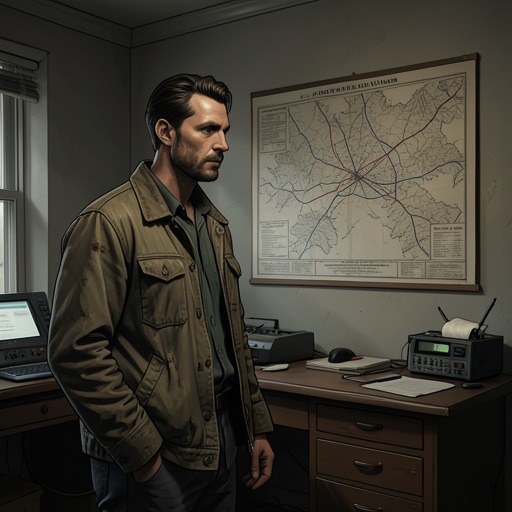
A plaque on the desk identifies Wolf by name, while his appearance suggests a bull moose rather than the name on the plaque. The contrast gives his introduction a wry physical note, but his manner is anything but comic. Left alone with James Mowry, he fixes his attention on him and speaks in hard, even tones, promising first that Mowry is entitled to an explanation and then, after a pause, that he will get one.
That measured delivery establishes Wolf as an official who controls both the information and the pace of the encounter. He does not begin with a friendly appeal or an open account of the matter; he holds Mowry’s attention and lets the promise of an explanation create its own pressure.
Files, Surveillance, and Survival
Wolf’s authority is backed by a personal file. He takes it from his desk, thumbs through it, and cites a fine imposed on Mowry on his fourteenth birthday: one hundred Sirian guilders for expressing an opinion. The detail reaches far back into Mowry’s life, making the file feel less like a record of current service than a durable account of an individual’s history. The supplied passage does not complete the description of the opinion, so its subject remains unstated.
When Mowry calls the surveillance nosey, Wolf answers that it is necessary and asks him to regard it as part of the price of survival. He then supplies the scale behind the claim: there is a punched card for every Terran in existence. The exchange turns an individual’s unease into a statement of institutional principle. Wolf neither denies the intrusiveness nor apologizes for it; he presents comprehensive record-keeping as an unavoidable condition of collective security.
Mowry’s Decision
Wolf’s file and manner form part of the encounter in which Mowry decides to volunteer. After Mowry concludes that the old man was right and says, “I hereby volunteer,” Wolf replies, “We knew you would.” His calm answer makes the decision feel both freely made and anticipated. Wolf does not celebrate or attempt to persuade him in the moment; the response suggests that Mowry’s choice fits an assessment already formed of him.
The encounter with Wolf recurs two days after Mowry has completed the arduous course and passed satisfactorily. That return places Wolf at both the point of commitment and the next stage of Mowry’s preparation, though the available episode does not specify what Wolf does during the later meeting.
Character and Narrative Role
Wolf is drawn through procedure and restraint rather than through an extended account of his private life. The file, the all-Terran card system, and his unhurried confidence give him the shape of a bureaucratic gatekeeper; the bull-moose comparison supplies the scene’s brief note of visual humor. His assurance that Mowry is entitled to an explanation also marks him as the holder of information, even as the evidence here leaves the substance of that explanation unstated.
The tension in Wolf’s role is that intimate scrutiny and practical necessity occupy the same conversation. He knows a detail from Mowry’s adolescence, calls such knowledge a price of survival, and then treats Mowry’s volunteering as something expected. The result is a compact portrait of authority that does not need to threaten or cajole: it can demonstrate how much it knows, explain why it keeps records, and wait for the subject to choose.