Radine
WaspRadine is a city of three hundred thousand people, located 240 miles south of Pertane and identified as having hydro-electric power. For James Mowry, it is first a distant place where a spreading crisis can gain force, then a setting for escape, and finally a possible refuge approached through the forest. Its recurring appearances give the city a double character: a populated, connected urban centre and a point on the map toward which danger repeatedly draws him.
Setting and Connections
The narrative introduces Radine through distance and scale. It lies 240 miles south of Pertane, far enough away to make the spread of trouble between separate places consequential. The account compares that spread to an epidemic: menace grows when it appears in locations far apart. In that context, James Mowry’s first outing from his new abode takes him to Radine. The journey makes the city part of a widening pattern rather than an isolated destination.
The city’s population of three hundred thousand and its hydro-electric power establish it as a substantial urban centre. The railway further connects it to the surrounding region. When Mowry arrives by train, Radine is the terminus, and all the passengers get out. He goes with the crowd through the station exit, moving into the city as part of a mass of arriving travellers rather than emerging into an empty or remote setting. The terminus gives Radine a practical role as a point of arrival, while its position south of Pertane makes it a significant location in Mowry’s movements.
Visits and Flight
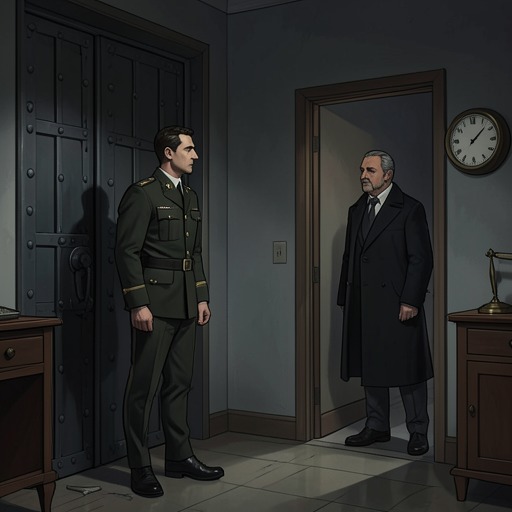
On one visit, Mowry searches the rooms of a house associated with Major Sallana and finds all four vacant. The absence is definite: Major Sallana is not at home. Mowry returns to the first room, examines it sharply, and spots a gun on top of a small filing cabinet. He checks that it is loaded and puts it in his pocket. The discovery turns an otherwise empty interior into a source of immediate equipment, linking Radine’s domestic spaces to the danger and improvisation of Mowry’s actions.
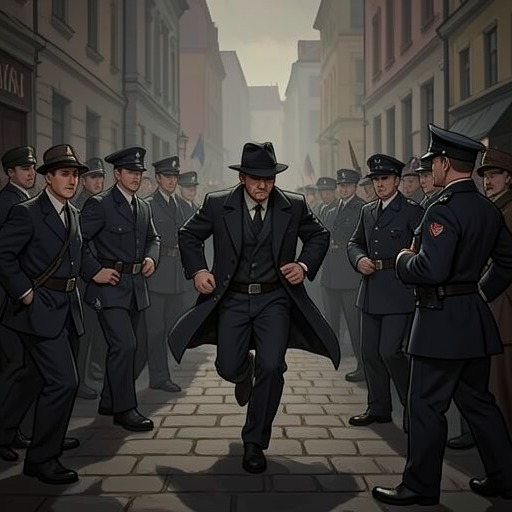
Later, the approach to Mowry’s high-class hideout is interrupted by a visible concentration of official response. Shortly before the twelve-time hour, he turns onto the road where the hotel is located and halts abruptly. A line of official cars stands outside, along with a fire-pump. The scene changes the hotel’s meaning from concealment to exposure: the road that should lead to a hideout instead presents the signs of an active emergency and official attention.
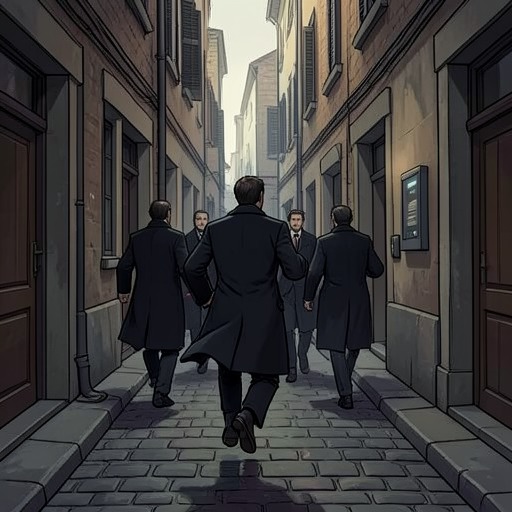
The demand that Mowry show his documents makes identification the immediate obstacle. He slides a hand into his inner pocket while those confronting him watch closely, tense and ready for his movement. He eventually gets beyond Radine: seven minutes later, he passes its last houses and heads into open country along an unfamiliar road. The precise interval and the transition from the town’s edge to unknown countryside make his departure a narrow escape from an urban setting where his presence has become perilous.
Roads, Return, and the Night Sky
Radine remains a destination even after Mowry has left it. While moving through the forest, he avoids the occasional lumberjacks and follows a westward circle intended to bring him not far south of the city. He keeps to a part of Jaimec he knows, despite the risks, and decides that near Radine he will use his gun to obtain another car and genuine documents, accepting that this could mean burying a corpse in the woods. He also considers checking the situation in the city and hiding there if conditions are not too dangerous. The plan shows how his approach to Radine is shaped by competing needs: transport, papers, and shelter, all weighed against the threat of violence and capture.
Two hours after sunset on his last day of wandering, Mowry reaches the main Radine–Khamasta road and parallels it through the forest as he continues toward Radine. Traffic swiftly thins and then stops altogether. From the darkened city, a thousand crimson, serpent-like streaks rise and drive into the night sky; another great flash comes from the region of Khamasta. The text does not explain the lights or the flash in this moment, but their scale and their appearance after traffic has ceased turn the distant urban horizon into a sign of upheaval. Radine is not yet a refuge: Mowry is still outside it, approaching through darkness while the landscape around the road falls quiet.
Narrative Significance
Radine’s role develops through successive changes in Mowry’s relation to it. At first it is a far-off city chosen for an outing amid a spreading menace. It then becomes a place of arrival, a site where an empty house yields a loaded weapon, and an urban threshold from which Mowry has to escape after official activity gathers around his hotel. Later, he circles back toward it with plans to acquire transportation and documents, while leaving open the possibility of hiding there. The city thus functions less as a secure destination than as a practical but unstable option in his efforts to keep moving.
The routes around Radine reinforce that instability. The station brings a crowd into the city; the road past its last houses carries Mowry into unfamiliar open country; the forest and the Radine–Khamasta road later lead him back toward its outskirts. At the end of the supplied sequence, he has not yet entered or secured refuge in Radine. He is still advancing toward it as traffic disappears and crimson lights rise over the city. The contrast between the ordinary markers of connection—railway, roads, power—and this ominous nighttime approach gives Radine its narrative force: it is both a usable centre of movement and a place whose safety cannot be assumed.