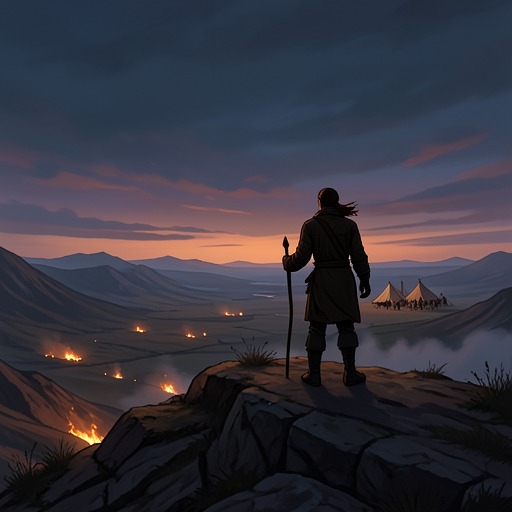
Merdon–Altai
WatchmenMerdon–Altai is one of the clearest relationships through which The Watchmen connects private attachment to the political choices of the Shinarian rebellion. They begin as close companions within Merdon’s insurgent movement, bound by trust, shared danger, and an evident emotional intimacy. Their bond is strong enough for Altai to comfort Merdon at moments of strain, but not strong enough to erase their disagreement over how Shinar can be defended. When Merdon refuses to cooperate with Emil Vorgens against the Komani, Altai chooses the immediate defense of their world over loyalty to the rebel leader she loves.
Intimacy Within the Rebellion
Merdon and Altai are first shown moving together away from the rebel group after Merdon has spoken with his father. Merdon turns the group over to a lieutenant and walks toward the far end of the compound; Altai follows without needing to be summoned, and he slows his pace so that she can come abreast of him. The small adjustment of movement establishes a relationship based on mutual awareness rather than formal command. Even when Merdon leaves the larger gathering, Altai remains close enough to continue the conversation privately.
Their exchange reveals that she knows how political pressure affects him. Altai observes that he becomes angry and argumentative whenever he speaks with his father, while Merdon admits that he has not recognized the pattern. Her response is physical as well as verbal: she places her hand against his cheek and tells him that he must not allow anyone or anything to upset him, because his mind must remain clear. The reason she gives is not merely personal concern. Merdon holds the lives of their fighters in his hands, and when he asks whether she means her own life as well, she answers that she does. Her attachment therefore carries an explicit shared-stakes dimension: she is emotionally close to him, but she also understands his authority as a danger imposed on everyone around him.
Shared Purpose and Political Pressure
Altai’s closeness to Merdon exists within a movement whose aim is Shinarian freedom. Merdon invokes the idea that freedom requires the intelligence and courage to stand independently and resist enslavement, recalling words studied by Clanthas’s son and originally spoken by Geoffrey Knowland. In Merdon’s hands, that ideal becomes a demand for uncompromising independence from the Terran Empire. Altai shares the struggle against oppression, but the narrative shows that shared opposition does not automatically produce agreement about tactics or alliances.
This tension becomes explicit when Vorgens asks the Shinarians to choose whether to fight with the Terrans against Okatar Kang’s Komani forces or allow the Komani to seize Shinar and use it as a springboard for a wider galactic war. Vorgens cannot guarantee that cooperation will produce self-government, but he presents resistance to Okatar as the urgent condition of preserving the planet. Merdon’s position is harder and more absolute: he wants Shinar freed, and he resists an arrangement that requires fighting beside the Empire. The relationship between Merdon and Altai is consequently placed between two kinds of loyalty—loyalty to a long-term national ideal and loyalty to the immediate survival of the people who embody it.
The Break Over Vorgens
The decisive rupture comes after Altai and several young fighters move away from Merdon’s position. When one lieutenant follows her, Tarat predicts that others will join once they hear what has happened. Merdon reacts with fury and insists that those who leave will crawl back after Shinar has been freed. His response reduces the disagreement to a temporary defection from the true cause; Altai, by contrast, treats the military situation as requiring an immediate decision.
Altai later tells Vorgens directly that she has left Merdon. Several squads have chosen to join Vorgens and fight against the Komani, and they are waiting for his orders. Her outward calm conceals intense strain, and the tears she has shed are no longer visible in her eyes. The controlled appearance matters because the announcement is both operational and personal: she is delivering fighters to a new commander while reporting the abandonment of the man who had been her closest ally.
Her account makes clear that the separation is not caused by a loss of feeling. Merdon refuses to change his mind and says that he will fight against Vorgens until Shinar is free. Altai’s choice is therefore not presented as simple betrayal or rejection. She leaves because Merdon’s refusal prevents him from joining the broader defense against the Komani, even though she remains affected by his decision. Their bond survives as emotional pain after it ceases to function as political unity.
Divergent Choices and Consequences
Altai’s decision helps turn a divided resistance into a more practical coalition. Clanthas subsequently reports that the other leaders have accepted Vorgens’s proposal and will help work against the Komani in whatever way possible. The alliance is not born from complete trust in the Empire; it emerges from the calculation that cooperation is necessary to prevent the Komani from destroying Shinar. Altai’s departure anticipates that collective shift by converting personal allegiance into a concrete military contribution.
Merdon’s later change in relation to Vorgens sharpens the significance of his break with Altai. When a rapid counterattack becomes possible, Vorgens offers to bring vans and troop carriers within an hour, solving the transport problem that had prevented Merdon from reaching Katan quickly. Merdon then acknowledges that he has been wrong about many things, especially about Vorgens, and says he will tell his people to follow the Watchman’s orders. He asks whether he may fight alongside Vorgens, and Vorgens answers not with an argument but by extending his hand. Merdon accepts it, and the two men go down together to the waiting people.
That reconciliation does not undo Merdon–Altai’s earlier separation. Instead, it shows that Merdon eventually makes the practical compromise Altai had already made. Her departure forces the issue before he is ready to accept it; his later alliance with Vorgens confirms the necessity of the choice without restoring the relationship to its earlier form. The contrast gives the pair’s story its emotional shape: Altai changes course first, while Merdon reaches the same strategic conclusion only after his absolutism has cost him her presence.
Narrative Significance
Merdon–Altai dramatizes how revolutionary movements test intimacy. Their relationship is not detached from politics, because affection itself is measured against responsibility for fighters, civilians, and the threatened planet. Altai’s touch at Merdon’s cheek and her insistence that his clarity protects her life make private attachment inseparable from command. Later, her calm report, hidden tears, and declaration that Merdon will continue fighting against Vorgens preserve the emotional truth of the bond even as its political basis collapses.
The relationship also gives human scale to the larger conflict among the Shinarian rebels, the Terran Empire, and Okatar Kang’s Komani. Merdon embodies resistance that fears compromise will corrupt freedom; Altai embodies resistance willing to use an imperial alliance to prevent conquest and preserve the possibility of self-government. Neither position is reduced to a casual disagreement. Their separation is the cost of choosing between ideological purity and immediate collective survival, and Merdon’s eventual cooperation with Vorgens suggests that Altai’s painful decision was not merely personal—it anticipated the course the wider struggle would take.