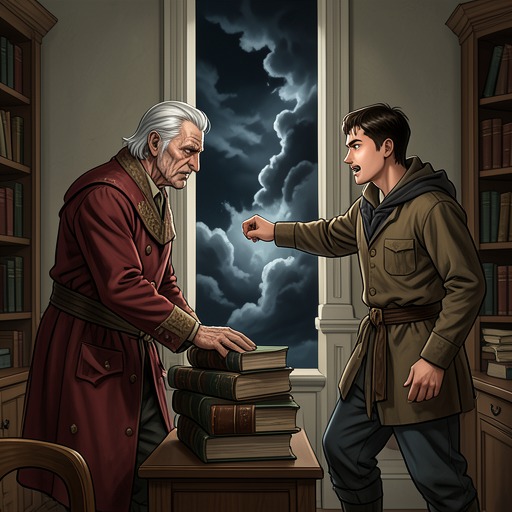
Merdon–Clanthas
WatchmenMerdon–Clanthas is one of the central family and political conflicts in The Watchmen: the bond between a father who fears that rebellion will destroy Shinar and a son who believes that decisive action is necessary to free it. Their relationship gives the planetary struggle an intimate scale. Clanthas does not confront an abstract revolutionary movement; he confronts his only son, whose attempt to defeat the Terrans has helped bring the Komani into the conflict and has placed the entire population between two foreign powers.
Identity and Political Circumstance
Clanthas is a merchant and the father of Merdon. By the standards of his people, he is in middle life, broad-girthed and puffy-faced, with a nut-brown complexion, dark hair, coal-like eyes, prominent cheekbones, a broad brow, and a massive, stubborn jaw. Merdon resembles him physically in youth: he is tall, broad, and strong-limbed, and shares the same facial structure. The resemblance emphasizes that their disagreement is not a clash between strangers but a division within one household and one political community.
Clanthas becomes the acting leader of his people before the decisive confrontation with his son. He is caught between the Terrans, who intend to “pacify” Shinar and restore it as a docile colony, and the Komani, who have entered the planet with their own plans. He also lacks complete control over Shinarian hotheads and opportunists. Merdon therefore confronts him not merely as a disobedient son but as the leader of a movement whose decisions may determine whether Shinar is occupied, devastated, or subordinated to a new outside power.
The Father–Son Confrontation
In a private room, Clanthas watches Merdon’s image through a tri-di transceiver. For that afternoon he tries to set aside the larger questions of politics and fighting and address his only son as an outraged, bewildered father. The attempt does not produce reconciliation. Clanthas tells Merdon that he had once dismissed his plans as lunacy, but now regards them as doom and the ruin of their planet and people. His anger is inseparable from fear: Merdon is not simply one rebel among many, but his only son and the ringleader of the scheme.
Clanthas’s accusations identify the particular failures he believes Merdon has committed. Merdon did not remain at his father’s side to help control his hot-blooded friends. He did not warn Clanthas about the plot against the governor’s life, and he did not oppose those who wanted to shoot back at the Terrans. Instead, he went further by pursuing a plan to free the planet through outside military intervention. Clanthas interprets Merdon’s silence and initiative as a betrayal of both filial trust and political responsibility.
Merdon answers that he did what necessity demanded because the Terrans would not be swayed by words. This reply establishes the fundamental difference between them. Clanthas still thinks in terms of restraint, concealment, and preserving a possible political escape. Merdon thinks in terms of force and irreversible action. His objective is to free Shinar and expel the foreigners, but the means he chooses require inviting another foreign people—the Komani—to fight on Shinar’s behalf.
The Komani Decision and Its Consequences
Merdon expects Okatar Kang to secure overwhelming strength before attacking the Terrans and speaks of wiping them out completely. Clanthas sees the Komani as barbarians drawn toward a wounded planet, while Merdon treats their intervention as the practical instrument of liberation. The conflict is therefore not only about whether rebellion is justified. It is about whether a people can regain autonomy by relying on a power whose own intentions may be just as threatening as those of the empire it seeks to resist.
Clanthas commands Merdon to keep his men away from the battle and not to join it. The Terrans do not yet know that Merdon and his allies invited the Komani to Shinar; if the truth becomes known, Clanthas believes they will never trust any Shinarian again. His proposed strategy is deliberately double-sided. If the Komani defeat the Terrans, their own losses may leave them weak enough for the Shinarians to overcome. If the Terrans win, the Shinarians may claim that they played no active part in the attack and perhaps escape the consequences. Clanthas’s reasoning is defensive and calculating, but it also reveals how thoroughly Merdon’s decision has narrowed the available choices.
The wider crisis confirms the danger of that decision. In an idle nutrient-processing plant, Merdon argues with Tarat and Romal while they pace back and forth. Vorgens fears that resistance to the Empire could spread to other planets and become a general war, especially if the Komani attack another Imperial world. Merdon’s position is harsher: Shinarian homes, farms, and cities may have to be surrendered because the Komani will take them by force if they are not given voluntarily. The father’s fear that foreign intervention will destroy Shinar thus becomes a concrete dispute over whether the population should sacrifice its possessions to avert immediate devastation.
Trust, Authority, and Competing Laws
The relationship also unfolds against competing claims of authority. Vorgens is sent to negotiate with the chief of the Komani raiders, offering them peaceful return to their homeworld if they stop attacking Oran VI and reminding them that the Komani were allies of the Terrans during the Galactic War. The appeal rests on imperial orders, treaty-like loyalty, and the idea that the attack violates an older friendship. Merdon’s political strategy rejects that framework: he treats the Komani as a force that can be redirected against Terran rule, even though their arrival threatens to make Shinar a battlefield between outsiders.
The collision becomes more explicit when Okatar Kang identifies Vorgens as a Terran prisoner who attempted escape and invokes the Komani tradition that prisoners who reject their hospitality are executed. Later, a Komani officer claims, in Okatar Kang’s name, that the Terrans sheltered at Sittas’s location are prisoners. Sittas rejects the claim with emphatic vehemence. These scenes show the same problem that governs Merdon and Clanthas: no single authority is accepted by all parties. Imperial orders, Komani custom, Shinarian political interest, religious protection, and Star Watch jurisdiction each compete to define what may be done to a person or a population.
After the crisis, Sittas acknowledges that he took authority into his own hands and says that a Star Watch court may later decide whether he had the right to do so. Vorgens, in turn, thanks him for saving the lives of Vorgens and the men of the Mobile Force. The exchange points toward a future in which responsibility must be judged after emergency action, whereas Clanthas and Merdon are forced to act before any such judgment is possible. Their family conflict is intensified by this absence of secure legal or political ground.
Development and Narrative Significance
Merdon and Clanthas do not simply represent youth against age. Merdon’s boldness is coupled with a political blindness: in seeking liberation, he creates dependence on the Komani and helps place Shinar inside a larger imperial conflict. Clanthas’s caution is coupled with its own moral and practical danger: his plan relies on concealment and on waiting for whichever foreign army emerges weakened. Each recognizes part of the truth, but neither can convert that recognition into a shared course of action.
Their relationship gives the novel’s anti-imperial conflict a tragic structure. Clanthas wants to protect his son and his people by limiting the damage, while Merdon believes that protection without action merely preserves subjection. The father’s warnings cannot undo the invitation already extended to the Komani, and the son’s revolutionary initiative cannot guarantee that Shinar will belong to the Shinarians afterward. Merdon–Clanthas therefore embodies the cost of resistance conducted under occupation: political choices become family accusations, filial loyalty becomes a demand for obedience, and the desire for freedom risks reproducing the domination it was meant to end.