Vorgens–Merdon
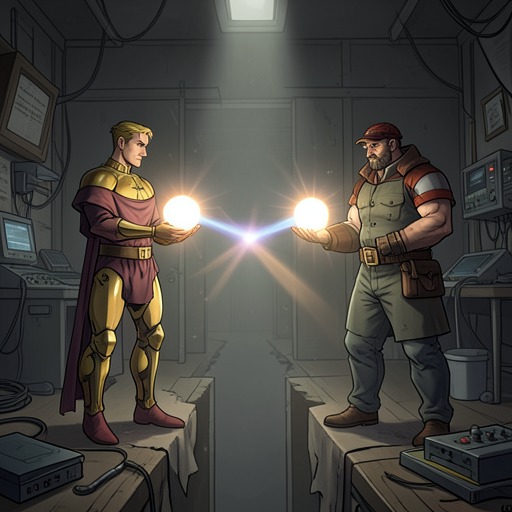
WatchmenVorgens–Merdon is one of the central political and moral relationships in The Watchmen, moving from confrontation over Shinar’s future to a partnership forged in military crisis. Merdon initially sees Emil Vorgens as an imperial officer who might be recruited against the Terran Empire; Vorgens sees Merdon as a rebel whose alliance with the Komani threatens both imperial stability and Shinar itself. Their eventual handshake, after Merdon admits that he has been wrong about Vorgens and agrees to fight beside him, gives the relationship its decisive significance: political trust emerges not from agreement about the Empire, but from recognition of a common responsibility toward Shinar and its people.
Identity and Initial Opposition
Merdon is introduced as a young Shinarian rebel working with Okatar Kang while the Komani occupy a central place in the rebellion’s military arrangements. When Vorgens and Sittas meet him in the Komani encampment, Merdon explains that the Komani are in Shinar because the Shinarians invited them. They are not, in his account, foreign conquerors manipulating an unsuspecting resistance; they are guests and allies helping the Shinarians fight the Terrans. This distinction defines Merdon’s political position. He regards the local alliance as an instrument of liberation, while imperial commanders interpret it as evidence that Shinar is becoming a base for Komani expansion.
Merdon’s confidence in that alliance leads him to treat Vorgens as a possible convert. He knows that Vorgens is not a native Terran and uses that fact to challenge the officer’s imperial loyalty. Merdon urges him to join the struggle to free Shinar and suggests that the same movement might eventually destroy the Empire and liberate Vorgens’s own people. The offer is both political and personal: Merdon tries to turn Vorgens’s complicated origin into a reason to reject the identity imposed by imperial service.
Vorgens refuses. He acknowledges that his people once fought the Terrans, but insists that they have since become so much a part of the Empire that independence is neither practicable nor desired. More importantly, he identifies himself as a sworn officer of the Star Watch and refuses to turn against men with whom he has served. Merdon dismisses this position as hiding behind duty, but Vorgens answers with a consequential argument: whatever the Empire has done on Shinar, its destruction would plunge the peoples under its rule into chaos and starvation. Their disagreement therefore exceeds a simple opposition between patriot and collaborator. Merdon treats imperial rule as the central evil; Vorgens accepts its injustices while fearing the catastrophe that might follow its collapse.
Negotiation, Captivity, and Competing Authorities
The relationship is repeatedly shaped by competing claims to authority. Vorgens arrives on Oran VI under explicit orders to negotiate with the chief of the Komani raiders, offering peaceful withdrawal if the raiding stops and invoking the Komani clans’ sworn loyalty to the Terran Council. The assignment places him between imperial diplomacy and a local conflict whose participants do not necessarily recognize the same political obligations. Merdon’s position makes that negotiation more difficult because he has already framed the Komani as Shinarian allies rather than enemies.
The tension becomes personal when Vorgens is captured. Okatar Kang identifies him as the Terran prisoner who attempted to escape and declares that prisoners who reject Komani hospitality are traditionally executed. Merdon is present among the Shinarians while this threat is made, linking him directly to the political and legal environment in which Vorgens’s life is endangered. Later, when a Komani officer claims the Terrans sheltered by Sittas as prisoners in Okatar’s name, Sittas rejects the claim with unexpected vehemence. These moments establish the unstable legal landscape surrounding Vorgens and Merdon: imperial orders, Komani custom, local protection, and military necessity all compete to determine who may command, imprison, or kill.
Vorgens’s eventual authority also remains legally uncertain. He tells Sittas that he has taken authority into his own hands and that whether he had the right to do so will be decided by a Star Watch court in the future. Yet this admission does not make him passive. The relationship with Merdon develops within precisely this gap between formal jurisdiction and emergency action. Vorgens’s status as a prisoner, officer, and later commander changes because he acts before institutions can settle the legitimacy of his choices.
From Rebellion to Conditional Cooperation
The decisive political change comes when Vorgens argues that the Mobile Force cannot defeat the Komani on Shinar by itself. It can defend itself, he explains, but Okatar could ravage the planet before reinforcements arrive. Vorgens therefore asks the Shinarians to fight alongside the Terrans, presenting the choice in stark strategic terms: they can defend their world against the Komani or allow the planet to become the springboard for a wider galactic war. He does not promise that the Empire will grant self-government in return. When asked whether Shinarian cooperation will win imperial approval for autonomy, he says only that it might and that he cannot guarantee it.
That refusal to offer certainty is important to the relationship. Vorgens does not attempt to win Merdon by pretending that imperial policy has already changed. Instead, he asks him to act under conditions of risk, with no guaranteed political reward. Merdon must decide whether cooperation with the officer he once regarded as an imperial obstacle is preferable to the Komani victory that could turn Shinar from ally into subject.
The danger becomes explicit when Okatar announces that the Komani will treat Shinar as a conquered subject rather than an ally. He accuses Merdon and his army of plotting to let the Terrans drive the Komani away and then attack the weakened invaders. Okatar intends to offer Merdon a bargain on Komani terms: continued service, but only as a subject. The offer exposes the weakness in Merdon’s original calculation. An alliance made to secure Shinarian freedom can be revoked by the stronger partner, leaving the rebels with dependence instead of sovereignty.
Merdon’s political reversal is therefore not a simple conversion to imperialism. It is a recognition that the Komani alliance has ceased to protect the independence it was meant to achieve. Vorgens’s warning becomes persuasive because events expose the consequences of treating military assistance as though it guaranteed equal political standing.
Trust and the Final Partnership
By the later encounter between the two men, Vorgens’s personal situation has changed: he is no longer a prisoner, and although he remains only a junior officer by rank, he is the Star Watch officer in command of Shinar. Merdon has heard of this transformation and responds with a grin, signaling that the old opposition has been replaced by a more complicated familiarity. Vorgens’s authority is now practical rather than merely institutional; he has acquired command through the crisis that once made him vulnerable to Merdon’s allies.
Their final cooperation is organized around an immediate attack on Katan. Merdon lacks enough groundcars to reach the threatened location quickly, but Vorgens says he can bring a squadron of vans and troop carriers within the hour. The exchange reverses their earlier roles. Merdon, once the man offering Vorgens a place in the rebellion, now agrees to tell his people to follow Vorgens’s orders. Yet he does not simply withdraw into political obedience. He says that he has been terribly wrong about many things, most of all about Vorgens, and asks whether he may fight alongside him.
Vorgens answers without a speech. He extends his hand. Merdon takes it in a firm grasp, and the two men descend side by side toward the waiting people. The gesture is modest but conclusive. It does not settle the question of Shinarian self-government, remove the Empire’s record of domination, or convert Merdon into an imperial loyalist. It establishes instead a working trust grounded in demonstrated conduct: Vorgens has shown that duty can include protecting Shinar, while Merdon has shown that resistance must sometimes revise its alliances to preserve the people it claims to liberate.
Narrative and Political Significance
The arc of Vorgens–Merdon dramatizes the instability of political categories under colonial and military pressure. Merdon begins by treating Vorgens’s non-Terran origin as an opening through which imperial allegiance might be broken. Vorgens replies that identity is not determined solely by ancestry, and that service, citizenship, and responsibility have become part of his people’s actual history. Their conflict thus places inherited belonging against chosen obligation without allowing either side to remain uncomplicated.
The relationship also reveals how collective action depends on changing calculations of danger. Merdon’s initial strategy relies on the Komani as allies, but Okatar’s later declaration shows that the same force can convert cooperation into subordination. Vorgens’s proposal to work with the Terrans offers no guarantee of autonomy, yet it provides a way to prevent immediate conquest. The eventual alliance is consequently conditional and practical rather than sentimental: both men act because the alternative is the destruction or enslavement of Shinar.
Their movement from distrust to partnership follows a compressed separation, ordeal, and return. They first stand on opposite sides of imperial authority; they then confront captivity, disputed jurisdiction, and the collapse of the Komani alliance; finally, they return to the political community not as ideological equals but as coordinated defenders. The final image of them walking side by side makes cooperation the relationship’s true resolution. Merdon does not abandon the demand for freedom, and Vorgens does not abandon his oath. What changes is their understanding of the other: rebellion and duty, once treated as mutually exclusive, become temporarily compatible when both are directed toward saving Shinar.