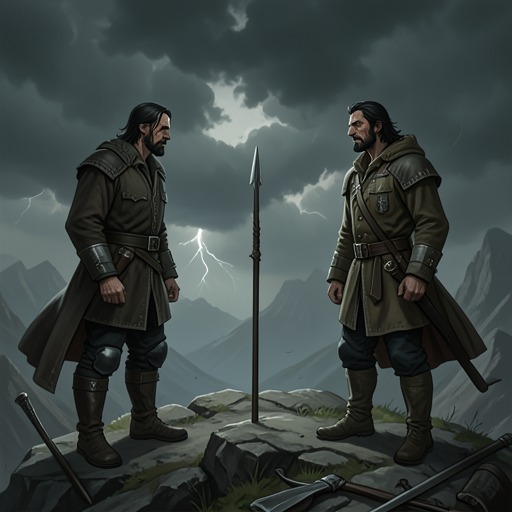
Okatar–Merdon
WatchmenThe Okatar–Merdon relationship gives the Shinarian conflict its clearest political and moral opposition: Merdon seeks freedom for his world, while Okatar Kang offers liberation only as part of a wider Komani campaign. Their encounters move from negotiation to surveillance, coercion, and open domination, revealing how quickly an alliance built against the Terran Empire can become another form of subjection.
A Tactical Alliance
Merdon initially deals with Okatar as the commander of a force that might remove Terran rule from Shinar. Okatar promises that the Komani will soon leave the planet, that the Terrans will be wiped out, and that Shinar will thereafter be free of them permanently. Merdon immediately identifies the qualification hidden inside that promise: Shinar is being used as a staging ground for attacks nearer the heart of the Terran Empire. Okatar does not deny it. He treats the Komani objective as paramount and dismisses the question of motive, insisting that freeing Shinar remains enough regardless of the larger strategic purpose.
This exchange establishes the asymmetry between them. Merdon regards Shinarian freedom as an end in itself; Okatar regards it as a consequence that can coexist with Komani expansion. Okatar further presents the Komani as fighters rather than governors, claiming that they will live on tribute from peoples liberated from the Terrans and fight only those who serve or resist the Empire. The promise sounds less like self-government than a new hierarchy, and Merdon’s private memory of his father’s warning signals his growing unease.
Negotiation and Distrust
Merdon’s suspicion becomes practical when Okatar examines the rebels’ weapons tallies and complains that the available supply is too small. The question exposes the material basis of the alliance: Okatar needs Shinarian resources, while Merdon must decide how much aid can be given without surrendering the movement’s independence. The relationship is therefore conducted through lists, equipment, and military calculations as much as through political ideals.
The Komani commander does not merely negotiate with Merdon; he monitors him. From a chamber in his main tent, Okatar watches six young Shinarian rebels on a tabletop viewscreen as they return to their tents. A remote receptor has captured every word they spoke, and Okatar responds with satisfaction to the technician who confirms its reach. The scene converts the supposed partnership into an unequal relation of observation: Merdon’s side is not a trusted ally but a population whose loyalty Okatar measures and tests.
From Alliance to Subjugation
The decisive rupture occurs when Okatar concludes that the Shinarians have betrayed him. Their retreat and refusal to offer the battle he wants convince him that they had intended the Terrans to be driven away and the Komani to be weakened afterward. He consequently abandons the language of allied cooperation and orders that Shinar feel the full might of the Komani. The Shinarians are to be treated as subjects, and Okatar declares the planet his to take.
Merdon’s position is caught between two invading powers. Emil Vorgens explains that the Imperial Marines’ Mobile Force cannot defeat the Komani on Shinar by itself; it can defend itself, but Okatar could ravage the planet before reinforcements arrive. Vorgens therefore offers Merdon a stark choice: fight alongside the Terrans against the Komani or allow the Komani to seize Shinar as the springboard for a galactic war. When Merdon asks whether cooperation might lead the Empire to grant self-government, Vorgens can offer only hope, not a guarantee. That uncertainty makes Merdon’s decision costly: he must risk association with the old imperial power to prevent a new conqueror from taking the world outright.
Okatar later confirms the coercive logic of his policy when Merdon asks whether supplying the Komani’s requested equipment would persuade them to leave Shinar in peace. Okatar agrees to consider striking the next Terran target if such a bargain can be arranged, but the proposal makes clear that Shinar’s safety depends on satisfying the conqueror’s appetite. Merdon is no longer bargaining over equal cooperation; he is trying to purchase temporary relief for his people.
Reversal and Recognition
The relationship’s final reversal comes when Merdon and Vorgens confront an urgent military problem at Katan. Merdon admits that he lacks enough groundcars to reach the threatened location quickly. Vorgens answers that he can bring a squadron of vans and troop carriers within the hour. The concrete offer of transport transforms his earlier argument into immediate action: the Terran officer can help defend Shinar rather than merely demand its allegiance.
Merdon then acknowledges that his judgment has been badly mistaken, especially about Vorgens. He tells his people to follow the Watchman’s orders and asks to fight beside him. Vorgens answers without a speech, extending his hand; Merdon takes it in a firm grasp, and they descend together toward the waiting people. Set against Okatar’s surveillance, demands, and treatment of Shinar as property, this gesture marks a different kind of alliance. Merdon does not cease to seek self-government, nor does Vorgens guarantee it, but the two men now share an immediate responsibility: preventing Okatar from converting Shinar’s desire for freedom into Komani domination.
Political and Thematic Significance
Okatar–Merdon dramatizes the danger of confusing an enemy’s enemy with a liberator. Merdon’s movement begins by needing outside help, while Okatar’s campaign exploits that need and reframes conquest as emancipation. The relationship’s progression—from promises, to demands, to intelligence-gathering, to the declaration that Shinar is “ours for the taking”—shows liberation being hollowed out by the power that claims to deliver it.
Merdon’s resistance is also shaped by a broader Terran idea of freedom, recalled from words attributed to Geoffrey Knowland: a person remains free through the intelligence and courage to stand independently and through the strength to resist enslavement. The irony is deliberate. The quotation comes from a Terran conqueror who established Terran rule over Shinar, yet Merdon applies its principle against both imperial domination and Komani replacement. His relationship with Okatar thus turns a historical maxim into a test: freedom cannot be validated merely by changing the flag above the occupying army; it requires the threatened people to retain the power to choose their own allegiance and future.