Terran Empire–Komani
WatchmenTerran Empire–Komani is one of the book’s central political relationships: an alliance forged in the war against the Masters becomes, a century later, the memory against which imperial rule is judged. The relationship moves between military cooperation, colonial authority, rebellion, and attempted negotiation, showing how a shared victory can become the foundation for both empire and resistance.
Historical Alliance and Imperial Order
The relationship began in the successful war against the Masters. The Star Watch, which had existed before the Terran Empire and even before the older Terran Confederation, fought that war and helped transform the Confederation into the new master of much of the galaxy. The Komani nation fought on the Terran side during that conflict, making the two peoples former allies rather than permanent hereditary enemies. That history remains politically important because the Terran Empire later invokes the alliance as evidence of friendship, while Komani leaders treat the same past as proof that their people once possessed the strength to act independently.
The victory over the Masters also created the structure that later strained the relationship. The Terrans’ expansion produced an interstellar empire whose routes were controlled by the Star Watch, while the Imperial Marines handled fighting on planetary surfaces. The imperial system therefore preserved order through specialized military institutions, but its authority over distant peoples also made former allies subjects of a wider political hierarchy. The Komani-Terran relationship carries this contradiction throughout the narrative: the Komani helped create the political order that eventually constrained them.
From Friendship to Conflict on Shinar
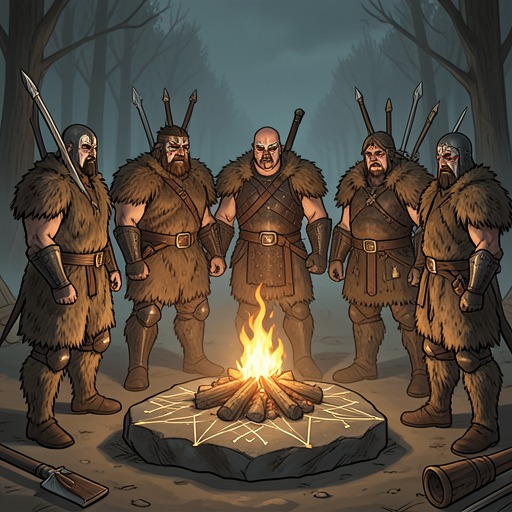
When Komani raiders attack Oran VI, Emil Vorgens receives orders to negotiate with their chief. He is expected to tell the raiders that they may return peacefully to their homeworld if they immediately stop raiding Imperial territory. He must also remind them that Komani clan chieftains have sworn loyalty to the Terran Council and that the attack violates the friendship established during the Galactic War. Negotiation thus begins not from mutual equality but from an imperial demand supported by a remembered alliance.
The appeal fails because the current Komani leadership no longer accepts the political meaning that the Terrans assign to the past. Okatar Kang argues that a single Komani clan has already humbled the Terran Mobile Force and the planetary garrison on Shinar. He points out that Terran reinforcements are distant, that the Mobile Force is trapped, and that the Star Watch fleets cannot arrive for at least a month. In his calculation, military weakness has exposed the Empire’s dependence on reputation. The former allies are no longer asking for recognition within the imperial order; they are testing whether that order can survive open defeat.
Okatar’s argument expands the local conflict into a projected galactic reversal. He claims that the people of Shinar do not want the Empire and that peoples across the galaxy have learned to hate the Terrans. The Terrans, he says, took control from the Masters, and the Komani will now take control from the Terrans. For too long, the Komani clans have fought one another while Terran power grew from their division; a visible Komani victory on Shinar could persuade the other clans to join Okatar. The relationship therefore becomes a contest over whether old inter-Komani divisions or renewed anti-Terran unity will shape the future.
Law, Captivity, and Competing Claims
The conflict is also expressed through rival legal and customary authorities. After Vorgens is captured, Okatar identifies him as the Terran prisoner who attempted to escape. He declares that prisoners who reject Komani hospitality are traditionally executed, making the execution custom a direct challenge to the norms and jurisdiction represented by the Star Watch. Later, a Komani officer claims, in Okatar’s name, the Terrans sheltered by Sittas as prisoners. Sittas rejects the claim emphatically, refusing to let Komani authority determine the status of people under his protection.
Vorgens’s own response reveals the tension within imperial authority. After surviving the crisis, he acknowledges that he acted with authority as a Star Watch officer, while admitting that a future Star Watch court may decide whether he had the right to take that authority into his own hands. His conduct therefore belongs to both military necessity and legal uncertainty. The relationship between the Empire and the Komani is not governed by a single accepted rule: imperial command, Komani custom, local sanctuary, and emergency action compete to define who may protect, imprison, or execute.
Shinarian Mediation and Conditional Cooperation
The relationship changes when the conflict is viewed from Shinar rather than solely from the imperial or Komani side. Sittas reminds Vorgens that the Komani were once allies of the Terrans and asks whether that history must end in everlasting hatred. His intervention does not deny the raiders’ violence; instead, it challenges the assumption that present enemies are incapable of change. The old alliance becomes a moral and political resource for imagining peace, even while the current war continues.
A sharper challenge comes from Merdon, who asks Vorgens to join the Shinarian rebels. Merdon notes that Vorgens is not a native Terran and argues that his own people once fought against the Empire. He invites Vorgens to help free Shinar and perhaps eventually destroy the Empire itself, linking Komani recruitment to a broader anti-imperial coalition. Vorgens refuses because, although his people once fought the Terrans, they are now deeply integrated into the Empire, and he is a sworn Star Watch officer who cannot betray the men with whom he has served. His refusal demonstrates that historical sympathy does not automatically override present institutional allegiance.
Vorgens then proposes a conditional alliance to the Shinarians. The Mobile Force cannot defeat the Komani alone, but it can defend itself while reinforcements are on the way. Okatar must win quickly and decisively; if he is delayed and frustrated, the other Komani clans may refuse to join him, and even his own people may tire of a fruitless war. Vorgens therefore asks the Shinarians to fight for their world alongside Terran troops rather than allow the Komani to seize Shinar as a springboard for galactic war. When a Shinarian asks whether such cooperation might persuade the Empire to grant self-government, Vorgens can offer only a possibility, not a guarantee. The proposed cooperation is consequently a bargain under pressure, not a restoration of uncomplicated friendship.
Recalculated Alliance and Political Consequences
The bargain begins to acquire practical force when Clanthas tells Vorgens and Altai that the other leaders have decided to accept his word and work against the Komani wherever possible. This decision marks a reversal in the local political balance. Shinarian leaders do not simply submit to the Empire; they calculate that cooperation against the Komani may protect their world and improve the prospect of governing themselves. The former Terran–Komani alliance is thus refracted through Shinarian interests, producing a new and unstable alignment among imperial officers, local leaders, and anti-Komani forces.
The emerging force is visibly improvised. Several hundred young men and women gather under Merdon’s command, traveling in trucks, small groundcars, or on foot. They possess many small arms but almost no heavy equipment, and their loosely organized column is led by a light Terran armored groundcar captured during the first battle at the university. The vehicle’s status as Merdon’s prized possession captures the asymmetry of the new coalition: it has determination and local commitment, but little conventional matériel. Its strength lies in political choice and participation rather than in the military resources associated with the Empire or the Komani.
The relationship’s significance lies in this repeated transformation. The Komani were once allies who helped the Terrans defeat the Masters; later, Komani raiders become the immediate enemy of the Empire and a threat to Shinar. Yet the book does not treat the division as fixed or timeless. Sittas recalls the possibility of renewed peace, Merdon seeks to recruit an imperial officer into liberation, Vorgens tries to turn Shinarian resistance against Okatar, and Clanthas’s leaders accept cooperation for their own political future. Terran Empire–Komani therefore names not merely a military rivalry but a contested history in which alliance, empire, resistance, and self-government continually redefine one another.