Conflict between alcohol and intimate relationships
WomenAlcohol and intimacy are repeatedly made rivals in Henry Chinaski’s life, but the conflict is not a simple choice between a bottle and a partner. Drinking serves as a nightly writing ritual, a response to emotional states, and a source of comic self-presentation; at the same time, it interferes with sex, provokes arguments, and persists despite illness and relational loss. The repetition gives the pattern its force: intimacy asks for attention and presence, while alcohol repeatedly draws Chinaski back toward solitary habit and its consequences.
A writing ritual with physical costs
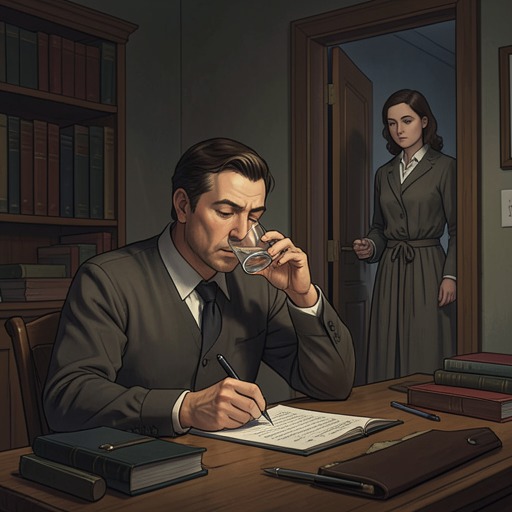
Before his relationship with Lydia Vance, Chinaski describes a writing routine organized around heavy nightly drinking. While attempting his first novel, he drank a pint of whiskey and two six-packs of beer each night, smoked cheap cigars, typed, and listened to classical music until dawn. He set a target of ten pages but could not tell how much he had written until morning, when he would get up, vomit, and inspect the pages on the couch. Some nights produced seventeen, eighteen, twenty-three, or twenty-five pages; he then had to revise the work or discard it. The novel took twenty-one nights to write. Alcohol is therefore presented both as part of the ritual that surrounds his work and as a bodily cost that begins the next day; the account does not establish that drinking alone caused the writing output.
That routine also clarifies the contrast at the center of the concept. Chinaski’s nights are structured around solitary drinking and work, whereas an intimate relationship requires a kind of availability that the routine does not provide. The book makes the clash concrete through repeated arguments and interruptions rather than through an abstract declaration that alcohol and love cannot coexist.
Lydia Vance: drinking, sex, and recurring quarrels
In Chinaski’s account of his relationship with Lydia Vance, his drinking directly obstructs their sex life. Lydia loved sex, he says, but his intoxication at night or illness in the morning prevented their lovemaking. Her frustration became so intense that even his drinking a bottle of beer in front of her could provoke a rage. Their disagreement recurred within a volatile pattern: they separated at least once a week, declared the split permanent, and then somehow reconciled. Alcohol did not simply accompany the relationship; it became a repeated source of conflict within it.
The conflict also extended beyond sex. Lydia called Chinaski a lousy drunk and told him to take a warm shower after he had made a scene; he answered by demanding sympathy. In another quarrel, she named his drinking and sickness as the consequences he should expect. Their exchanges reveal how the pair convert frustration into insults, while the underlying disagreement remains unresolved: Lydia objects to drinking that makes him unavailable, and Chinaski resists the criticism even when he recognizes the danger.
A small object made their separations into a recurring ritual. Lydia had sculpted Chinaski’s head and given it to him. Whenever they split, he would put the sculpture on the passenger seat, drive it to her home, leave it on the porch, and call from a phone booth to announce that her head was outside. It went back and forth with the relationship. The gesture turns a work of intimacy into a prop in their quarrels, while its repeated return mirrors the couple’s own departures and reunions.
On one occasion, Chinaski sat alone drinking, listening to symphonic music, and playing with his Coleman lantern when Lydia phoned and recognized precisely what he was doing. She challenged him over drinking and recalled a previous hospitalization, warning that alcohol had nearly killed him. He said he would never forget the hospital, yet the exchange did not end his drinking. After Lydia hung up, he wrote her a four-page letter, cut the middle finger of his right hand, and signed the letter in blood before mailing it. The episode joins a plea for distance from the relationship to the continuing presence of alcohol: he says he needs a vacation and a rest, while also turning to drink and making a dramatic gesture rather than resolving their conflict.
The bottle becomes the literal focus of another separation. Lydia came into the room, saw a pint of liquor, grabbed it, and struggled with Chinaski to get out with the bottle. They wrestled onto the porch and fell down the steps; the bottle broke on the pavement, and Lydia drove away. Chinaski reached for the remaining liquor among the shards, later drank what remained in beer bottles around the room, and waited until a liquor store opened at six in the morning to buy another pint. He then phoned Lydia to tell her he was opening it. The scene makes the imbalance plain: the immediate rupture does not interrupt his drinking. Even the broken bottle and Lydia’s departure are followed by a return to alcohol.
Their dispute could also take the form of mutual taunts about sex and boredom. Lydia told Chinaski that when he got drunk, she went dancing and asked men to dance with her; she defended this as her right. He called her a whore, and she replied that something worse than a whore was a bore. Elsewhere, he describes her as flirtatious and says he became jealous when she seemed intimate with his male friends. His own drinking irritated her; her attention to other men irritated him. The result was not a settled division of fault but a recurring loop of suspicion, drinking, sexual frustration, and separation.
Repeated pattern beyond the relationship
Chinaski’s conduct with Lydia forms part of a larger pattern in which alcohol meets nearly every emotional condition. He reflects that he drinks when something bad happens in order to forget, when something good happens in order to celebrate, and when nothing happens in order to make something happen. The formulation presents drinking as a flexible response that can absorb opposite circumstances, leaving little room for the event itself to change the habit. Its recurrence helps explain why appeals, arguments, or temporary separations do not reliably produce a change in behavior.
The conflict also appears when drinking affects work and health. Later, Chinaski went to Houston with a heavily bandaged leg and took antibiotics for an infection. His doctor warned that drinking would nullify the benefit of the pills. At a reading in a modern art museum, he appeared sober; when asked why, he answered, "Henry Chinaski couldn't make it," and presented himself as his own brother, Efram. The joke turns sobriety into a performed absence of his familiar persona. Yet the circumstances make the choice consequential: on this occasion, alcohol had a stated medical cost, and he went onstage without it.
A later description of Chinaski with Katherine exposes a different consequence of the same pattern. He understands that she sees him as aligned with racetrack people and the boxing crowd and recognizes that his tastes and habits do not fit her idea of a wholesome life. He describes himself as drawn to drinking, laziness, and a settled nothingness, wanting a soft, hazy place to live and to be left alone. He also acknowledges that drunkenness could make him scream and lose control, a behavior at odds with his desire for quiet. After sex, he concludes that this was the night he lost Katherine. The account does not reduce the separation to alcohol alone, but places his drinking and self-described way of life within the incompatibility he recognizes.
Intimacy repeatedly displaced
Across these episodes, alcohol functions as more than a substance consumed alongside relationships. It is a routine that competes with a partner’s expectations, a provocation in arguments, a response to distress and celebration alike, and a habit Chinaski continues even after medical warning or a relationship rupture. The consequences vary: Lydia’s repeated anger and departures, a sober performance at the Houston reading under medical pressure, and Chinaski’s recognition that his way of life alienates Katherine. Together, they show intimacy repeatedly demanding a change in attention or conduct that he does not sustain.
The narrative’s balance between frank damage and self-mocking performance is central to the pattern. Chinaski can acknowledge vomiting, hospitalization, illness, sexual incompatibility, and loss, while also turning sobriety into a joke or a quarrel into a dramatic episode. That comic framing does not erase the costs it records. Instead, the repeated return to drinking—after warnings, after arguments, and after the bottle is gone—makes the conflict with intimacy feel persistent rather than resolved.