Chinaski’s legendary writer persona
WomenChinaski’s legendary writer persona is both a performance and a practical, contested reputation. At readings he turns poems into confrontation and spectacle, while his imagined status as “Chinaski the legend” colors private decisions as well. Yet the prestige is never secure: Mindy questions whether he is famous, and Chinaski himself calls drinking no help to writing. The persona’s force lies in this gap between an audience’s response, the workaday economics of performing, and the grand figure he sometimes claims to be.
Origins in Small-Press Literary Life
The image develops from a literary world far from conventional institutions. Chinaski recalls editing The Laxative Approach with two co-editors, Kenneth Mulloch and Sammy Levinson. They believed they were printing the best poets of their time, along with some less distinguished work; once the sheets were printed, their task was to collate them and staple them into covers. Sammy proposed making that labor a party, with drinks and conversation to bring people in. The scene places Chinaski’s literary identity among improvised publications, shared work, and social performance, rather than established cultural authority.
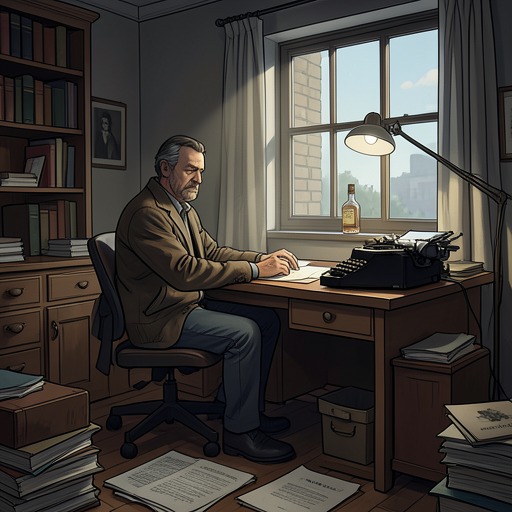
His account of the period also emphasizes the distance between literary ambition and ordinary employment. He was working eleven hours a night as a postal clerk when he began corresponding with William Keesing, an ex-Marine and former prisoner supported by his wife, Cecelia, and later a codeine user. Years afterward, Keesing had obtained temporary university teaching work and brought Chinaski to give a reading. Chinaski warned that teaching could be dangerous for someone who wanted to write, even as Keesing taught his class plenty of Chinaski. The episode shows the persona circulating through correspondence, poetry magazines, work, and readings: it is a name that can enter a classroom, but it belongs to a literary culture whose participants remain materially precarious.
The Reading as Performance
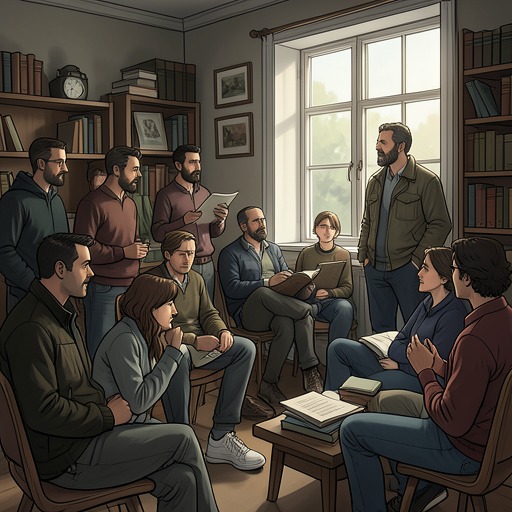
At a university reading, Chinaski begins by reading for about twenty minutes, then puts down the poems and tells the audience, “This shit bores me,” inviting them to talk with him instead. The event becomes an exchange of shouted remarks: he screams at the audience, and they scream back. The performance is not a simple recitation of written work. Chinaski makes impatience part of the act, turning the room’s response into its own kind of entertainment.
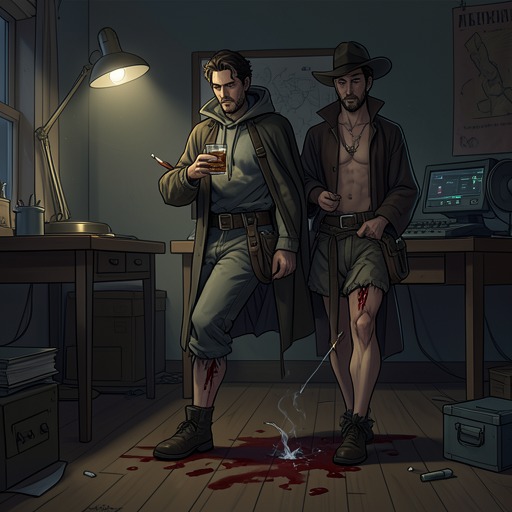
The spectacle continues after the formal event. Professors take him to a room in the women’s dormitory, where he drinks whiskey, blacks out, and wakes to find the others gone and half a bottle remaining. Alone, he thinks of himself as Chinaski the legend, then approaches a nearby door in shorts and stockings and announces himself as an immortal writer. The women behind the door giggle, but do not open it. The episode makes the private cost and comic excess of the persona visible: the legendary identity persists when there is no stage, yet it does not guarantee the response Chinaski seeks.
At another reading, the familiar act appears more effective. Chinaski walks out with Tammie beside him as the audience applauds; he describes the old Chinaski routine as working. He has many beers in an ice bucket and reads both old and new poems, including five or six love poems about Tammie. Here the reading joins audience management, alcohol, and personal material. The poems are not only literary works but part of a public performance whose immediate evidence of success is applause.
Fame, Recognition, and Its Limits
Mindy directly tests Chinaski’s claim to literary importance by asking whether people would know him if he went to New York City, and whether he is famous like Norman Mailer or Truman Capote. Chinaski answers that he does not care about trumpets and only wants to keep writing, while Mindy insists that he would take all the acclaim he could get. Their exchange exposes a division between his stated indifference and her belief that recognition matters to him. When she says he likes to pretend he is already famous, he answers that he acted the same way even before he wrote. Her description of him as the most unknown famous man she has met captures the persona’s central contradiction: conspicuous self-presentation without universally established fame.
Recognition nonetheless has practical value. Chinaski says readings help pay the rent and may help sell books; they also take him away from East Hollywood and put him among air travel, business passengers, stewardesses, iced drinks, and small packets of peanuts. The reading circuit gives the writer persona a material function, even though Chinaski dislikes the events. At a club, promoter Marty Seavers tells him that he draws larger crowds than rock groups and offers to book him every Friday and Saturday. Chinaski refuses the regular engagement, arguing that a band can repeat the same song whereas audiences expect poems to be new. The refusal marks a limit to converting popularity into routine entertainment: the audience is valuable, but the work cannot simply be reproduced on demand.
Writing, Alcohol, and the Persona’s Contradictions
The public figure’s relationship to alcohol is similarly double. In one encounter, a woman asks how much of a drink he wants; he answers, “Half and half,” and drinks it immediately. Elsewhere, he describes his isolation as a wish to sit alone in a darkened room, and says that being broke after a woman leaves him makes the empty walls and lack of drink especially hard to bear. When Dee Dee is with him, her conversation makes him laugh and eases the blues, though thoughts of Lydia remain. These scenes place drinking and company around the writer persona without making them evidence of artistic discipline or stable confidence.
Asked whether drinking has helped his writing, Chinaski answers, “No. I'm just an alcoholic who became a writer so that I would be able to stay in bed until noon.” The joke punctures the romantic image of the writer sustained by drink. It also links writing to a prosaic desire to avoid an early start, not to a claim that alcohol produces literary talent. Chinaski can cultivate the legend at a reading, enjoy applause, and benefit from paid appearances, but he does not present intoxication as the source of his work.
His stated influences further complicate the image. After critics leave, he says he had meant to tell them that his real influences were Clark Gable, James Cagney, Humphrey Bogart, and Errol Flynn. The remark shifts the frame from literary lineage to screen performers, fitting a persona shaped by acting as well as writing. Across the small magazine, the unruly readings, the audience’s applause, the questions about fame, and the refusal of a repetitive club booking, Chinaski’s writer identity remains visibly made and remade. It is neither mere fraud nor settled celebrity: it is a performance with audiences, income, limits, and a persistent uncertainty about who, beyond the room, knows the name.