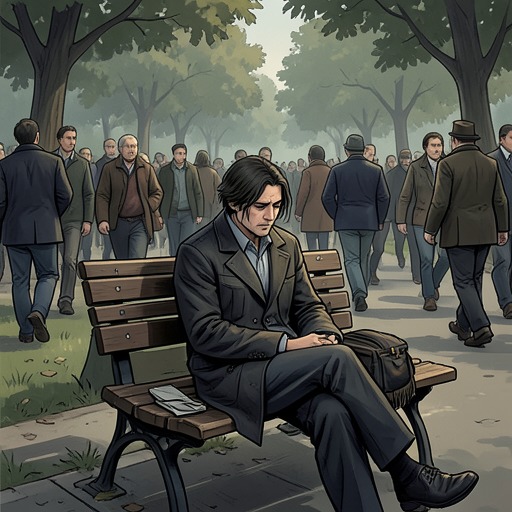
Conflict between solitude and social life
WomenThe conflict between solitude and social life is a recurring strain in Henry Chinaski’s relationship with Lydia Vance and a defining limit on the kind of intimacy he is willing to sustain. He wants a quiet life organized around living, eating, and sleeping with a partner, the racetrack, boxing, and writing; Lydia wants conversation, parties, dancing, and frequent company. Neither ideal remains private: their incompatible needs turn ordinary choices about going out, meeting people, and spending time together into arguments, departures, and, eventually, a violent rupture.
Two Competing Ideas of a Good Life
Chinaski describes himself as a loner, even a recluse, and says solitude is necessary for his writing. His preferred companionship is undemanding: he can live with a woman, eat and sleep beside her, and walk down the street with her without wanting much conversation or an active social calendar. Beyond the racetrack and boxing matches, he avoids entertainment that requires sharing a public experience, including films and television. Parties are worse: their small talk, flirting, and social games make him sick. The stance is not merely an objection to one particular gathering; it is his general preference for minimal social contact.
Lydia understands social life as pleasure and release, not as a threat to seriousness or fidelity. She says she likes people and misses parties, and points to her sisters, who will travel a thousand miles to attend one. Her account of how they were raised in Utah makes sociability part of a familiar family and community culture. She rejects Chinaski’s suspicion that having fun leads to sex, insisting that people can simply let go and enjoy themselves. Their disagreement therefore concerns more than where to spend an evening: it is a clash between his guarded, solitary routine and her expectation that a shared life include other people.
Arguments at Home
The difference becomes explicit when Lydia accuses Chinaski of withdrawing from their home life. She recalls that he used to work there, bringing ink and making drawings, but now goes home to pursue what he finds interesting, then returns only to eat and sleep before leaving in the morning. He says he likes the arrangement; she says it is dull and complains that they have not been to a party in months. Her frustration escalates into a demand for activity and a declaration that she wants to live, while Chinaski responds by getting dressed to leave.
In another argument, Chinaski frames isolation as a necessity for artistic work and asks Lydia why she cannot understand that he is a recluse. Lydia answers that a person cannot learn about people without meeting them. He claims already to know them; she counters with a specific observation about his conduct in restaurants, where he keeps his head down rather than looking at anyone. He calls the act of looking an invitation to feel sick, while Lydia says she observes people and studies them. The exchange exposes different accounts of knowledge as well as different social preferences: he regards withdrawal as sufficient, while she regards attention to people as something acquired through encounter.
Their dispute does not remain verbal. When Lydia says that Chinaski makes her sick, he offers to give her room. During a later separation, she leaps at him as he tries to leave. He sidesteps, and she falls; as he steps toward the door, she grabs his coat and tears its sleeve. He leaves with one arm bare. The scene gives physical consequence to their recurring struggle over distance and departure, without resolving the underlying mismatch.
Social Spaces and Uneasy Belonging
Chinaski’s account of social life is shaped by dislike and by sharp judgments about the people and settings he enters. At a crowded, expensive restaurant with Dee Dee Bronson, the diners seem young, scrubbed, and bland to him; the scene supplies an image of public sociability that he watches rather than joins. At a bar Dee Dee identifies as a gathering place for scriptwriters and little-theatre people, Chinaski immediately disparages the writers for performing cleverness and superiority. His metaphor for their mutual proximity is “Like flies on the same turd.” The contempt does not prevent him from taking a table among them. Instead, he measures his position against theirs: he earns $65 a week beside writers who earn $1,000, and imagines Lydia regretting the day he is recognized and given a special table in a restaurant.
That fantasy complicates the appearance of complete indifference to other people. Chinaski scorns the writers’ company, yet imagines public recognition as a future answer to his low-paid position among them. His desire for solitude thus coexists with an awareness of status and an appetite for recognition. The social world repels him, but it also supplies the audience before whom he can picture his eventual success.
His arrival in New York City with Lydia offers a different view of a crowd. Gary Benson, a poet who drives a cab, meets them in nearly 110-degree heat and drives them through traffic. Chinaski watches cars press against one another and reads the drivers’ apparent lack of courtesy as resignation to the conditions of the city. The mass of people is not a party or a community he wants to enter; it is a spectacle he can observe from inside a car. The contrast with Lydia’s interest in meeting people clarifies how readily Chinaski accepts observation at a distance while resisting social participation.
Withdrawal, Conflict, and Consequence
The conflict is not confined to Lydia. Chinaski’s solitary preference shapes his response to unfamiliar company and to shared activities. When the women accompanying him visit an antique store, he becomes bored among objects priced at $800 and $1,500, leaves them to browse, and goes across the street for a beer. Later, he waits in the car with a six-pack, watching people in traffic. He turns their silence and waiting into a reflection on ordinary life and death. The scene makes isolation both refuge and vantage point: apart from the other shoppers, he can convert a mundane wait into material for thought, but his method depends on remaining outside the activity they share.
His withdrawal also sits uneasily beside moments when public performance and collective attention become unavoidable. At one poetry event, Tammie introduces him, but as they approach the stage people scream and curse, bottles fall, and a fistfight breaks out. Such scenes do not show him simply choosing between home and a party; they show that his life as a writer repeatedly brings him into social spaces that he dislikes or cannot control. The discrepancy between private recluse and public poet is one reason solitude never settles into a stable solution.
With Lydia, the difference has lasting consequences. Her desire for people and his insistence on distance recur as a source of argument, while his later recollection of his own nature emphasizes that he is content with a sparse life and that she wants people as often as possible. The relationship’s scenes of conflict include not only words about parties but separation, physical aggression, and the destruction of his paintings and books. Those acts cannot be reduced to a disagreement over sociability, but they make the rupture concrete: the struggle over closeness and distance unfolds alongside damage to the objects through which Chinaski works and understands himself.
The novel gives neither preference a simple victory. Chinaski’s solitude protects the routine he associates with writing and allows him to observe social behavior with biting detachment, but it also leaves a partner’s need for shared life unanswered. Lydia’s sociability is, in his account, a persistent source of pressure, while her own words present it as an ordinary desire for company and enjoyment. Their conflict exposes the cost of treating one person’s preferred distance as a complete model for life together: the more firmly Chinaski claims that he needs to be left alone, the more often the relationship makes that demand a point of confrontation.