Alcohol and drinking as coping
WomenAlcohol and drinking as coping is a central, recurring practice in Henry Chinaski’s life, serving as fuel for his writing, a response to emotional discomfort, and a routine he maintains even when it worsens his health and relationships. The narrative’s pattern is stark: whether events are painful, welcome, or uneventful, drinking offers Chinaski an immediate answer, while repeatedly leaving the underlying difficulty unresolved.
Writing and Daily Routine
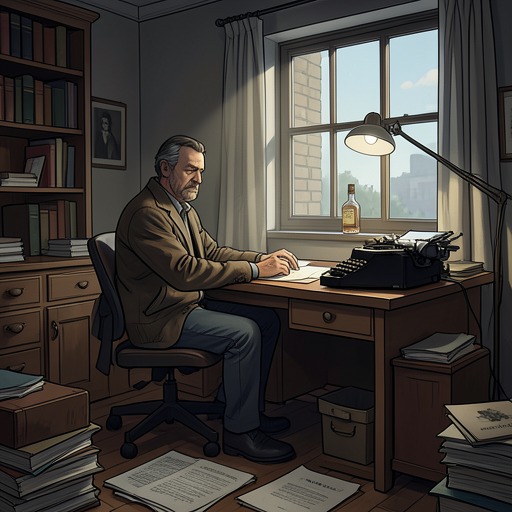
During his first attempt at a novel, Chinaski drank a pint of whiskey and two six-packs of beer each night while typing, smoking cheap cigars, and listening to classical music until dawn. He set a goal of ten pages, but did not know what he had produced until morning; after vomiting, he would count the pages on the couch, sometimes finding seventeen, eighteen, twenty-three, or twenty-five. Each night’s work still had to be revised or discarded, and the novel took twenty-one nights to write. Drinking here is embedded in the labor of composition: it accompanies an intense, repetitive schedule rather than appearing as an occasional indulgence.
That routine also shows how little the drinking depends on a particular crisis. Chinaski can describe it as a means of getting through a difficult night, but he also drinks when nothing has happened, as if alcohol could supply an event or purpose. The book sets this habit against his attempts to work and to sustain relationships, making drinking at once ordinary in his daily life and consequential in its effects.
Distress, Repetition, and Loss of Control
After a conflict with Lydia Vance, Chinaski writes her a four-page letter, signs it in blood, and posts it. The gesture does not settle the dispute. In another confrontation, the two struggle over a bottle of scotch; it breaks when they fall, and Lydia leaves. Chinaski then drinks what remains and searches empty beer bottles for the last drops, waiting until the liquor store opens at six in the morning before buying another pint. The sequence turns drinking into a physical routine of continuation: the argument ends, but the pursuit of alcohol does not.
His drinking likewise persists during a night of sleeplessness. He finishes his last beer around 4:30 a.m., waits until six to get more, and spends the morning walking through the house and singing. By 11:15 he is dressed to leave for the airport, with only reading glasses in his shirt pocket and no baggage. The episode links drinking to disrupted rest and an unsettled daily rhythm without presenting alcohol as a solution to either.
Chinaski’s choices are not only individual habits; other characters name their consequences. Lydia calls him a drunk and tells him to take a warm shower after pointing out that he has made an ass of himself. Mrs. O’Keefe, when he asks whether his girlfriend and her children can move into a vacant unit, calls Lydia crazy. Chinaski acknowledges that Lydia is crazy but says he cares for her. In these exchanges, drinking and the instability surrounding it become part of the social judgment that shapes how others respond to him.
Health and Relationships
During a trip to Houston, Chinaski travels with a heavily bandaged leg and is taking antibiotics for an infection. His doctor warns that drinking would nullify their benefit. At the poetry reading, Chinaski appears sober; when someone asks why, he answers that Henry Chinaski could not make it and claims to be his brother Efram. The joke converts an unusual attempt at sobriety into a public performance, while the medical warning makes the stakes of drinking concrete.
Alcohol also shadows Chinaski’s response to bereavement. After William Keesing’s death, he reflects that he drinks when something bad happens in order to forget, when something good happens to celebrate, and when nothing happens to make something happen. He phones Cecelia over several nights and then stops. The pattern gives drinking an apparent purpose in every circumstance, but the calls and their cessation show that grief still shapes his actions beyond the drink itself.
A later passage places his evening drinking beside a question about why he is still alive and thoughts of Katherine, Lydia, and Tammie. At another point, after observing that people take up pursuits and that these efforts eventually fall apart, Chinaski retreats to his bedroom and drinks vodka straight. The recurrence connects alcohol to isolation and reflection as well as conflict: it accompanies his awareness of mortality without resolving it.
Narrative Significance
The book refuses to make drinking a single-purpose symbol. It is part of Chinaski’s writing regimen, an answer to distress, a way to celebrate, and a response to emptiness; it also conflicts with medical treatment and intensifies the consequences of volatile encounters. Its reach across work, health, grief, and ordinary hours is what makes it more than background behavior.
The repeated logic that every kind of day calls for a drink gives the habit an ironic structure: no change in circumstances is required for drinking to continue. Chinaski can turn that pattern into a joke or a line of self-observation, but the scenes of waiting for the liquor store to open and drinking after a broken bottle resist the idea that the routine is merely comic. Alcohol offers immediate relief or momentum; the book repeatedly shows that it cannot restore health, repair relationships, or prevent loss.