Henry Chinaski–Katherine relationship
WomenThe Henry Chinaski–Katherine relationship is a brief, consequential attachment in which an unexpected meeting gives Henry a glimpse of domestic commitment without overcoming the habits that keep him apart from other people. Their intimacy advances quickly, but Katherine’s visit also exposes the gap between Henry’s momentary wish for a shared life and his established attachment to drinking, horse racing, boxing, and solitude.
An Unexpected Meeting
The relationship begins after a poetry reading, at a party and dinner held at a cafe. Henry notices Katherine, a young woman around twenty-two, and repeatedly calls her Katherine Hepburn; she seems to welcome the teasing. He assumes nothing will come of their meeting, and, as he is leaving, tells the museum director that he will miss her. The director answers that Katherine is coming home with them, a turn Henry says he cannot believe.
At the director’s home, Katherine says she does not drink. Henry is unsettled by her presence and wonders why a woman like her is there with him, but he does not reject the encounter. His astonishment is part of the relationship’s initial imbalance: he treats her interest as improbable good fortune, while the account provides little explanation of what she sees in him. Her attraction is not presented as a conventional response to his social standing or charm; the encounter instead unsettles his assumptions about what his poems can bring about.
A Visit and a Sudden Proposal
After returning to Los Angeles, Henry contacts Katherine, who lives in Austin, Texas. She sounds glad to hear from him, and he invites her to visit, offering to pay for the round-trip airfare and proposing outings to the racetrack and Malibu. When she asks whether he has a girlfriend, he says no and describes himself as a recluse. Katherine points out the contradiction between that claim and the women in his poems. Her question brings the distance between his self-description and his writing into their courtship: he presents himself as withdrawn, while his work advertises his entanglements.
Katherine phones the next day to say she has tickets and will arrive at Los Angeles International on Friday at 2:30 p.m. Henry starts to tell her something important, but her question about whether he wants to see her interrupts the disclosure. The evidence does not establish what he intended to say; it does show that, despite his hesitation, she makes the trip and he welcomes her into his home.
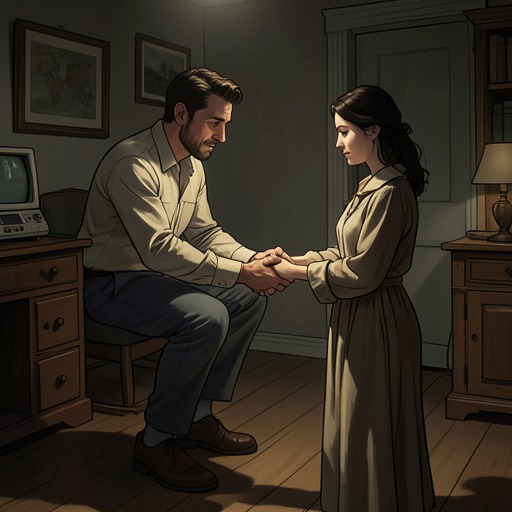
During the visit, Henry’s sense of the relationship shifts toward marriage. After spending the night together, he imagines a house, a dog and a cat, and ordinary supermarket shopping. The domestic images stand apart from the life he actually describes elsewhere: they are a sudden projection, not a plan the couple has discussed or agreed upon. In the morning he proposes while Katherine sits brushing her long red-brown hair. She asks him not to, and he insists that he means it. His proposal is sincere in the moment, but her response does not accept it.
Desire, Solitude, and Social Worlds
The relationship is shaped by Henry’s self-understanding as a loner. He says he is content to live, eat, sleep, and walk with a woman, but does not want conversation or much social activity beyond the racetrack and boxing matches. Parties and small talk repel him; they energize Lydia, whose preference for frequent company has repeatedly produced conflict with him. Henry says he needs seclusion in order to write, while the woman he is seeing asks how he can learn about people without meeting them. This larger pattern helps explain why Katherine’s arrival does not automatically make him available for a durable partnership: he wants the closeness of a woman beside him without embracing the wider social life that relationships can entail.
Henry also connects his pursuit of younger women to his fear of aging. He wonders whether sexual relationships with young women can help him avoid feeling old, and whether he is trying to screw his way past death. This is his own speculation, not a motive Katherine supplies or confirms. It casts his pursuit of intimacy as partly defensive: the excitement of a new affair promises temporary resistance to decline, even as Henry recognizes that novelty fades and that people eventually become less important to one another.
Katherine encounters the life behind that self-image when Henry takes her to the boxing matches at the Olympic Auditorium. He understands that she is connecting him with the racetrack crowd and the boxing world, and accepts that this is where he belongs. He also describes himself to himself as lazy, godless, and settled into a kind of nothingness, preferring a soft, hazy space where he can be left alone. He knows his behavior changes when he is drunk: he can become loud and uncontrollable, a contrast he acknowledges without trying to resolve. The intimacy between them may be good, but it cannot erase what Katherine sees of his habits and chosen surroundings.
Separation and an Unresolved Ending
Henry later identifies the night of the boxing outing as the night he lost Katherine. His account links that loss to the incompatibility he has already recognized: he is drawn to drinking and to a life that does not meet her idea of wholesomeness, while he wants neither reform nor the effort of becoming more interesting. Although he says there is nothing he can do about the separation, the relationship does not end with a definitive rejection or a settled explanation of Katherine’s decision.
At their parting, Katherine kisses Henry and asks him to come see her, saying she has a nice house and lives alone. She also tells him to write. Henry answers that he will. Her invitation preserves the possibility of future contact, but no reunion or lasting commitment is established in the evidence. The relationship therefore closes in suspension: Henry has briefly imagined marriage, Katherine has refused the proposal, and her offer of a visit leaves a door open without promising that either of them will walk through it.