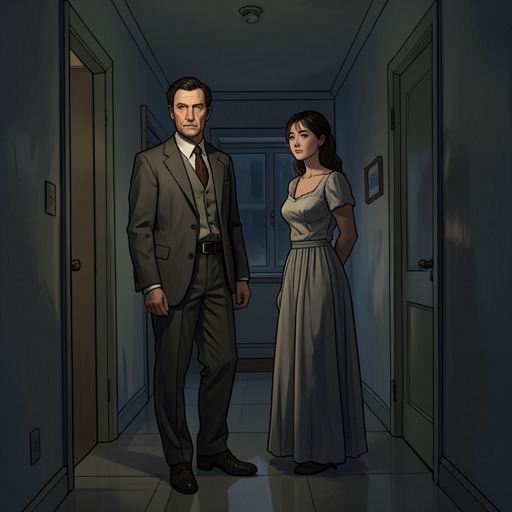
Henry Chinaski–Lydia Vance relationship
WomenThe Henry Chinaski–Lydia Vance relationship is a volatile affair in which attachment repeatedly gives way to jealousy, alcohol-fueled conflict, and separation. Its decisive pattern is a struggle over intimacy and control: Chinaski maintains other sexual relationships and speaks of them, while Lydia’s objections escalate into threats and the destruction of his work. The relationship leaves concrete damage behind, but its ending is marked not by a final confrontation but by Lydia’s miscarriage and departure from Los Angeles.
Background and Pattern
Chinaski first encountered Lydia Vance around the time he left a twelve-year job as a postal clerk and tried to become a writer. He was frightened, drinking more than before, and working on his first novel through long nights of whiskey, beer, cigars, typing, and classical music. The relationship began alongside this uncertain transition into writing, in a life already organized around alcohol and solitary work.
The relationship’s recurring conflict is visible in the contrast between Chinaski’s conduct and Lydia’s attempts to set limits. He continues to pursue women beyond their relationship, while Lydia objects specifically to hearing about those women. That tension is not contained in private feelings: it becomes a dispute over what Chinaski may say, what Lydia will tolerate, and whether his books and paintings can remain separate from their quarrel.
Jealousy and the Destruction of His Work
After returning from the harness races, where he had lost $32, Chinaski found his home ransacked. Drawers and bedclothes were scattered; roughly twenty books, including his own, were gone, along with his typewriter, toaster, radio, and paintings. The television remained, which he understood as a deliberate choice because Lydia knew he never watched it.
He later found Lydia with two shopping bags of books and a portfolio of paintings. When he asked for his work back, she tore the paintings, threw the pieces into the air, and stamped on them in her cowgirl boots. She then flung the books across the street and lawn. Her outburst made the conflict over his other women material: the relationship did not merely interrupt his work but turned that work into something she could seize and destroy.
Lydia later called from home and threatened to repeat the destruction if Chinaski spoke to her about his other women again. The threat shows the condition she tried to impose, while the destroyed books and paintings show the consequence of the earlier confrontation. The episode offers no indication that Chinaski accepted the condition or that trust was restored.
Drinking, Contact, and Separation
Alcohol recurs as both background and response to conflict. In one phone exchange, Lydia tells Chinaski to drink and kill himself; after they hang up, he says he needs a vacation and a rest. He sits at his typewriter and writes her a four-page letter, then signs it in blood after cutting his finger with a razor blade and drops it in a corner mailbox. When she calls again, the exchange continues rather than settling the rupture. The sequence links a plea for distance to an act of dramatic, self-injuring communication, and shows how drinking and provocation occupy the space where a calmer resolution might have been.
Chinaski also describes drinking as a response to every possible condition: he drinks to forget bad events, celebrate good ones, or make something happen when nothing does. That formulation is broader than his dealings with Lydia, but it clarifies the habit surrounding their relationship. Alcohol is not a single cause that explains every conflict; it is a constant coping mechanism within a relationship already marked by jealousy and repeated instability.
The pair’s intimacy also exists alongside Chinaski’s relationships with other women. He tells himself that he craves women who make few personal demands, yet also yearns for a gentle, loving partner and fears the emotional cost of such intimacy. That divided account helps explain the gulf between wanting connection and sustaining the obligations it brings. His conduct repeatedly places Lydia in conflict with women outside the relationship, while his own reflections expose a pattern of desire and withdrawal rather than a settled commitment.
Pregnancy, Miscarriage, and Lydia’s Departure
Later, Lydia telephones and tells Chinaski she is pregnant. In a further account, she describes having slept with a man who loved her and wanted to marry her, a married man she liked, and a stranger she met at a bar. She says she does not know which man fathered the child and will have to wait to see whom the child resembles. The uncertainty makes the pregnancy a disclosure about Lydia’s life beyond Chinaski as well as a consequential development in their relationship; the available account does not establish the father’s identity.
When Lydia calls again, she says she has sold her house and is moving to Phoenix the following morning. She also tells Chinaski that she had a miscarriage, nearly died, and lost a great deal of blood, adding that she had not wanted to bother him. She says she is all right now but wants to leave Los Angeles because she is sick of the town. Chinaski asks if she is all right and wishes her luck. Her departure follows the loss and closes the cited sequence without a reunion or a clear account of what happens to the relationship afterward.
Narrative and Ethical Significance
The relationship is narrated through Chinaski’s first-person perspective, which makes the contrast between his interpretations and the reported consequences especially important. He frames some encounters with other women as sexual freedom or as material for writing, but later condemns himself for treating people as playthings and disguising selfish pleasure as research. That self-criticism does not undo the harm described; it complicates his image of himself by showing that he can recognize, at least retrospectively, the gap between his excuses and his actions.
The destruction of his work, the prohibition on discussing other women, the uncertain pregnancy, and Lydia’s departure give the relationship a chain of concrete consequences. Its recurrent movement is from contact to conflict, from conflict to damage, and from damage to separation. Lydia’s final calls bring news rather than reconciliation: the bond remains consequential even as the account leaves its future unresolved.