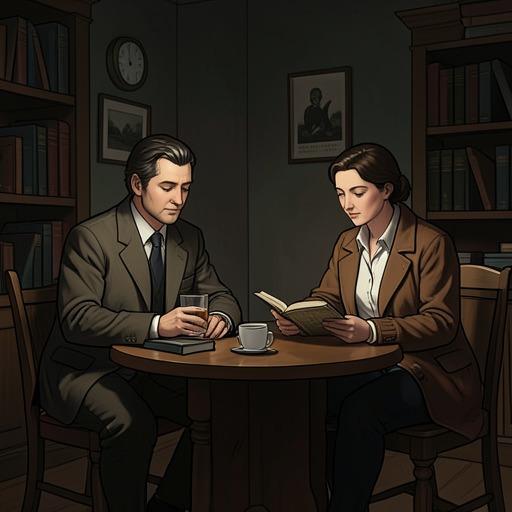
William Keesing-Cecelia marriage
WomenWilliam Keesing and Cecelia’s marriage is strained by his drug use and the exhaustion it brings into their home, yet it does not end in a simple withdrawal of affection: Cecelia is seeking a divorce while still loving him, and Keesing says he loves her too. His death shortly after Henry Chinaski’s visit turns that unresolved separation into bereavement, while the posthumous preparation of Keesing’s poems gives their life together a final public consequence.
A Marriage Under Strain
During Chinaski’s visit, Keesing explains that Cecelia is divorcing him because she has had enough of his drugs, vomiting, and the broader disruption of his life. He does not blame her. He says that she has endured the situation for years and can no longer continue, while also describing their diminished sexual relationship and her involvement with a younger man. His account is not framed as an accusation: he explicitly says he cannot blame her.
The practical separation is already under way. Keesing has moved out and has a room of his own, but he offers Chinaski the choice of staying either at the house or in that room. The marriage is therefore at a threshold rather than a clean break: Keesing and Cecelia are living apart, yet their relationship remains active in the home and in his feelings. Cecelia retires early for work, while Keesing remains with Chinaski and continues taking pills.
Affection Within the Separation
The conversation makes clear that divorce has not erased Keesing’s attachment. Chinaski asks whether Keesing still loves his wife, and Keesing answers yes. Chinaski offers a bleak generalization about what happens when a woman turns against a man, but the exchange does not resolve the tension between that bitterness and Keesing’s own direct declaration of love. Keesing’s feelings remain personal and specific even as Chinaski casts the situation in harsher, more sweeping terms.
Cecelia’s later words establish the other side of that bond. She tells Chinaski that she still loves Keesing but cannot go through the situation any longer. The distinction is central to the marriage’s portrayal: affection persists, but it has not made the strain of his drug use sustainable. Cecelia also recalls that Keesing used to read Chinaski’s letters to her and that the two of them laughed at them. The detail suggests a shared domestic history and a capacity for warmth that exists alongside the conditions driving them apart.
The Last Visit and Keesing’s Death
After Keesing leaves for his university teaching, the marriage’s unresolved state becomes starkly final. About a week and a half after Chinaski returns to Los Angeles, Cecelia phones him in tears and says Keesing is dead. She tells Chinaski that he is the first person she has called and credits the visit with having mattered deeply to Keesing, who talked about Chinaski after he left.
Cecelia says Keesing felt very ill, was taken to a hospital, and died within two hours. She anticipates that people may assume he overdosed, but insists that he did not. The account distinguishes the known circumstances of his final illness from the suspicion that his drug use might provoke. Cecelia also says that, despite having been on the verge of divorce, she loved him. The death does not settle the marriage’s conflict so much as make its remaining possibility of resolution disappear.
Bereavement and Posthumous Recognition
Chinaski responds to Keesing’s death by reflecting on how drinking functions across different circumstances: he drinks after something bad to forget, after something good to celebrate, and when nothing happens in order to make something happen. The thought places bereavement inside the ordinary cycle of his drinking rather than presenting it as an exception. He also reflects that Keesing had not seemed like someone about to die, and that the unexpected death of a person he regards as exceptional and lovable remains difficult despite familiarity with death.
Chinaski phones Cecelia on the night she tells him and again on the next two nights, then stops. A month later, R.A. Dwight, editor of Dogbite Press, asks him to write a foreword for Keesing’s Selected Poems. Chinaski observes that Keesing is at last going to receive recognition beyond Australia, with death serving as the circumstance that brings this recognition. Cecelia then tells Chinaski she is going to San Francisco to meet Dwight with photographs and unpublished work, and asks to stop in Los Angeles and stay with him. The marriage’s final aftermath thus moves from private grief toward the preservation and publication of Keesing’s work, with Cecelia still acting as a custodian of his memory.