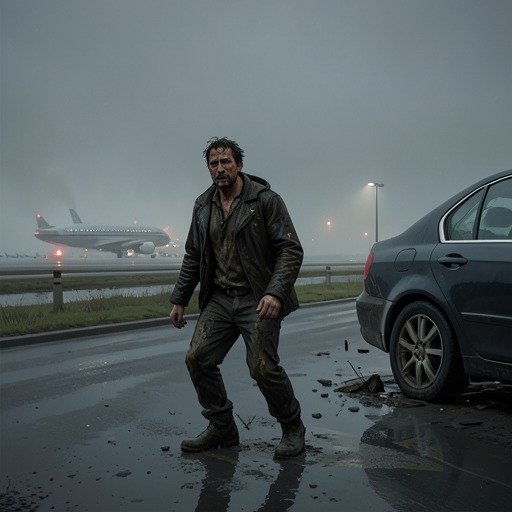
Kansas City poetry reading and the women’s dormitory debacle
WomenThe Kansas City poetry reading and the women’s dormitory debacle bring Henry Chinaski’s stage persona into collision with the practical consequences of his drinking. A university reading that begins with an arrival in freezing weather and ends with him lost in a dormitory turns the image of the “immortal writer” into a spectacle of confusion and isolation. The incident is comic in its escalating misjudgments, but its conclusion is not triumphant: disoriented and hung over in an unfamiliar room, Chinaski phones Lydia in Los Angeles for help.
Arrival and Reading
Chinaski arrives in Kansas City underdressed for the cold, wearing a thin California sports coat and shirt, lightweight pants, summer stockings, and shoes with holes. He has no baggage, only a portfolio of poems. Frenchy, a drama teacher and collector of Chinaski’s books, waits for him and greets him with tequila; the two pass the bottle in a warm car as they leave the airport. The icy roads establish the trip’s physical hazards before the reading begins.
At the campus, Chinaski’s escort drives onto the lawn in front of the auditorium, and they arrive only fifteen minutes late. Chinaski vomits before going inside. The group has stopped for vodka, which is meant to get him through the performance. He reads for about twenty minutes, then puts down the poems and tells the audience that the material bores him and that they should talk to one another instead. The reading shifts from recitation toward confrontation: Chinaski shouts at the audience, and the audience shouts back. After roughly another half-hour, two professors intervene and offer him a room in the women’s dormitory.
The Dormitory Performance
The professors’ offer becomes the setting for Chinaski’s private continuation of the public performance. He is taken to a room on the third floor. One professor brings a fifth of whiskey; another gives him a check for the reading and airfare. They drink and talk until Chinaski blacks out. When he comes to, the others have gone and half the whiskey remains.
Alone, he recasts the circumstances as proof of his own legend. He thinks of himself as “Chinaski the legend,” sees the dormitory’s many women as an opportunity, and acts as if his literary reputation entitles him to command their attention. Wearing only shorts and stockings, he goes into the hall, knocks on the nearest door, identifies himself as an immortal writer, and demands that the occupants open up. He hears giggling. Rather than take that response as a reason to stop, he tries another door and then continues through the building.
Disorientation and Aftermath
Chinaski tries every door on the third floor, then works through the second and first floors, carrying and drinking the whiskey as he goes. The episode’s aimless repetition replaces the confident pursuit he had imagined. Eventually he forgets which floor his room is on. Wanting only to return, he tries the doors again in silence, now acutely aware of his exposed clothing. His self-dramatizing declaration that the greatest men are the most alone accompanies a practical failure: he cannot find his own room.
Back on the third floor, a door opens onto the room he recognizes by the portfolio of poems, used glasses, ashtrays, and clothes he had left there. He closes the door, sits on the bed, and finishes the whiskey. The next time he wakes, it is daylight and he is in a clean, unfamiliar place with two beds, curtains, a television, and a bathroom. Snow and ice are outside; he has no explanation for where he is. Hung over and depressed, he reaches for the telephone and calls Lydia in Los Angeles. He says he does not know where he is; she reminds him that he went to Kansas City. The exchange punctures the legend’s self-sufficiency: at the end of the episode, the man who announced himself to strangers as immortal depends on Lydia to orient him.
Significance
The episode links the reading’s public disorder to Chinaski’s private loss of control. His shift from poems to shouting wins an animated response, but the dormitory’s closed doors do not confirm the audience’s engagement as personal access. Instead, the repeated knocks expose the difference between performing a writer’s bravado and having authority over other people. His imagined status as a famous man does not make the women answer him, and his insistence gives way to confusion, solitude, and a call for help.
Alcohol is the thread connecting each stage: tequila on arrival, vodka before the reading, and whiskey after the professors leave. It does not simply accompany the performance; it helps carry Chinaski from the public event into the prolonged, increasingly disoriented encounter with the dormitory. The episode’s comic reversal is therefore also a measure of the distance between his self-mythology and what he can manage. He begins with an audience and a paid reading, invents a role for himself as a conquering literary celebrity, and ends unable to locate his room or even name his whereabouts without assistance.