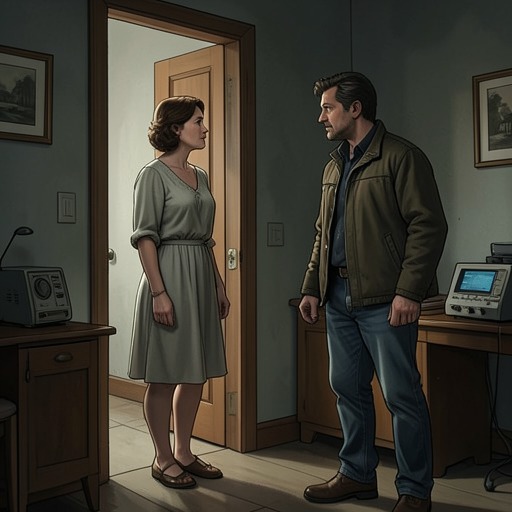
Sara and Chinaski argue over her birthday party
WomenThe birthday argument between Sara and Chinaski is a domestic rupture driven by noise, frayed nerves, and a failed attempt at celebration. An errand for butter, tomatoes, and cucumbers ends with Chinaski shouting that he cannot hear, leaving Sara, and abandoning the groceries on the ground after she throws them at him. The scene’s defining reversal is its return to ordinary life: after the outburst, Chinaski remembers the forgotten produce and carries it back, but the gesture does not restore their closeness.
The Birthday Errand
The conflict follows a modest birthday exchange. Chinaski tells Sara, “Happy birthday. I'll get the butter and things.” After drinking another glass of wine, he gets into the Volkswagen and drives to a small grocery. He finds butter, but the tomatoes and cucumbers there look old and shriveled, so he pays for the butter and continues looking for a larger market. He eventually finds one, buys better produce, and drives back to Sara’s place.
The errand’s small complications matter because they frame the later explosion as the end of an accumulating strain rather than a planned confrontation. Chinaski approaches the house carrying only the bag of butter; he has left the tomatoes and cucumbers in the car. From outside, he hears Sara’s stereo playing at full volume again. As he walks closer, he begins to sicken, and his nerves reach what he describes as their breaking point. The sound is so loud that he cannot distinguish one sound from another.
The Argument and Departure
Sara comes out of the kitchen, and Chinaski responds by screaming, “GOD DAMN YOU!” When she asks what is wrong, he shouts, “I CAN'T HEAR!” Their exchange fails to become a conversation: Sara repeatedly asks what he said, while he escalates from complaint to accusation. He yells, “YOU'RE PLAYING THAT FUCKING STEREO TOO LOUD! DON'T YOU UNDERSTAND?” and then declares, “I'M LEAVING!” Sara answers, “No!”
Chinaski turns and bangs out through the screen door. His announcement makes leaving sound decisive, but the forgotten groceries complicate the exit almost immediately. At the Volkswagen, he sees the bag of tomatoes and cucumbers he had left behind. He picks it up and walks back up the driveway, so the scene briefly brings the two of them together again after his departure. He pushes the bag toward Sara and says, “Here.”
The Thrown Groceries
The return does not reconcile them. Chinaski turns and walks away, while Sara screams, “You rotten rotten rotten son-of-a-bitch!” She throws the bag; it hits him in the middle of the back. Sara then turns and runs into her house. The produce that had prompted Chinaski’s second trip up the driveway becomes the physical center of their final exchange: the groceries pass from his hand to hers, then strike him and scatter.
In the moonlight, Chinaski looks at the tomatoes and cucumbers scattered on the ground. For a moment he considers picking them up, but he turns and walks away instead. This ending gives the argument a concrete, unresolved consequence. The birthday provisions have been bought and brought back, yet neither the errand nor the returned bag can repair the breach; the scene closes not with another exchange but with the produce left where it fell.
The Argument’s Aftermath
The later conversation with Debra establishes that the break is temporary, without suggesting that the underlying tension has been settled. Debra asks whether Chinaski has heard from Sara. He replies that he phoned her and that they had had a little argument, which he had “sort of patched” up. Asked whether he has seen Sara since returning from Canada, he says no. The contrast between the dramatic departure and this understated account recasts the fight as one episode in an unsettled relationship: contact resumes by phone, but a repaired disagreement has not yet become an in-person reunion.
Significance
The episode turns on a mismatch between practical care and emotional tolerance. Chinaski does fulfill the birthday errand, searching beyond the first store for acceptable produce, but he cannot endure the loud stereo on arriving home. His departure is immediately interrupted by the groceries he forgot, and his return supplies no reconciliation: the bag becomes a projectile, and the food ends scattered beneath the moonlight. The later report of a partial repair preserves the relationship’s instability rather than resolving it. What changes is not simply whether Chinaski leaves, but the scene’s movement from birthday preparation to sensory overload, accusation, and a separation that can be softened afterward without being erased.