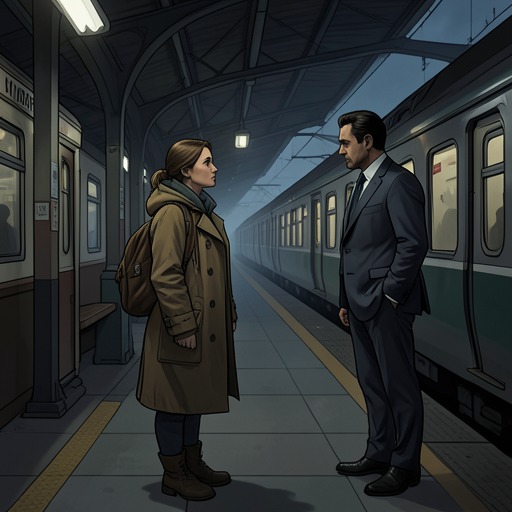
Lola’s attempt to free the poet from Mondragon
2666Lola’s attempt to free the poet from the Mondragón asylum is an episode of determined planning without a completed escape. She and Imma devise a way to visit him, and Lola presents a future in France in which he would leave the institution, resume writing, and live with her. Yet the asylum’s gates remain the fixed point of the story: after their plan is stated, Imma leaves to seek money, Lola loses her lodging, and her visits become solitary acts of waiting rather than steps toward liberation.
Failed visits and a way inside
Lola and Imma first travel to San Sebastián and try to see the poet at the asylum in Mondragón, where he is being held. The guards refuse them entry. They return after finding a cheap place to stay and hitchhiking back, but again cannot get inside. Instead, they study the institution from outside: its gray walls, dirt and gravel roads, the movements of inmates and caretakers, and the land around it. Their attention to the grounds does not yield access, but it gives their failed visit a kind of reconnaissance, as if close observation might make the boundary more permeable.
For their third attempt, they arrange an appointment. Imma claims to be a reporter for a Barcelona newspaper, while Lola presents herself as a poet. This time they are admitted and led through long, blue-and-white corridors to a plain room. The asylum’s staff appear familiar with the poet, who is treated as a known patient and goes to the garden and to receive tranquilizers. The visit makes clear that he is not simply out of reach by accident: he is embedded in the institution’s daily routine.
The escape plan
Alone with the poet, Lola tells him she has missed him and explains that she had watched over the philosopher’s apartment in the Ensanche without finding him again. She insists that her failure to reach him was not for lack of effort. The poet asks for a cigarette; Imma gives him one, then stands beside the bench reading as Lola speaks. This small arrangement places the two women differently in the conversation: Lola addresses the poet directly, while Imma remains present, attentive, and essential to the practical scheme.
Lola’s proposal is explicit. She says she knows the poet is a prisoner and wants to escape, and that she has come to help him leave the asylum for France. When he asks what will happen to Imma, Lola says Imma will help them and that the plan was hers originally. They would cross the mountains as pilgrims, reach Saint-Jean-de-Luz, and take a train to Paris. There, Lola and Imma would find work cleaning or caring for children in wealthy neighborhoods while the poet wrote. The arrangement gives the hoped-for escape a route, a livelihood, and a future: it is not merely a request that he leave, but an imagined life organized around travel, work, and poetry.
Lola extends the plan beyond the journey. She imagines living modestly in Paris, then returning to Spain when she is six months pregnant, crossing back through La Jonquera or Port Bou rather than Irun. The poet listens with interest, but the narrative does not show him agreeing to flee or the proposed route being attempted. The plan’s detail therefore sharpens the distance between the future Lola can describe and the action the asylum’s constraints permit.
Separation and life outside the gates
After the visit, Lola and Imma return, but the poet is repeatedly unavailable, first because he is on bed rest. Their money runs out, and Imma decides to travel south to Madrid to ask her brother for a loan. Lola is not strong enough to travel and stays behind, expecting Imma to return in a week. On the ninth day, the boardinghouse owner evicts her. She sleeps in a railway station, an abandoned warehouse, or outdoors near the boundary between the asylum and the surrounding world. Once she spends the night in an empty cemetery niche, then decides to wait there because it is peaceful and close to the institution.
Lola continues to visit the asylum grounds. From outside the fence, she sees the poet among other patients and tries to signal to him. She watches an altercation between him and another inmate, then sees him return to the bench and sit between two men. The episode offers no sign that her messages reach him; in a letter to Amalfitano, Lola herself allows that what she perceived may have been her own madness laughing. The scene leaves her in the role of witness, able to watch the poet but unable to determine what he understands or intends.
An unresolved attempt
Larrazabal eventually offers Lola a place to stay, drives her to the asylum, and gives her money without asking for anything in return. He proposes marriage, but she reminds him that she is already married. His help changes her immediate circumstances without resolving her purpose: she visits the asylum less often and no longer expects to see the poet, yet she continues looking for a sign she knows she may not understand until much later. She eventually tells Larrazabal she plans to leave and asks him for train fare; he offers to give her what he has but says he cannot give her money to go away.
The attempted rescue thus ends without a depicted escape or reunion. Its central tension is between the clarity of Lola’s imagined itinerary and the repeated deferral of its first necessary step. The asylum is approached, studied, and briefly entered, but it continues to determine the limits of the encounter. Lola’s effort remains consequential as a record of attachment and persistence, while its outcome stays open: she seeks a route out for the poet, but the evidence does not establish that he leaves Mondragón with her.