World War II
2666World War II enters 2666 not as one continuous campaign narrative but as a scattered historical pressure: Hans Reiter’s regiment advances into Poland, Boris Abramovich Ansky’s notebook places private thought against the widening conflict, and later characters read the war’s aftermath through exile, poverty, and a writer’s prolonged disappearance. The novel’s fragments connect military history to the lives and interpretations that survive it, without making those interpretations interchangeable with the historical events themselves.
The Invasion of Poland
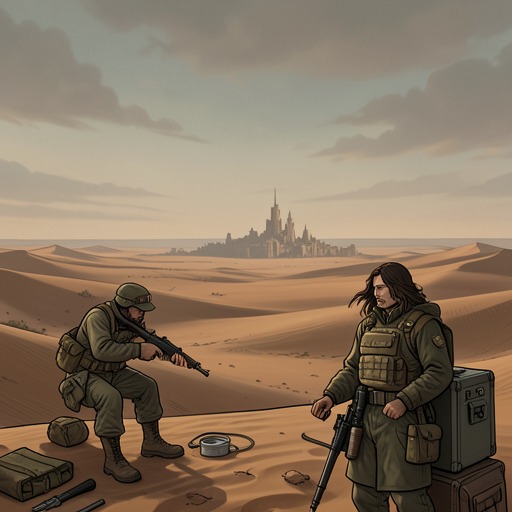
In September, after Reiter leaves with a few belongings and a copy of Animals and Plants of the European Coastal Region, his division advances to the Polish border and crosses behind the Panzer and motorized infantry divisions. Reiter’s regiment travels by forced marches, initially without fighting and with few precautions. The men move in a festive atmosphere that resembles a pilgrimage more than a march toward a war in which some of them will die.
The advance passes through several towns in orderly fashion. The soldiers do not plunder them; they smile at children and young women, while motorcycle messengers carry orders between the road and the staffs. The regiment moves ahead of its artillery. From hilltops the men look east toward the imagined front and see only a landscape at the end of summer; to the west, dust marks the artillery’s effort to catch up. The gap between the apparently peaceful countryside and the war approaching behind the soldiers gives the march its uneasy character.
On the third day, Reiter’s regiment turns onto a dirt road and reaches a river shortly before nightfall. Beyond it lie woods and, according to what the soldiers have been told, a village where Poles have taken a stand. The regiment assembles machine guns and mortars and fires flares, but receives no response. Two assault companies cross the river after midnight, move through the woods, and approach the village. When the men rush toward its first houses, they discover that it is deserted. The episode records an advance into enemy territory, but its immediate encounter is with absence rather than combat; the regiment continues east the following day.
Ansky’s Notebook and the Expanding War
In the sequence of notes that Reiter reads, Ansky’s private reflections on suicide, memory, and the limits of knowledge unfold alongside the larger political catastrophe. Ansky leaves Moscow without papers, travels through landscapes and unnamed stations, and eventually reaches Kostekino, where his mother opens the door without recognizing him. After his father dies, Ansky spends nights reading beside his sleeping mother and thinks about chaos, the end of time and space, and the possibility of parallel universes. The notebook’s movement between intimate return and abstract speculation gives the war’s historical scale a personal, unsettled counterpoint.
The widening conflict supplies a stark chronological frame: Hitler invades Poland, Warsaw falls, Paris falls, and the Soviet Union is attacked. Ansky’s recurring thought that only in chaos can people be conceived is set against these events rather than offered as an explanation for them. One night he dreams that the sky is an ocean of blood; on the last page of the notebook, he draws a map intended to join the guerrillas. The sequence ends not with a resolution of his reflections but with a practical sign of commitment to resistance.
The Postwar Encounter in Friesland
The war’s end also shapes the circumstances in which the Swabian cultural promoter meets the young Benno von Archimboldi. The Swabian recalls a Frisian town still marked by social and economic wounds after the war, where visiting writers read for audiences and might sell self-published books at a table. Archimboldi, then twenty-nine or thirty, arrives without books to sell and reads two chapters of a novel in progress. The first novel he had published in Hamburg that year is present only as a small, worn copy carried in his pocket.
The encounter’s most enduring object in the Swabian’s recollection is not the book but Archimboldi’s loose black leather jacket, suited to cold and rain and suggestive, to the Swabian, of jackets worn by Gestapo officers. The recollection explicitly places that association within the clothing fashions of the time: people wore such jackets without necessarily considering what they evoked. In this postwar setting, clothing, literary ambition, and damaged civic life bring the recent past close without turning the reading itself into a scene of combat.
Later, the four critics interpret the meeting through the shared history of the two men. Morini imagines the Swabian and Archimboldi as grotesque doubles: both young during the years of terror and barbarism under Hitler, both World War II veterans, both writers, and both poor men in a bankrupt nation. The likeness is a critical metaphor, not proof that the Swabian is Archimboldi; Norton rejects that possibility on the basis of their different physical descriptions. Pelletier and Espinoza instead speculate that the Swabian was the widow’s lover. The disagreement makes the war’s afterimage part of a broader problem in the novel: a past event is recalled through competing conjectures, and the story does not collapse them into a single authoritative account.
War Memory, Exile, and Political Analogy
The critics’ later search for Archimboldi likewise draws on his war record. He is discussed as an elderly veteran and deserter still on the run, a figure whose possible Nobel recognition might recall Europe’s past in troubled times. The account does not establish that his travel to Mexico is an escape from a particular danger. The critics consider several explanations—including a visit to a friend, research for a novel, tourism, and flight—without resolving the question. Their uncertainty links the war’s unfinished consequences to Archimboldi’s absence from public view, while preserving the difference between evidence and conjecture.
The book also places World War II within characters’ later political and historical comparisons. As a child, Amalfitano answers his father’s claims about Chilean boxers by invoking Italy’s conduct in the war; the exchange is a family argument shaped by national stereotypes, not a neutral account of the conflict. Elsewhere, a speaker discussing the legibility of death contrasts the mass deaths of the Paris Commune and the mortality of enslaved people transported by ship with individual murders that became widely reported stories. That comparison concerns how societies decide whose deaths count as narratable; it does not equate those historical situations or make war the sole subject of the speech.
Amalfitano’s own account of exile gives another distinct historical connection. He explains that he was in Argentina in 1974 because the coup in Chile forced him to leave. He subsequently describes exile as a natural movement that may help abolish what is usually understood as fate. His statement concerns the Chilean coup and its consequences, not World War II, but its presence beside the novel’s European wartime memories broadens the book’s concern with displacement under political violence.
Narrative Significance
World War II appears through changes in narrative scale and viewpoint: a soldier’s march, a reader’s encounter with a notebook, a remembered literary evening, and later debates about what those memories mean. The transitions refuse the shape of a single authoritative chronicle. Reiter’s advance includes precise movements through roads, a river, woods, and an empty village; Ansky’s notes juxtapose the fall of cities with philosophical questions and a decision to seek the guerrillas; the Swabian’s memory attaches the postwar era to a writer, a reading, and a jacket whose associations remain qualified by the period’s ordinary fashions.
These fragments make the war both a historical event and a test of interpretation. Characters use it to understand national identity, political rupture, literary reputation, and the persistence of danger after fighting ends, but their analogies remain partial and sometimes plainly speculative. The novel’s structure preserves that distance: the war’s events are stated, while the meanings later assigned to them belong to particular speakers, memories, and conjectures. Through that separation, World War II becomes a recurring background against which 2666 examines what survives catastrophe—and how incompletely it can be known.