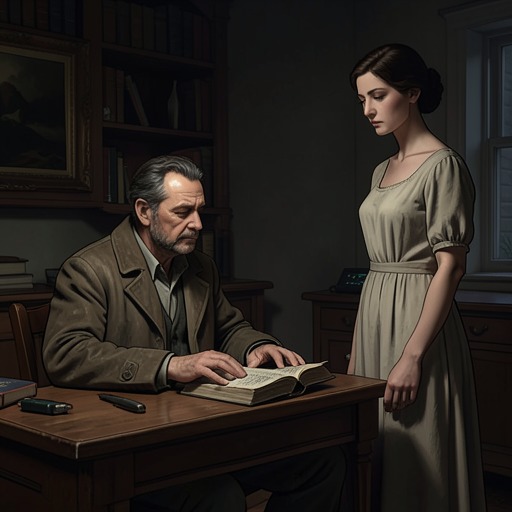
Norton and Morini reunite and begin living together
2666Norton and Morini reunite and begin living together when Liz Norton leaves London for Turin and asks Piero Morini to let her stay. What begins as an unplanned arrival becomes an intimate domestic reunion: conversation, tea, a meal, and a nighttime misunderstanding give the two a way to name a love that had gone unrecognized. Norton’s letter closes the episode without promising permanence; happiness, rather than certainty, is the commitment they share.
The Journey to Turin
The day before leaving, Norton tidies her apartment and puts her papers in order, finishing sooner than she expects. She goes to a film, but afterward cannot reconstruct its plot or remember who acted in it. That evening she has dinner with a friend and goes to bed early, although midnight passes before she falls asleep. The next morning, without a ticket, she goes to the airport and books a seat on the next flight to Italy.
Her journey takes her from London to Milan and onward by train to Turin. When Morini opens his door, she tells him she has come to stay and leaves the choice of a hotel or his home to him. He does not answer verbally: he moves his wheelchair aside and asks her in. The small gesture settles the immediate question of where she will stay, while leaving the deeper question of what their reunion means to be answered through their time together.
Hospitality and Conversation
Norton washes her face in the bathroom. When she returns, Morini has made tea and put three small biscuits on a plate. She tastes one, finds its pistachio-and-fig filling delicious, eats all three, and drinks two cups of tea. Morini makes a phone call, then listens as she talks, occasionally stopping her to ask questions she is glad to answer. Their welcome takes the form of attentive conversation as much as food and shelter.
They talk for hours about the Italian Right, the resurgence of fascism in Europe, immigrants, Islamic terrorists, and British and American politics. The subjects are depressing, yet Norton says she feels better and better as they talk. When she asks Morini for another of the biscuits, he looks at the clock, observes that it is only natural she is hungry, and offers something more substantial: he has reserved a table at a restaurant in Turin and will take her to dinner. The exchange turns care into action, carrying their reunion beyond the threshold of his home.
The restaurant stands in the middle of a garden with benches and stone statues. Norton pushes Morini’s wheelchair as he shows her the figures: some represent mythological characters, others ordinary peasants apparently lost in the night. Other couples stroll through the park; Norton and Morini sometimes cross their paths and sometimes glimpse only their shadows. In that setting, they talk about Pelletier and Espinoza. Norton tells Morini that the lead placing Archimboldi in northern Mexico was false and that he has probably never set foot in the country. She also recounts their Mexican friend El Cerdo, and the two laugh together. Norton again describes herself as feeling better.
The Nighttime Misunderstanding
Norton spends the first hours of her first night in Turin in Morini’s guest room. A thunderclap, which may be real or part of a dream, wakes her. She thinks she sees Morini’s wheelchair at the end of the hallway and Morini himself in the sitting room, turned away from her. At first she tries to ignore the sight, but then gets up, grabs an ashtray, and turns on the light. The hallway and sitting room are empty.
Norton goes to Morini’s room. His wheelchair is beside the bed, and Morini is lying there breathing steadily. She whispers his name; when he does not move, she raises her voice, and he answers by asking what is wrong. Norton says she saw him in the hallway. Morini asks when, and she says it was a minute earlier, when she heard the thunder. He asks whether it is raining, and she replies that it must be.
The sight unsettles Norton beyond the immediate question of whether she has mistaken a dream for waking life. She tells Morini that the wheelchair had seemed to be watching her while he stood there, cool and turned away. Morini asks her to calm down, but she rejects the instruction and insists he understand what she saw. The scene gives their conversation a sharper emotional edge: Norton is not merely describing an apparition but accusing him of being distant from her.
Morini props himself on his elbows and considers what she has said. He understands her perception as a split between himself and the chair: the wheelchair seemed to watch while he ignored her. In that reading, both the chair and Morini seemed bad to Norton, because the chair was watching her and he was not. Norton then laughs and tells him that, as far as she is concerned, neither he nor the wheelchair could be bad, since the chair is so useful to him. The perceived separation between Morini and the wheelchair becomes a way to articulate the separation between his attention and her need to be seen.
Love Named and a Shared Life
The rest of the night, Norton and Morini spend together. She tells him to move over and make room for her, and he obeys without a word. The movement from the guest room to his bed gives the reunion its decisive turn: they are no longer treating her stay as a practical arrangement whose terms remain open.
Afterward, Norton asks Morini how it could have taken her so long to realize that he loved her, then asks how it could have taken her so long to realize that she loved him. Morini answers that it is his fault, because he is hopeless at such things. His reply accepts her recognition while also acknowledging his difficulty in expressing himself. The affection that had remained unspoken is now mutual and explicit, but the scene does not suggest that either person has mastered the uncertainties of intimacy.
In the morning, Espinoza gives rugs and serapes he has accumulated to the hotel clerks, guards, waiters, and the women who clean his room. He places the last serape, patterned in red, green, and lavender geometric shapes, in a bag and asks the clerk to send it to Pelletier. Espinoza calls it an anonymous gift. This gesture belongs to the surrounding sequence of the critics’ stay in Mexico, not to Norton and Morini’s new household, but it preserves the other emotional thread of the reunion: Norton has arrived from a relationship with Pelletier and Espinoza, and the change in her life occurs while Pelletier remains nearby.
Happiness Without a Guarantee
Norton’s letter does not turn the reunion into a promise of lasting security. She says she does not know how long she and Morini will last together, and adds that the uncertainty does not matter to either of them, as far as she can tell. What matters is that they love one another and are happy. She trusts Pelletier and Espinoza to understand.
The episode therefore resolves an emotional uncertainty without resolving the future. Norton’s sudden journey, Morini’s quiet welcome, their hours of conversation, and the exchange in the dark culminate in a shared life whose duration neither can guarantee. The letter’s form keeps that ending measured and personal: the reader receives Norton’s own account, including her uncertainty, rather than an external assurance that the relationship will endure.