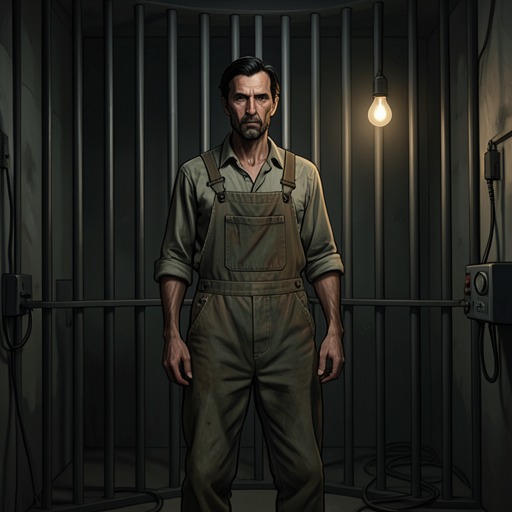
Los Caciques members are massacred in prison
2666The prison massacre of members of Los Caciques turns the killing of Linda Vazquez into a spectacle of retaliation inside the Santa Teresa penitentiary. After Jesus Chimal and three other suspects are admitted to the prison, inmates attack them in the laundry room while guards watch and take photographs. The subsequent news report names no perpetrators or motive; Klaus Haas’s account instead connects the attack to the gang’s killing of a wealthy man’s daughter and to the prison’s wider economy of intimidation, complicity, and silence.
Background and Arrival
In October, Jesus Chimal, whom the narrative identifies as responsible for Linda Vazquez’s death, arrives at the prison with three others arrested in the case. His admission stirs unusual anticipation among the inmates. Haas senses a charged expectation in the cell blocks, though prisoners do not speak about it directly: their ordinary conversations about sports, family, and imagined nightlife carry an awareness that Chimal is coming. Some inmates who are usually disruptive behave better, as if they want to be worthy in someone’s eyes.
The former members of Los Caciques are the exception to this general suspense. They keep their distance from the drama, but when Chimal arrives, they alone come out to greet him. Chimal and his three companions remain close together, even when moving around the prison. One of the gang members already inside slips Chimal a steel shiv; another passes him amphetamines. Chimal carries both the weapon and the capsules, sleeping with the shiv in his hand and treating the drugs like a talisman. The gifts offer a small measure of protection, but they also place the new arrivals visibly within the prison’s existing gang networks.
The Laundry-Room Attack
On the eighth day of their imprisonment, Chimal and his three companions are forced into the laundry room. Guards disappear from the immediate scene, while four inmates keep watch at the door. When Haas arrives, the watchers let him enter as though he belongs to the group; he accepts the invitation tacitly but continues to despise those responsible. Inside, the four Caciques are restrained and silenced. Some of the attackers have already stripped two of them, and Haas sees one shaking. He watches Chimal’s eyes and thinks that, if allowed to speak, Chimal might address or harangue his captors.
The guards have not simply abandoned the room. They look down from a window, and one carries a camera. Their presence turns the attack into a witnessed event: they can observe and record it, yet do not intervene. When Haas notices that they have removed their caps, he registers the detail without fully interpreting it. His attention stays on the spectacle and its audience, including the other inmates gathered to watch.
Ayala leads the assault with Farfan, while Gomez also takes part; other prisoners hold the victims in place. The violence is rendered through Haas’s perspective, whose response unsettles him: he watches to the end and finds that it does not make him sick. That reaction becomes part of the event’s significance, not evidence that the violence is ordinary or harmless. Haas later tells his lawyer that Chimal begged to be killed and that the attackers paused so the guards could take photographs. He estimates that six men initially restrained the victims, revises the number to twelve, and then includes the entire cell block among those responsible because they watched without acting.
Deaths and the Public Account
A short newspaper report describes the killings as a settling of prison scores. It says that four Los Caciques members awaiting trial were massacred by inmates and that their bodies were found piled in the laundry-supply room. Later, two other former gang members are found dead in the sanitary facilities. Although police and prison officials investigate, they fail to establish either the motives or the identities of those responsible.
That compressed public account contrasts with Haas’s detailed testimony. He distinguishes the four deaths he witnessed in the laundry room from the two later discoveries in the bathroom, whose killers he does not know. He names Ayala, Farfan, and Gomez as participants in the first attack, along with the prisoners who helped restrain the victims, and describes guards photographing the scene without intervening. What the newspaper presents as an unresolved incident, Haas describes as collective action carried out in full view of the institution’s officers and the prison population.
Haas, His Lawyer, and the Logic of Silence
When his lawyer visits at noon, Haas tells her that the whole cell block witnessed the attack and that the guards took pictures. He asks whether the journalists outside know what happened. His lawyer replies that people are discreet, and that reporters are especially discreet because discretion means money. The exchange makes silence more than a failure of information: it is presented as a practice sustained by incentives and shared knowledge.
Haas asks why the Caciques were killed. He says he does not know, but his lawyer supplies the material explanation that organizes the episode: the gang had killed the daughter of a man with money. Her answer gives the massacre a motive without solving every uncertainty. The identities and roles Haas reports do not become the basis of the public account, while the people who watched—and the guards who recorded the attack—remain part of the surrounding structure of nonintervention.
Narrative Significance
The massacre is not presented as justice delivered by a reliable institution. It is an extrajudicial killing inside a prison, staged before an audience and left officially unresolved. Chimal’s case links the violence to Linda Vazquez’s murder and to the power of a wealthy victim’s family, while the lawyer’s remarks expose how money can govern both retaliation and what becomes publishable. The event therefore sharpens the novel’s contrast between abundant witnesses and scarce accountability: a roomful of people can see what happened, yet the public record still says that the responsible parties are unknown.