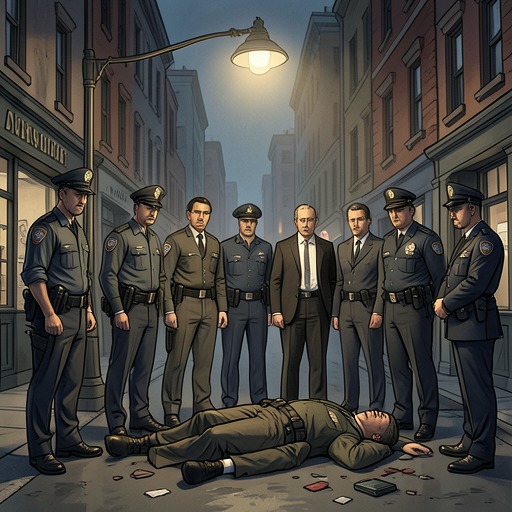
Los Bisontes members arrested as women’s serial murders declared solved
2666The arrest of five Los Bisontes members in January 1997 became the basis for Santa Teresa’s official declaration that the serial murders of women had been solved. Yet the announcement rested on a disputed chain of evidence and accusations, while Klaus Haas, already imprisoned as the principal suspect, denied financing the gang. The episode thus offered the city a conclusion in public before it offered an uncontested explanation.
Arrests and Allegations
The five arrested men were Sebastian Rosales, nineteen; Carlos Camilo Alonso, twenty; Rene Gardea, seventeen; Julio Bustamante, nineteen; and Roberto Aguilera, twenty. All had prior convictions for sexual abuse. Rosales and Alonso had also been held in custody in connection with the rape of a minor, Maria Ines Rosales, Rosales’s cousin; she withdrew the charges months after he was sent to the Santa Teresa penitentiary.
The police linked the group to several killings after Haas’s arrest. Alonso was said to have rented the house on Calle Garcia Herrero where the bodies of Estefanía and Herminia Noriega were found. The five were accused of kidnapping, raping, torturing, and killing two women found in the Podesta ravine, and were also charged with the murders of Marisol Camarena and Guadalupe Elena Blanco, as well as the killings of the Noriega sisters.
Evidence and Institutional Pressure
The case against the five men was accompanied by signs of coercion and uncertainty. During interrogation, Carlos Camilo Alonso lost all his teeth and suffered a fractured nasal septum, reportedly in a suicide attempt; Roberto Aguilera sustained four broken ribs. Julio Bustamante was placed in a cell with two men who assaulted him and broke fingers on his left hand. These accounts do not establish what the suspects knew or did, but they complicate the evidentiary setting in which their accusations were assembled.
A lineup offered limited identification: of ten residents of Calle Garcia Herrero, only two recognized Alonso as the tenant at 677. Two witnesses, including a known police informer, said they had seen Sebastian Rosales in a black Peregrino during the week the Noriega sisters were kidnapped. Rosales testified that the car had been stolen. Three firearms were found among the Bisontes, including two CZ model 85 9mm pistols and a German Heckler & Koch; another witness said Alonso had boasted of owning a Smith & Wesson like the weapon used to kill the sisters, and claimed Alonso later sold it to American drug traffickers. The reported evidence therefore consisted of different kinds of leads and testimony, not a single conclusive account.
The Prison Link and the Official Conclusion
The arrests quickly became entangled with the prison’s own hierarchy. Roberto Aguilera was discovered to be the younger brother of Jesus Aguilera, known as El Tequila, an inmate who was a friend and protégé of Klaus Haas. From that connection, police inferred that the Bisontes’ killings might have been contract murders, alleging that Haas paid three thousand dollars for each dead woman who resembled his victims. The claim was leaked to the press and prompted calls for the warden’s resignation. Reports also described the prison as controlled by organized-crime gangs and identified Enriquito Hernandez, a drug lord from Cananea, as its effective authority, allegedly continuing to run his affairs from inside.
A report in La Tribuna de Santa Teresa linked Hernandez to Haas through drug trafficking disguised as a legitimate cross-border computer-parts import-export business. Its evidentiary standing was uncertain: the article was unattributed, and its reporter had seen Haas only once, yet it placed statements in his mouth that he had never made. The public account therefore grew beyond the arrests and physical evidence, combining police inference, anonymous reporting, and claims about prison power.
On television in Hermosillo, Santa Teresa’s mayor, Jose Refugio de las Heras, announced that the serial killings had been solved. He said that subsequent deaths should be treated as ordinary crimes expected in a rapidly growing city, and declared the end of the psychopaths. The statement converted the arrests into a civic resolution, though the case against the gang and the alleged link to Haas remained contested rather than settled by an independently established chain of proof.
Denial and the Uneasy Aftermath
After the arrests, the city experienced a pause in the discovery of women’s bodies, and local news treated the capture of the five gang members as welcome relief. January and February brought other deaths, but none of women found raped and killed. The absence made the official account seem persuasive: the serial killer was behind bars, as were his supposed imitators, followers, or hired killers, and Santa Teresa appeared able to breathe again. Yet a lull in the killings could not by itself establish the accusations that had been made against the Bisontes or resolve who had committed the earlier murders.
The certainty of the public announcement was directly challenged by Haas. In a call to journalist Sergio Gonzalez, he said that the allegation that he had paid the Bisontes was false, arguing that he would have needed substantial money to finance so many deaths. He acknowledged being friends with El Tequila and said one of the arrested men was El Tequila’s brother, but insisted that this was the extent of the connection. Gonzalez replied that he no longer wrote about the killings; Haas answered that everyone kept directing him elsewhere, even though his lawyer already knew his denial. The call ended without a response from Haas after he said the authorities were postponing his trial and trying to destroy him.
The episode leaves the arrests suspended between apparent resolution and unresolved accountability. The mayor’s declaration made the case legible as a victory over a group of perpetrators, while the shifting allegations, limited identifications, disputed prison connections, and Haas’s denial kept that explanation unstable. The city’s return to ordinary life followed not a demonstrated resolution of every question, but the official naming of one—and the temporary quiet that seemed to confirm it.