Our Lord Jesus Christ Church
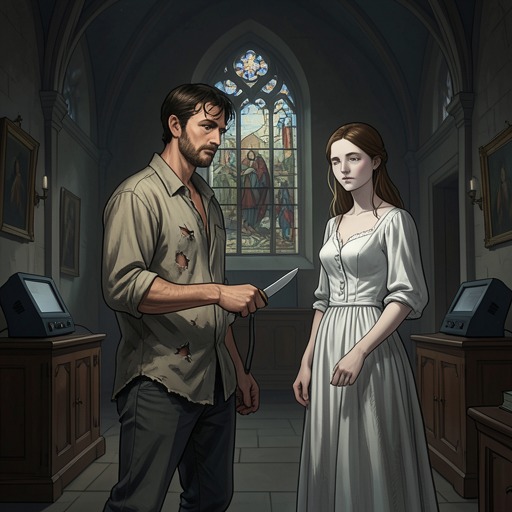
2666The Church of Nuestro Señor Jesucristo, Santa Teresa’s oldest church, becomes the setting for the Penitent’s deadliest known attack. Three days after he desecrates Santa Catalina, he breaks into this historic building; the ensuing assault leaves Father Juan Carrasco and the caretaker dead and prompts Inspector Juan de Dios Martinez to infer that the perpetrator travels by car. The church is at once a place of worship, a site layered with the city’s history, and a point on a criminal’s hidden route across Santa Teresa.
Setting and History
Built in the mid-eighteenth century, the church was once the seat of the Diocese of Santa Teresa. It stands in Colonia Reforma, and its connection to an adjacent building runs through a passageway leading directly to the rectory office. The priests and two Papago seminarians lodging there use that building for daily life as well as study: the students are enrolled in anthropology and history at the University of Santa Teresa and help with small household tasks.
A local story holds that another passage beneath the complex was used by priests during the Revolution and the Cristero War. The student who encounters the intrusion has never heard of it. This detail sets the church within an older history of conflict and concealment, but the narrative does not establish that the rumored passage plays any role in the Penitent’s entry or escape.
The Penitent’s Intrusion
Three days after the desecration at Santa Catalina, the Penitent enters the church in the early hours. One seminarian, awake late after trying to study, hears glass break and then sounds from inside the church. Afraid to investigate alone, he wakes the other seminarian; the two discreetly alert Father Juan Carrasco.
Carrasco recognizes the likely culprit from news reports, puts on pants and sneakers, takes an old baseball bat from a cupboard, and goes toward the church with the student who raised the alarm. The student stops short, unable to follow, while Carrasco advances toward the sounds. From where he stands, the student hears the bat strike, voices and shouting, then more blows and the arrival of the caretaker and others. His account is shaped by fear and uncertainty: he cannot be sure what he sees in the candlelit church, or exactly whom Carrasco is addressing.
The attack is reported afterward as an escalation. Inspector Jose Marquez says the Penitent went berserk; Father Carrasco and the caretaker are found dead. The intruder’s presence also leaves a further trace inside the church: the amount of urine is judged far beyond what one man could normally produce. The crime thus joins the Penitent’s recurring desecrations to lethal violence, while the building’s interior bears evidence of both his presence and the failed attempt to stop him.
Investigation and the City
After examining the window through which the Penitent entered, Inspector Juan de Dios Martinez walks the nearby streets before returning to the church, where he confers with Pedro Negrete and Epifanio. Martinez argues that the offender must have a car: the distances between Reforma and other neighborhoods where the Penitent has acted would make walking difficult without attracting attention, particularly given the distinctive smell left by his attacks. The chief accepts the possibility, and Martinez adds that the offender may keep a change of clothes in the vehicle.
The reasoning is practical rather than conclusive. Martinez and his colleagues are trying to account for repeated attacks across a large city, and a vehicle offers a possible means of moving between distant churches while avoiding notice. The exchange does not identify the Penitent or establish where he lives. It turns the church’s location into one element of a wider geographical puzzle: the offender’s route extends beyond a single parish, and the police must decide how to cover a city whose size complicates surveillance.
Narrative Significance
The church’s historical and religious status sharpens the contrast between sacred space and the violence committed within it. Its age and former diocesan role give the attack a setting already marked by the passage of time and earlier upheaval, while the priests’ and seminarians’ ordinary routines make the intrusion a rupture in an inhabited community rather than an abstract act of desecration.
The scene also limits what can be known. The seminarian’s fear leaves parts of the encounter uncertain, and the investigation yields an inference about a car rather than an arrest or a name. The church therefore matters not only as the site of a double death, but as a place where witnessing, rumor, physical traces, and police reasoning meet without resolving the identity of the person who entered.